

Subscribe
August 19, 2026

Michigan’s Options to Respond to Shrinking SNAP Benefits Would Minimize Economic Disruption 

In A Nutshell:

  • Federal changes to SNAP have already led to an eight percent decrease in SNAP beneficiaries in Michigan since last fall. 
  • SNAP benefits, made up entirely of federal dollars, reduce hunger and health care costs, while also serving as an economic multiplier for local communities. 
  • The state likely cannot replace the $300 million in lost benefits annually, but it has several policy options to blunt the impact.

Last summer, the federal One Big Beautiful Bill Act (OBBBA) was enacted which, among other things, made significant changes to the Supplemental Nutrition Assistance Program (SNAP) – the primary food assistance program for low-income people in the United States. OBBBA altered program eligibility and made changes to the federal-state cost-sharing arrangement, which were collectively expected to lead to fewer people receiving benefits and a major hit to state budgets.  

The Research Council has covered the latter issue extensively, highlighting how the state budget will be impacted by an increase in the state share of SNAP administrative costs and the new provision that will require states to contribute up to 15 percent of benefit costs, conditional on their SNAP payment error rate. These changes would have hit the state budget even if SNAP recipients themselves were unaffected. 

Yet other provisions in OBBBA directly impacted the SNAP eligibility criteria, which many expected would reduce the number of households and individuals who would receive benefits under the program. Over the first year of implementation, it is clear that OBBBA has reduced the number of people receiving SNAP benefits by a substantial amount in Michigan and around the country, putting pressure on households and businesses. While the state cannot easily fill the $300 million food assistance gap created by the new OBBBA provisions, it does have some options to respond. 

SNAP Overview 

SNAP is a joint federal-state program that provides direct payments to low-income households to purchase food at authorized retailers. Benefits (previously known as “food stamps”) are delivered to recipients via a specialized debit card with the amount based on the household’s monthly income. Some states, not including Michigan, also condition eligibility on liquid assets. The benefit amount is based on a formula that takes into consideration household size, income, and certain expenses. Many enrollees must meet work effort requirements, as well as citizenship or legal permanent resident tests, to be eligible. 

The federal government defines the primary rules of eligibility and oversees retailer participation, while funding 100 percent of benefits. The share of administrative costs paid by the federal government is decreasing from 50 percent to 25 percent in Fiscal Year (FY)2027 and the benefits share paid by the federal government could decrease to as low as 85 percent depending on a state’s payment error rate beginning in FY2028. States handle the actual enrollment side of the equation, operate the cash transfer, and pay the balance of the administrative costs. 

Nationwide, SNAP provided benefits to over 42 million people in over 22 million households in FY2025. Total benefits exceeded $95 billion, with about $7 billion of additional administrative costs shared between the federal government and the states. About 1.5 million Michigan residents received $3.1 billion in SNAP benefits in FY2025 across approximately 780,000 households. The average benefit per person is about $175 per month in the state. 

OBBBA Made Changes to SNAP 

In addition to the federal-state cost sharing changes, OBBBA made changes to SNAP eligibility in a couple of ways. First, refugees and asylum seekers are no longer eligible for SNAP. Second, work effort requirements expanded to two groups that were previously excluded. Prior to OBBBA, work effort requirements did not apply to anyone 55 or older. OBBBA raised that age to 65, meaning that people between 55-64 must now work or be in job training for at least 80 hours per month to qualify for SNAP benefits. Additionally, caregivers of children under 18 previously did not have to meet the work effort requirements, but OBBBA dropped the dependent age to 14, meaning that parents of older children now have to meet these criteria. Exceptions to work effort requirements were also removed for homeless individuals, veterans, and those 24 and younger who aged out of foster care. Finally, location-based waivers are now only available in places with unemployment rates at about 10 percent or more. 

Similar to Medicaid work requirements, some people will fail to qualify because they do not meet the criteria and some will fail to qualify because they fail to demonstrate that they qualify because they do not have proper documentation. Additionally, because SNAP benefit totals are calculated at the household level, an individual person in the household failing to qualify can sometimes lead to a disproportionate reduction in household benefits depending on the household income and the share of deductions that are attributable to the person no longer eligible. Additionally, in some situations, one person losing eligibility because they do not meet work requirements can result in the closure of the entire case if the system wrongly determines the household failed to properly submit its documentation. This can sometimes require the eligible members to reapply, which can delay benefits, rather than simply having the ineligible person’s share of the benefits removed. 

These changes were designed to reduce the federal cost of SNAP to offset the cost of tax cut extensions in OBBBA. The federal-state cost sharing shift puts some direct costs on the states, while the changes in eligibility serve to decrease the number of people who receive benefits. The eligibility changes were effective immediately, but states were given a four-month grace period to implement them. The impact started to hit states in November and December of 2025, although some states made an effort to implement the changes early. 

SNAP Enrollment and Benefits Have Declined Since OBBBA Implementation Began 

Since the enactment of OBBBA, SNAP enrollment has declined dramatically across the country. In June 2025, 42 million people in 22.4 million households were receiving $7.8 billion in monthly benefits. By April 2026 (the last month for which data is available), those figures had dropped to 37 million people in 20 million households receiving $6.9 billion in monthly benefits. In the same period, Michigan’s SNAP population declined from 1,474,701 to 1,370,616 people, or about eight percent. Despite losing over 100,000 SNAP participants, Michigan’s decline has been smaller than average as a percentage of participants. On average, states have SNAP enrollment 12 percent below the pre-OBBBA average.  

Individual SNAP Enrollment in United States and Michigan as a Percentage of Enrollment in October 2024, October 2024 to April 2026 
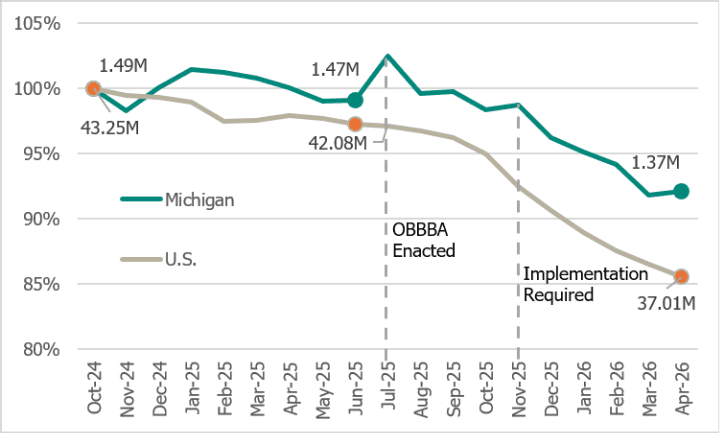
Source: Snap Data Tables. U.S. Department of Agriculture. August 6, 2026. Note: Y-Axis does not start at 0 to highlight trend. 

It is not clear where the bottom is, either. Looking nationally by month, the downward trajectory was still present through April. In Michigan, the April enrollment was higher than March, although it is possible that is indicative of poor economic conditions hitting Michigan first rather than the SNAP enrollment decline subsiding. It is worth noting prior to COVID-19, SNAP enrollment had been declining along with some changes to the program and improved economic conditions, so it is possible that a portion of this year’s decline is not attributable directly to OBBBA. Data over the next few months will provide a clearer picture.  

On an annualized basis, about $8.4 billion less in SNAP benefits is reaching households nationwide, with about a $300 million decline in assistance to Michigan families since OBBBA changes took effect. Those numbers could grow if participation continues to fall. Even if states have settled into a new normal, the amount of food assistance that has disappeared over the first six months of implementation will have significant consequences. 

The Likely Impact of Declining SNAP Enrollment and Benefits 
 

SNAP has a number of well-documented positive impacts on society, so reducing SNAP benefits through a reduction in people who qualify for the program is likely to lead to worse outcomes across those metrics relative to the pre-OBBBA status quo. 

 SNAP reduces food insecurity and hunger, and benefits are correlated with better diet quality. Similarly, SNAP is an anti-poverty program, lifting a few million people out of poverty each year, including roughly one million children. SNAP also has been shown to improve high school graduation rates and reduces reliance on public assistance programs as adults for those who received SNAP during childhood. SNAP benefits also are tied to lower rates of child neglect investigations. 

SNAP also reduces health care expenditures, as better diet and nutrition leads to better health outcomes and having more money for food reduces stress. This is visible in overall health expenditures and hospital admissions, but it also comes through directly for states in a reduction in spending on Medicaid. 

The program also has broader economic value, as studies show every $1 in SNAP benefits leads to about $1.50 in total economic activity to grocery stores and food supply chain businesses. Cutting SNAP benefits also tends to strain philanthropic organizations, such as food banks, that cannot keep up with higher demands. 

A reduction in SNAP benefits, therefore, is likely to be associated with an increase in hunger, poverty, and health care spending (especially for the state), and a reduction in educational performance and economic activity.  

State Options to Respond to SNAP Cuts 

SNAP benefits are currently funded entirely by the federal government, so reducing SNAP benefits does not free up any state money to be spent on other priorities. As a result, the state should be highly motivated to blunt the impact of the cuts because the state is bearing all of the negative consequences without any cost savings. 

The state is under significant budget pressures, so finding another $300 million or more per year to fill the gap left by the federal government is not particularly feasible. However, food assistance is an area where any contribution is likely to make a difference. Spending $90 million on alternatives may not quite replace $90 million of SNAP’s impact, but it is likely to be much closer than similar investments in other kinds of policy areas. 

For example, Medicaid cuts through OBBBA are also likely to hit the state hard. In the Medicaid context, blunting the negative impacts for people losing coverage would require the state to find a way to cover them. If a person used to receive health care coverage at no cost, finding $500 per person to offset uninsured, out-of-pocket health care expenses is unlikely to get them to seek preventive medical care because it would still be too expensive. On the other hand, getting $500 into the hands of a person who used to get $2,000 of SNAP benefits will lead to $500 of spending on food and some proportion of the benefits associated with that spending.  

Michigan, like every state, is worse off because of this reduction in SNAP spending, but it has options to respond to the ongoing increase in food insecurity.

SNAP Navigation Assistance: One important option for states is to devote resources toward minimizing the number of people who lose SNAP benefits, both through the promotion of work and training opportunities and through assistance documenting that compliance. Similarly, improving the review process at the state level to avoid incorrect eligibility determinations would contribute toward this goal. The state has devoted resources to this in the upcoming budget, but more may be necessary, as highlighted by similar issues with Medicaid work requirements. 

Support for Food Banks: In the face of reduced SNAP benefits, more people rely on food banks. The state can direct additional grants or resources to food banks and their associated partners to provide food directly to people in need. Food banks typically have greater purchasing power than individuals, so directing resources to an entity that can purchase food more cheaply can be more efficient. In addition, Michigan already has the Michigan Agricultural Surplus System in place, which works directly with farms in the state to distribute “surplus and cosmetically imperfect but nutritious food” to families in need via food bank networks. In FY2027, the program received a $12 million appropriation, but given its high return on investment it could be a place to spend more. The program has requested higher appropriations in the past, indicating it has capacity to deliver more than it current is. 

Parallel Benefits and Minimum Floors: States can also direct general fund dollars to SNAP or SNAP-equivalent programs in a couple of ways. For eligible households and beneficiaries, the state can add money to monthly benefits. One way this can occur is through a minimum benefit floor increase. The federal minimum benefit is only $23 per month per person, but New Jersey has increased this to $95 with state dollars. In this situation, a household that lost benefits due to one member being ineligible will get additional benefits through higher benefits to the other household members. Another option is through programs like Double Up Food Bucks, where the money spent on produce at some retailers is matched and buying power is increased. The state could increase its support for this program or work to expand it in some fashion. 

Alternatively, states can establish separate food assistance funding streams and connect those benefits to the existing SNAP debit card infrastructure as long as the money is kept administratively separate from the SNAP dollars. California and Minnesota use this approach to cover certain non-citizens, but states could consider this approach to offer benefits to people who lose eligibility due to work requirement issues. The procedural hurdles of implementing this kind of parallel policy may prove difficult, but the state should at least explore what it can do and what it would cost to pursue. 

Other Offsets: Another approach the state could take is targeted tax relief aimed at offsetting lost SNAP benefits. Expanding the Earned Income Tax Credit (EITC) or creating a refundable state level child tax credit are alternative ways to get money to people within existing benefit structures. This approach would be less targeted, as benefits would also flow to households that did not lose SNAP benefits, but it could be a backstop if needed. 

The state’s universal school meals program, which is entering its fourth year, provides this kind of assistance, as it is a broader program that offers benefits to a wider range of residents than will be directly affected by SNAP changes. Living in a SNAP eligible household creates an automatic eligibility for the federal school lunch program, so households that lost SNAP eligibility could also have lost access to free school lunches if not for the state’s program. As long as the program remains in place, low-income families will have access to free school meals regardless of their SNAP status. It is worth noting that the state’s investment in this program is likely to become more costly as SNAP changes will have an impact on the share of the cost of school meals being picked up by the state versus the federal government because SNAP enrollment figures impact federal school lunch funding to certain schools. 

Conclusion 

Federal changes to SNAP are about to hit Michigan’s budget, but they have already been hitting Michigan families. Over 100,000 fewer people are receiving SNAP benefits in the state since OBBBA reforms went into effect, meaning that the state will see $300 million less in federal SNAP money this year compared to last year. A reduction in SNAP benefits will increase hunger; produce worse health outcomes and higher health care costs; harm educational outcomes; and lead to downstream economic consequences.  

It will be difficult for the state to offset $300 million in lost benefits annually, but it has some policy options to blunt the impact. These include minimizing the $300 million reduction with better implementation, but also additional funding for food banks, farm-to-food bank programs, and state-specific benefit programs that can run parallel to SNAP. 

Research Associate - Health

About The Author

Karley Abramson

Research Associate - Health

Karley Abramson joined the Research Council in 2022 as a Research Associate focusing on health policy. Previously, Karley was a nonpartisan Research Analyst at the Michigan Legislative Service Bureau where she specialized in the policy areas of public health, human services, education, civil rights, and family law. Karley has worked as a research fellow for various state and national organizations, including the National Institutes of Health and the ACLU of Michigan. She is a three-time Wolverine with a bachelor’s degree in sociology, a master’s of public health, and a juris doctor from the University of Michigan.

Michigan’s Options to Respond to Shrinking SNAP Benefits Would Minimize Economic Disruption 

In A Nutshell:

  • Federal changes to SNAP have already led to an eight percent decrease in SNAP beneficiaries in Michigan since last fall. 
  • SNAP benefits, made up entirely of federal dollars, reduce hunger and health care costs, while also serving as an economic multiplier for local communities. 
  • The state likely cannot replace the $300 million in lost benefits annually, but it has several policy options to blunt the impact.

Last summer, the federal One Big Beautiful Bill Act (OBBBA) was enacted which, among other things, made significant changes to the Supplemental Nutrition Assistance Program (SNAP) – the primary food assistance program for low-income people in the United States. OBBBA altered program eligibility and made changes to the federal-state cost-sharing arrangement, which were collectively expected to lead to fewer people receiving benefits and a major hit to state budgets.  

The Research Council has covered the latter issue extensively, highlighting how the state budget will be impacted by an increase in the state share of SNAP administrative costs and the new provision that will require states to contribute up to 15 percent of benefit costs, conditional on their SNAP payment error rate. These changes would have hit the state budget even if SNAP recipients themselves were unaffected. 

Yet other provisions in OBBBA directly impacted the SNAP eligibility criteria, which many expected would reduce the number of households and individuals who would receive benefits under the program. Over the first year of implementation, it is clear that OBBBA has reduced the number of people receiving SNAP benefits by a substantial amount in Michigan and around the country, putting pressure on households and businesses. While the state cannot easily fill the $300 million food assistance gap created by the new OBBBA provisions, it does have some options to respond. 

SNAP Overview 

SNAP is a joint federal-state program that provides direct payments to low-income households to purchase food at authorized retailers. Benefits (previously known as “food stamps”) are delivered to recipients via a specialized debit card with the amount based on the household’s monthly income. Some states, not including Michigan, also condition eligibility on liquid assets. The benefit amount is based on a formula that takes into consideration household size, income, and certain expenses. Many enrollees must meet work effort requirements, as well as citizenship or legal permanent resident tests, to be eligible. 

The federal government defines the primary rules of eligibility and oversees retailer participation, while funding 100 percent of benefits. The share of administrative costs paid by the federal government is decreasing from 50 percent to 25 percent in Fiscal Year (FY)2027 and the benefits share paid by the federal government could decrease to as low as 85 percent depending on a state’s payment error rate beginning in FY2028. States handle the actual enrollment side of the equation, operate the cash transfer, and pay the balance of the administrative costs. 

Nationwide, SNAP provided benefits to over 42 million people in over 22 million households in FY2025. Total benefits exceeded $95 billion, with about $7 billion of additional administrative costs shared between the federal government and the states. About 1.5 million Michigan residents received $3.1 billion in SNAP benefits in FY2025 across approximately 780,000 households. The average benefit per person is about $175 per month in the state. 

OBBBA Made Changes to SNAP 

In addition to the federal-state cost sharing changes, OBBBA made changes to SNAP eligibility in a couple of ways. First, refugees and asylum seekers are no longer eligible for SNAP. Second, work effort requirements expanded to two groups that were previously excluded. Prior to OBBBA, work effort requirements did not apply to anyone 55 or older. OBBBA raised that age to 65, meaning that people between 55-64 must now work or be in job training for at least 80 hours per month to qualify for SNAP benefits. Additionally, caregivers of children under 18 previously did not have to meet the work effort requirements, but OBBBA dropped the dependent age to 14, meaning that parents of older children now have to meet these criteria. Exceptions to work effort requirements were also removed for homeless individuals, veterans, and those 24 and younger who aged out of foster care. Finally, location-based waivers are now only available in places with unemployment rates at about 10 percent or more. 

Similar to Medicaid work requirements, some people will fail to qualify because they do not meet the criteria and some will fail to qualify because they fail to demonstrate that they qualify because they do not have proper documentation. Additionally, because SNAP benefit totals are calculated at the household level, an individual person in the household failing to qualify can sometimes lead to a disproportionate reduction in household benefits depending on the household income and the share of deductions that are attributable to the person no longer eligible. Additionally, in some situations, one person losing eligibility because they do not meet work requirements can result in the closure of the entire case if the system wrongly determines the household failed to properly submit its documentation. This can sometimes require the eligible members to reapply, which can delay benefits, rather than simply having the ineligible person’s share of the benefits removed. 

These changes were designed to reduce the federal cost of SNAP to offset the cost of tax cut extensions in OBBBA. The federal-state cost sharing shift puts some direct costs on the states, while the changes in eligibility serve to decrease the number of people who receive benefits. The eligibility changes were effective immediately, but states were given a four-month grace period to implement them. The impact started to hit states in November and December of 2025, although some states made an effort to implement the changes early. 

SNAP Enrollment and Benefits Have Declined Since OBBBA Implementation Began 

Since the enactment of OBBBA, SNAP enrollment has declined dramatically across the country. In June 2025, 42 million people in 22.4 million households were receiving $7.8 billion in monthly benefits. By April 2026 (the last month for which data is available), those figures had dropped to 37 million people in 20 million households receiving $6.9 billion in monthly benefits. In the same period, Michigan’s SNAP population declined from 1,474,701 to 1,370,616 people, or about eight percent. Despite losing over 100,000 SNAP participants, Michigan’s decline has been smaller than average as a percentage of participants. On average, states have SNAP enrollment 12 percent below the pre-OBBBA average.  

Individual SNAP Enrollment in United States and Michigan as a Percentage of Enrollment in October 2024, October 2024 to April 2026 

Source: Snap Data Tables. U.S. Department of Agriculture. August 6, 2026. Note: Y-Axis does not start at 0 to highlight trend. 

It is not clear where the bottom is, either. Looking nationally by month, the downward trajectory was still present through April. In Michigan, the April enrollment was higher than March, although it is possible that is indicative of poor economic conditions hitting Michigan first rather than the SNAP enrollment decline subsiding. It is worth noting prior to COVID-19, SNAP enrollment had been declining along with some changes to the program and improved economic conditions, so it is possible that a portion of this year’s decline is not attributable directly to OBBBA. Data over the next few months will provide a clearer picture.  

On an annualized basis, about $8.4 billion less in SNAP benefits is reaching households nationwide, with about a $300 million decline in assistance to Michigan families since OBBBA changes took effect. Those numbers could grow if participation continues to fall. Even if states have settled into a new normal, the amount of food assistance that has disappeared over the first six months of implementation will have significant consequences. 

The Likely Impact of Declining SNAP Enrollment and Benefits 
 

SNAP has a number of well-documented positive impacts on society, so reducing SNAP benefits through a reduction in people who qualify for the program is likely to lead to worse outcomes across those metrics relative to the pre-OBBBA status quo. 

 SNAP reduces food insecurity and hunger, and benefits are correlated with better diet quality. Similarly, SNAP is an anti-poverty program, lifting a few million people out of poverty each year, including roughly one million children. SNAP also has been shown to improve high school graduation rates and reduces reliance on public assistance programs as adults for those who received SNAP during childhood. SNAP benefits also are tied to lower rates of child neglect investigations. 

SNAP also reduces health care expenditures, as better diet and nutrition leads to better health outcomes and having more money for food reduces stress. This is visible in overall health expenditures and hospital admissions, but it also comes through directly for states in a reduction in spending on Medicaid. 

The program also has broader economic value, as studies show every $1 in SNAP benefits leads to about $1.50 in total economic activity to grocery stores and food supply chain businesses. Cutting SNAP benefits also tends to strain philanthropic organizations, such as food banks, that cannot keep up with higher demands. 

A reduction in SNAP benefits, therefore, is likely to be associated with an increase in hunger, poverty, and health care spending (especially for the state), and a reduction in educational performance and economic activity.  

State Options to Respond to SNAP Cuts 

SNAP benefits are currently funded entirely by the federal government, so reducing SNAP benefits does not free up any state money to be spent on other priorities. As a result, the state should be highly motivated to blunt the impact of the cuts because the state is bearing all of the negative consequences without any cost savings. 

The state is under significant budget pressures, so finding another $300 million or more per year to fill the gap left by the federal government is not particularly feasible. However, food assistance is an area where any contribution is likely to make a difference. Spending $90 million on alternatives may not quite replace $90 million of SNAP’s impact, but it is likely to be much closer than similar investments in other kinds of policy areas. 

For example, Medicaid cuts through OBBBA are also likely to hit the state hard. In the Medicaid context, blunting the negative impacts for people losing coverage would require the state to find a way to cover them. If a person used to receive health care coverage at no cost, finding $500 per person to offset uninsured, out-of-pocket health care expenses is unlikely to get them to seek preventive medical care because it would still be too expensive. On the other hand, getting $500 into the hands of a person who used to get $2,000 of SNAP benefits will lead to $500 of spending on food and some proportion of the benefits associated with that spending.  

Michigan, like every state, is worse off because of this reduction in SNAP spending, but it has options to respond to the ongoing increase in food insecurity.

SNAP Navigation Assistance: One important option for states is to devote resources toward minimizing the number of people who lose SNAP benefits, both through the promotion of work and training opportunities and through assistance documenting that compliance. Similarly, improving the review process at the state level to avoid incorrect eligibility determinations would contribute toward this goal. The state has devoted resources to this in the upcoming budget, but more may be necessary, as highlighted by similar issues with Medicaid work requirements. 

Support for Food Banks: In the face of reduced SNAP benefits, more people rely on food banks. The state can direct additional grants or resources to food banks and their associated partners to provide food directly to people in need. Food banks typically have greater purchasing power than individuals, so directing resources to an entity that can purchase food more cheaply can be more efficient. In addition, Michigan already has the Michigan Agricultural Surplus System in place, which works directly with farms in the state to distribute “surplus and cosmetically imperfect but nutritious food” to families in need via food bank networks. In FY2027, the program received a $12 million appropriation, but given its high return on investment it could be a place to spend more. The program has requested higher appropriations in the past, indicating it has capacity to deliver more than it current is. 

Parallel Benefits and Minimum Floors: States can also direct general fund dollars to SNAP or SNAP-equivalent programs in a couple of ways. For eligible households and beneficiaries, the state can add money to monthly benefits. One way this can occur is through a minimum benefit floor increase. The federal minimum benefit is only $23 per month per person, but New Jersey has increased this to $95 with state dollars. In this situation, a household that lost benefits due to one member being ineligible will get additional benefits through higher benefits to the other household members. Another option is through programs like Double Up Food Bucks, where the money spent on produce at some retailers is matched and buying power is increased. The state could increase its support for this program or work to expand it in some fashion. 

Alternatively, states can establish separate food assistance funding streams and connect those benefits to the existing SNAP debit card infrastructure as long as the money is kept administratively separate from the SNAP dollars. California and Minnesota use this approach to cover certain non-citizens, but states could consider this approach to offer benefits to people who lose eligibility due to work requirement issues. The procedural hurdles of implementing this kind of parallel policy may prove difficult, but the state should at least explore what it can do and what it would cost to pursue. 

Other Offsets: Another approach the state could take is targeted tax relief aimed at offsetting lost SNAP benefits. Expanding the Earned Income Tax Credit (EITC) or creating a refundable state level child tax credit are alternative ways to get money to people within existing benefit structures. This approach would be less targeted, as benefits would also flow to households that did not lose SNAP benefits, but it could be a backstop if needed. 

The state’s universal school meals program, which is entering its fourth year, provides this kind of assistance, as it is a broader program that offers benefits to a wider range of residents than will be directly affected by SNAP changes. Living in a SNAP eligible household creates an automatic eligibility for the federal school lunch program, so households that lost SNAP eligibility could also have lost access to free school lunches if not for the state’s program. As long as the program remains in place, low-income families will have access to free school meals regardless of their SNAP status. It is worth noting that the state’s investment in this program is likely to become more costly as SNAP changes will have an impact on the share of the cost of school meals being picked up by the state versus the federal government because SNAP enrollment figures impact federal school lunch funding to certain schools. 

Conclusion 

Federal changes to SNAP are about to hit Michigan’s budget, but they have already been hitting Michigan families. Over 100,000 fewer people are receiving SNAP benefits in the state since OBBBA reforms went into effect, meaning that the state will see $300 million less in federal SNAP money this year compared to last year. A reduction in SNAP benefits will increase hunger; produce worse health outcomes and higher health care costs; harm educational outcomes; and lead to downstream economic consequences.  

It will be difficult for the state to offset $300 million in lost benefits annually, but it has some policy options to blunt the impact. These include minimizing the $300 million reduction with better implementation, but also additional funding for food banks, farm-to-food bank programs, and state-specific benefit programs that can run parallel to SNAP. 

  • Permission to reprint this blog post in whole or in part is hereby granted, provided that the Citizens Research Council of Michigan is properly cited.

  • Recent Posts

  • Stay informed of new research published and other Citizens Research Council news.
    [ctct form="10424" show_title="false"]
    Research Associate - Health

    About The Author

    Karley Abramson

    Research Associate - Health

    Karley Abramson joined the Research Council in 2022 as a Research Associate focusing on health policy. Previously, Karley was a nonpartisan Research Analyst at the Michigan Legislative Service Bureau where she specialized in the policy areas of public health, human services, education, civil rights, and family law. Karley has worked as a research fellow for various state and national organizations, including the National Institutes of Health and the ACLU of Michigan. She is a three-time Wolverine with a bachelor’s degree in sociology, a master’s of public health, and a juris doctor from the University of Michigan.

    Latest Research Posts

    Back To Top

    Join our email/text message lists to stay connected with the Citizens Research Council. In addition to a weekly newsletter, you will receive emails notifying you of new publications, event invitations, and related information. We promise not to overburden your inbox.

    Preference(Required)
    How do you prefer to receive information?