
Subscribe
  • Permission to reprint this blog post in whole or in part is hereby granted, provided that the Citizens Research Council of Michigan is properly cited.

  • Recent Posts

  • Stay informed of new research published and other Citizens Research Council news.
    August 6, 2026

    Michigan’s New Declining Student Enrollment Funding Policy is Good News . . . at Least for Now

    In a Nutshell

    • Declining student enrollment has been a financial challenge for Michigan K-12 school districts for over two decades and is projected to continue. But, only recently has the state begun to develop funding policies to address the fiscal realities arising from shrinking enrollments.
    • Michigan’s newly expanded declining enrollment policy provides meaningful short-term relief for districts facing immediate revenue losses, and it reflects a welcome recognition that shrinking enrollment is not a temporary or isolated problem. But the state funding policy relies on one-time resources and applies for only one year.
    • This creates significant risks for districts that build ongoing expenditures around temporary state dollars. State policymakers should consider whether declining enrollment assistance should become a permanent and sustainable component of the School Aid budget.

    Declining student enrollment has been a financial challenge for Michigan K-12 school districts for over two decades and is projected to continue. Under the state-controlled per-student funding model in place since the mid-1990s, when districts enroll fewer students than the previous year, they lose the per-student dollars assigned to those children. To help districts address some of the immediate financial pain recent state School Aid budgets have set aside dedicated funding to offset up to one half of districts’ funding losses due to declining enrollment. The Fiscal Year (FY)2027 School Aid budget more than doubles the current “enrollment stabilization” appropriation to allow districts to use a three-year average student count to calculate their 2026-27 per-student payments.

    As we noted in our recent state budget analysis, the FY2027 School Aid budget includes over $1.4 billion in “one-time” appropriations. Several of these appropriations have appeared for at least four consecutive budgets and many districts have come to rely on these “one-time” dollars every year to finance their general operations.

    Because the FY2027 School Aid budget uses one-time funding to finance the expanded enrollment stabilization appropriation, there is a real possibility that declining enrollment districts will face sizeable funding cliffs if local officials are not careful in how they program these dollars. Using “one-time” funding to support ongoing spending is an unsustainable long-term financial strategy and can result in structural budget deficits.

    The state’s recognition that declining student enrollment is a problem is certainly welcomed news for affected districts’ finances and should be applauded. However, how this new policy is designed and funded should give those districts pause as the funding is not guaranteed beyond the next school year. If state policymakers are serious about helping declining enrollment districts, they should consider making the state funding for enrollment stabilization a permanent piece of the FY2028 School Aid budget and stop the practice of treating declining enrollment as a temporary phenomenon funded with one-time resources.

    Declining K-12 Student Enrollment

    Michigan public schools have been dealing with shrinking K-12 enrollments and accompanying funding reductions for over two decades now and this trend is expected to continue. Statewide, the total public K-12 enrollment has dropped by 20 percent from 1,714,867 students in the 2002-03 school year to an expected 1,371,500 students for the upcoming 2026-27 school year. Looking forward, federal projections show Michigan is one of 15 states that will experience at least an eight percent decline in public school enrollment between 2022 and 2031, well above the 5.5 percent enrollment drop projected for all states combined. Michigan’s shrinking enrollment pie is being driven by several factors, including declining birth rates, demographic shifts, and changing economic conditions. Michigan had just under 100,000 live births in 2023, the lowest amount since 1940.

    Additionally, state school choice policies also contribute to district-level enrollment declines. Since the mid-1990s, the expansion of public charter schools, combined with growing participation in inter-district school choice programs, have created a heightened level of competition for students (and funding) among districts. To be clear, there are two sides to the schools-of-choice equation: while some districts lose students, others gain students.

    Given the compounding effects of school choice policies and the state’s ongoing population growth challenges, the number of Michigan school districts coping with shrinking enrollment has grown. Approximately two-thirds of Michigan’s 828 school districts experienced year-over-year enrollment decline in the 2025-26 school year, a percentage that has remained constant dating back to before the COVID-19 pandemic.

    Our previous research shows how the combined effects of a shrinking K-12 enrollment pie and the state’s school choice policies have not been evenly spread across school districts, with some being impacted much more than others. Districts of all sizes, locations, and types (charter and traditional public) have been affected; however, both charter and traditional districts in urban settings (for example, Detroit, Flint, Mt. Clemens, and Pontiac) have been most affected. Urban locations tend to be home to the majority of charter school activity as well as greater inter-district choice participation. While there is some heavy use of school choice in more rural areas of the state, some of Michigan’s largest and most iconic urban centers have experienced the greatest amount of de-population.

    Michigan’s Evolving Declining Enrollment Policy

    Regardless of the reason, sustained student enrollment losses present financial challenges for districts. Michigan schools receive the bulk of their annual operating revenues through the per-student foundation allowance, set at $10,300 for the upcoming 2026-27 school year. Other state and federal funding streams are also student-based and can be impacted when fewer students enroll in a district. But the foundation allowance is the largest single funding source for districts and is primarily driven by pupil enrollment. Districts receive foundation funding based on a “blended” student enrollment count equal to 90 percent of the current year’s student count and 10 percent of the previous year’s count.

    Because the foundation dollars (and other state/federal funds) follow students to the enrolling district, districts experiencing enrollment declines face immediate revenue reductions even though many operating costs—including staffing, transportation, facilities, and debt obligations—cannot be reduced at the same pace.

    For instance, if a district loses 50 students for the upcoming school year, that equates to a loss of $515,000 in foundation allowance revenue. But removing 50 students across all schools, grade-levels and classrooms district-wide likely doesn’t give the affected district a clear immediate path to downsizing teaching staff.  While districts can “right-size” their budgets to meet the revenue losses from fewer students, reducing staffing, and then eventually consolidating classrooms and/or closing schools takes time. Michigan law requires public schools to have balanced budgets.

    While declining student enrollment has been a decades-long challenge for many schools, only recently has Michigan’s K-12 funding policy begun to catch up to the fiscal realities facing districts across the state. For the last three years, the state School Aid budget has partially addressed this challenge through a temporary Enrollment Stabilization Fund (ESF) that provides supplemental aid to qualifying districts with declining enrollment. This fund was established about five years ago as a separate reserve account within the School Aid Fund (SAF). At the time, the SAF had a $3.6 billion one-time surplus and lawmakers used it to create several dedicated reserve accounts for specific multi-year priorities. Specifically, they deposited over $300 million in the ESF with the intent to use the money over several years to assist declining enrollment districts.

    To this end, each of the last three state School Aid budgets has appropriated $71 million from the Enrollment Stabilization Fund to allow districts to receive per-pupil funding for up to 50 percent of their year-over-year enrollment losses. However, these district payments are prorated based on the number of qualifying districts, so the actual support falls below this 50 percent cap. For the 2025-26 school year, a total of 560 districts (about two-thirds of all districts) received enrollment stabilization aid, while the appropriation provided per-student funding ($10,050) for an additional 7,065 students across all declining enrollment districts.  After proration, this funding effectively offsets about 33 percent of the revenue decline resulting from enrollment losses in these districts.

    The FY2027 School Aid budget makes major changes to the state’s declining enrollment policy and funding. Rather than a separate funding stream (i.e., categorical grant), the new state budget incorporates the declining enrollment policy into the main foundation allowance formula by changing how districts count students for their base operational funding.

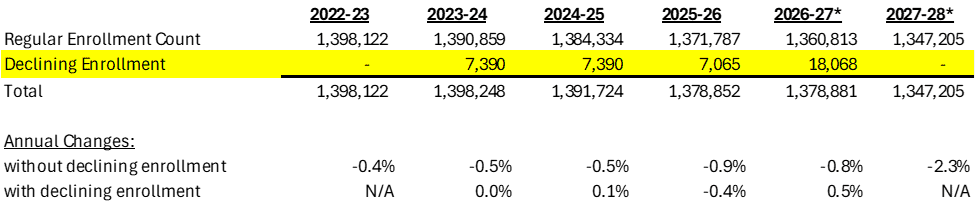
    For the 2026-27 school year, districts will be able to use the greater of their current year’s student count or their three-year average student count for their foundation funding. While the school year has not yet started and the official student count day is not until October, state fiscal analysts expect about two-thirds of districts to benefit from the switch from a single- to a three-year average count. Unlike the capped appropriation ($71 million) provided the last three years, the student count change is estimated to require an additional $186 million in foundation payments across all declining enrollment districts. Collectively, districts’ use of a three-year average enrollment count will add 18,068 students to the calculation of their state foundation allowance payment (Table 1).

    Table 1
    Michigan Student Enrollment Counts by School Year
    Source:  State Budget Office
    * Estimated based on May 2026 Consensus Revenue Estimated Conference student counts

    To pay for these additional foundation grants, the FY2027 state budget appropriated the remainder of the Enrollment Stabilization Fund ($130 million) and $56 million in one-time SAF funds. As shown in Table 1, the budget will fund a total of 1,378,881 foundation allowances instead of 1,360,813 allowances in the upcoming 2026-27 school year. Although districts’ declining enrollment aid will be paid directly through the state’s foundation, these payments will be financed entirely with non-recurring state dollars.

    Since the state adopted its declining enrollment policy/funding in the 2023-24 school year, the annual reduction in the number of students counted for foundation funding has been substantially mitigated or completely erased in some years. What would otherwise be an estimated 0.8 percent enrollment decline in the 2026-27 school year will be a 0.5 percent increase instead. Notably, the declining enrollment policy change for the 2026-27 school year (i.e., three-year average student count) will more than double the number of students claimed by declining enrollment districts compared to the policy in place for the 2025-26 school year, from roughly 7,000 students to over 18,000 students.

    Potential Funding Cliff Ahead

    One major caution for declining enrollment districts next year is the fact that the state’s new policy/funding is available for one year. Language in the FY2027 School Aid budget changed the student counting method (i.e., three-year average) for the 2026-27 school year only.  Similarly, the $186 million appropriation from the School Aid Fund to cover the additional 18,000 foundation allowances is financed from one-time resources rather than the ongoing SAF dollars normally used finance foundation payments. Funding the state’s new policy for one year means that, notwithstanding the possibility of another one-time appropriation, declining enrollment districts will have to assume they will return to the regular method of counting students in the 2027-28 school year.

    Table 1 illustrates the estimated effects on statewide pupil counts for the 2027-28 school year in the absence of the declining enrollment policy. Based on estimates from the May 2026 Consensus Revenue Estimating Conference, the total number of students counted for foundation funding will drop 2.3 percent, from 1,378,881 pupils in the 2026-27 school year to 1,347,205 pupils the following year. This reduction is a function of the natural student enrollment decline (approximately 13,600 pupils) plus the potential elimination of the state’s declining enrollment policy (about 18,000 pupils).

    Although the 2027-28 foundation allowance amount has not been set yet, this decline in student counts memberships is expected to result in a total foundation funding drop statewide of more than $325 million (assuming the current $10,300 per-pupil foundation), and declining enrollment districts will bear the vast majority of this funding loss. Given the one-time nature of the state’s declining enrollment policy, districts using a three-year student count to calculate their foundation funding would be wise to carefully program the additional one-time dollars they receive in the 2026-27 school year to avoid major funding cliffs when it comes time to develop their 2027-28 spending plans.

    Conclusion

    Michigan’s expanded declining enrollment policy provides meaningful short-term relief for districts facing immediate revenue losses, and it reflects a welcome recognition that shrinking enrollment is not a temporary or isolated problem. However, because the FY2027 policy is funded with one-time resources and applies for only one year, it also creates significant risks for districts that build ongoing expenditures around temporary dollars. To avoid future funding cliffs and structural budget pressures, local officials should treat the additional aid as transitional support, while state policymakers should consider whether declining enrollment assistance should become a permanent and sustainable component of the School Aid budget. Without a longer-term solution, the state’s new policy may ease the pressure for now, but it will not resolve the underlying fiscal challenges facing Michigan’s declining enrollment districts.

    Michigan’s New Declining Student Enrollment Funding Policy is Good News . . . at Least for Now

    In a Nutshell

    • Declining student enrollment has been a financial challenge for Michigan K-12 school districts for over two decades and is projected to continue. But, only recently has the state begun to develop funding policies to address the fiscal realities arising from shrinking enrollments.
    • Michigan’s newly expanded declining enrollment policy provides meaningful short-term relief for districts facing immediate revenue losses, and it reflects a welcome recognition that shrinking enrollment is not a temporary or isolated problem. But the state funding policy relies on one-time resources and applies for only one year.
    • This creates significant risks for districts that build ongoing expenditures around temporary state dollars. State policymakers should consider whether declining enrollment assistance should become a permanent and sustainable component of the School Aid budget.

    Declining student enrollment has been a financial challenge for Michigan K-12 school districts for over two decades and is projected to continue. Under the state-controlled per-student funding model in place since the mid-1990s, when districts enroll fewer students than the previous year, they lose the per-student dollars assigned to those children. To help districts address some of the immediate financial pain recent state School Aid budgets have set aside dedicated funding to offset up to one half of districts’ funding losses due to declining enrollment. The Fiscal Year (FY)2027 School Aid budget more than doubles the current “enrollment stabilization” appropriation to allow districts to use a three-year average student count to calculate their 2026-27 per-student payments.

    As we noted in our recent state budget analysis, the FY2027 School Aid budget includes over $1.4 billion in “one-time” appropriations. Several of these appropriations have appeared for at least four consecutive budgets and many districts have come to rely on these “one-time” dollars every year to finance their general operations.

    Because the FY2027 School Aid budget uses one-time funding to finance the expanded enrollment stabilization appropriation, there is a real possibility that declining enrollment districts will face sizeable funding cliffs if local officials are not careful in how they program these dollars. Using “one-time” funding to support ongoing spending is an unsustainable long-term financial strategy and can result in structural budget deficits.

    The state’s recognition that declining student enrollment is a problem is certainly welcomed news for affected districts’ finances and should be applauded. However, how this new policy is designed and funded should give those districts pause as the funding is not guaranteed beyond the next school year. If state policymakers are serious about helping declining enrollment districts, they should consider making the state funding for enrollment stabilization a permanent piece of the FY2028 School Aid budget and stop the practice of treating declining enrollment as a temporary phenomenon funded with one-time resources.

    Declining K-12 Student Enrollment

    Michigan public schools have been dealing with shrinking K-12 enrollments and accompanying funding reductions for over two decades now and this trend is expected to continue. Statewide, the total public K-12 enrollment has dropped by 20 percent from 1,714,867 students in the 2002-03 school year to an expected 1,371,500 students for the upcoming 2026-27 school year. Looking forward, federal projections show Michigan is one of 15 states that will experience at least an eight percent decline in public school enrollment between 2022 and 2031, well above the 5.5 percent enrollment drop projected for all states combined. Michigan’s shrinking enrollment pie is being driven by several factors, including declining birth rates, demographic shifts, and changing economic conditions. Michigan had just under 100,000 live births in 2023, the lowest amount since 1940.

    Additionally, state school choice policies also contribute to district-level enrollment declines. Since the mid-1990s, the expansion of public charter schools, combined with growing participation in inter-district school choice programs, have created a heightened level of competition for students (and funding) among districts. To be clear, there are two sides to the schools-of-choice equation: while some districts lose students, others gain students.

    Given the compounding effects of school choice policies and the state’s ongoing population growth challenges, the number of Michigan school districts coping with shrinking enrollment has grown. Approximately two-thirds of Michigan’s 828 school districts experienced year-over-year enrollment decline in the 2025-26 school year, a percentage that has remained constant dating back to before the COVID-19 pandemic.

    Our previous research shows how the combined effects of a shrinking K-12 enrollment pie and the state’s school choice policies have not been evenly spread across school districts, with some being impacted much more than others. Districts of all sizes, locations, and types (charter and traditional public) have been affected; however, both charter and traditional districts in urban settings (for example, Detroit, Flint, Mt. Clemens, and Pontiac) have been most affected. Urban locations tend to be home to the majority of charter school activity as well as greater inter-district choice participation. While there is some heavy use of school choice in more rural areas of the state, some of Michigan’s largest and most iconic urban centers have experienced the greatest amount of de-population.

    Michigan’s Evolving Declining Enrollment Policy

    Regardless of the reason, sustained student enrollment losses present financial challenges for districts. Michigan schools receive the bulk of their annual operating revenues through the per-student foundation allowance, set at $10,300 for the upcoming 2026-27 school year. Other state and federal funding streams are also student-based and can be impacted when fewer students enroll in a district. But the foundation allowance is the largest single funding source for districts and is primarily driven by pupil enrollment. Districts receive foundation funding based on a “blended” student enrollment count equal to 90 percent of the current year’s student count and 10 percent of the previous year’s count.

    Because the foundation dollars (and other state/federal funds) follow students to the enrolling district, districts experiencing enrollment declines face immediate revenue reductions even though many operating costs—including staffing, transportation, facilities, and debt obligations—cannot be reduced at the same pace.

    For instance, if a district loses 50 students for the upcoming school year, that equates to a loss of $515,000 in foundation allowance revenue. But removing 50 students across all schools, grade-levels and classrooms district-wide likely doesn’t give the affected district a clear immediate path to downsizing teaching staff.  While districts can “right-size” their budgets to meet the revenue losses from fewer students, reducing staffing, and then eventually consolidating classrooms and/or closing schools takes time. Michigan law requires public schools to have balanced budgets.

    While declining student enrollment has been a decades-long challenge for many schools, only recently has Michigan’s K-12 funding policy begun to catch up to the fiscal realities facing districts across the state. For the last three years, the state School Aid budget has partially addressed this challenge through a temporary Enrollment Stabilization Fund (ESF) that provides supplemental aid to qualifying districts with declining enrollment. This fund was established about five years ago as a separate reserve account within the School Aid Fund (SAF). At the time, the SAF had a $3.6 billion one-time surplus and lawmakers used it to create several dedicated reserve accounts for specific multi-year priorities. Specifically, they deposited over $300 million in the ESF with the intent to use the money over several years to assist declining enrollment districts.

    To this end, each of the last three state School Aid budgets has appropriated $71 million from the Enrollment Stabilization Fund to allow districts to receive per-pupil funding for up to 50 percent of their year-over-year enrollment losses. However, these district payments are prorated based on the number of qualifying districts, so the actual support falls below this 50 percent cap. For the 2025-26 school year, a total of 560 districts (about two-thirds of all districts) received enrollment stabilization aid, while the appropriation provided per-student funding ($10,050) for an additional 7,065 students across all declining enrollment districts.  After proration, this funding effectively offsets about 33 percent of the revenue decline resulting from enrollment losses in these districts.

    The FY2027 School Aid budget makes major changes to the state’s declining enrollment policy and funding. Rather than a separate funding stream (i.e., categorical grant), the new state budget incorporates the declining enrollment policy into the main foundation allowance formula by changing how districts count students for their base operational funding.

    For the 2026-27 school year, districts will be able to use the greater of their current year’s student count or their three-year average student count for their foundation funding. While the school year has not yet started and the official student count day is not until October, state fiscal analysts expect about two-thirds of districts to benefit from the switch from a single- to a three-year average count. Unlike the capped appropriation ($71 million) provided the last three years, the student count change is estimated to require an additional $186 million in foundation payments across all declining enrollment districts. Collectively, districts’ use of a three-year average enrollment count will add 18,068 students to the calculation of their state foundation allowance payment (Table 1).

    Table 1
    Michigan Student Enrollment Counts by School Year

    Source:  State Budget Office
    * Estimated based on May 2026 Consensus Revenue Estimated Conference student counts

    To pay for these additional foundation grants, the FY2027 state budget appropriated the remainder of the Enrollment Stabilization Fund ($130 million) and $56 million in one-time SAF funds. As shown in Table 1, the budget will fund a total of 1,378,881 foundation allowances instead of 1,360,813 allowances in the upcoming 2026-27 school year. Although districts’ declining enrollment aid will be paid directly through the state’s foundation, these payments will be financed entirely with non-recurring state dollars.

    Since the state adopted its declining enrollment policy/funding in the 2023-24 school year, the annual reduction in the number of students counted for foundation funding has been substantially mitigated or completely erased in some years. What would otherwise be an estimated 0.8 percent enrollment decline in the 2026-27 school year will be a 0.5 percent increase instead. Notably, the declining enrollment policy change for the 2026-27 school year (i.e., three-year average student count) will more than double the number of students claimed by declining enrollment districts compared to the policy in place for the 2025-26 school year, from roughly 7,000 students to over 18,000 students.

    Potential Funding Cliff Ahead

    One major caution for declining enrollment districts next year is the fact that the state’s new policy/funding is available for one year. Language in the FY2027 School Aid budget changed the student counting method (i.e., three-year average) for the 2026-27 school year only.  Similarly, the $186 million appropriation from the School Aid Fund to cover the additional 18,000 foundation allowances is financed from one-time resources rather than the ongoing SAF dollars normally used finance foundation payments. Funding the state’s new policy for one year means that, notwithstanding the possibility of another one-time appropriation, declining enrollment districts will have to assume they will return to the regular method of counting students in the 2027-28 school year.

    Table 1 illustrates the estimated effects on statewide pupil counts for the 2027-28 school year in the absence of the declining enrollment policy. Based on estimates from the May 2026 Consensus Revenue Estimating Conference, the total number of students counted for foundation funding will drop 2.3 percent, from 1,378,881 pupils in the 2026-27 school year to 1,347,205 pupils the following year. This reduction is a function of the natural student enrollment decline (approximately 13,600 pupils) plus the potential elimination of the state’s declining enrollment policy (about 18,000 pupils).

    Although the 2027-28 foundation allowance amount has not been set yet, this decline in student counts memberships is expected to result in a total foundation funding drop statewide of more than $325 million (assuming the current $10,300 per-pupil foundation), and declining enrollment districts will bear the vast majority of this funding loss. Given the one-time nature of the state’s declining enrollment policy, districts using a three-year student count to calculate their foundation funding would be wise to carefully program the additional one-time dollars they receive in the 2026-27 school year to avoid major funding cliffs when it comes time to develop their 2027-28 spending plans.

    Conclusion

    Michigan’s expanded declining enrollment policy provides meaningful short-term relief for districts facing immediate revenue losses, and it reflects a welcome recognition that shrinking enrollment is not a temporary or isolated problem. However, because the FY2027 policy is funded with one-time resources and applies for only one year, it also creates significant risks for districts that build ongoing expenditures around temporary dollars. To avoid future funding cliffs and structural budget pressures, local officials should treat the additional aid as transitional support, while state policymakers should consider whether declining enrollment assistance should become a permanent and sustainable component of the School Aid budget. Without a longer-term solution, the state’s new policy may ease the pressure for now, but it will not resolve the underlying fiscal challenges facing Michigan’s declining enrollment districts.

  • Permission to reprint this blog post in whole or in part is hereby granted, provided that the Citizens Research Council of Michigan is properly cited.

  • Recent Posts

  • Stay informed of new research published and other Citizens Research Council news.
    [ctct form="10424" show_title="false"]

    Latest Research Posts

    Back To Top

    Join our email/text message lists to stay connected with the Citizens Research Council. In addition to a weekly newsletter, you will receive emails notifying you of new publications, event invitations, and related information. We promise not to overburden your inbox.

    Preference(Required)
    How do you prefer to receive information?