


September 29, 2026
In a Nutshell
- From 2005 to 2024, aggravated assaults among 10- to 19-year-olds in Detroit have declined by 73 percent, and larcenies by 63 percent.
- Aggravated assault rates among 10- to 19-year-olds in Detroit have largely plateaued since 2018. In 2024, Detroit had the third-highest aggravated assault rate relative to the size of the youth population among peer cities, as well as the second-lowest larceny rate.
- The Research Council recommends comprehensive youth crime-prevention policies that target individuals, families, schools, and social risk factors, including substance use, mental health, moral development, family bonds, school supports, and peer pressure.
Detroiters continue to call for more action to address crime and safety in the city. In a 2025 survey by the Detroit Metro Area Communities Study (DMACS), Detroiters reported that crime and safety should be a high priority for Mayor Mary Sheffield.
In the latest news, there have been several media reports about youth or juvenile crime in Detroit. According to MLive, “teen takeovers” have become a recurring trend during Detroit summers. They are usually organized over social media and have occasionally resulted in violent crime and property crimes, leading to arrests. Residents who live near these takeovers of public spaces, usually downtown, report them as nuisances. The coverage on youth crime has prompted discussions about spaces for youth to gather, recreational programs, youth engagement, and youth empowerment.
“Teen takeovers” have prompted the Mayor to take action to address and prevent youth crime. Occupy the Summer, an initiative part of Mayor Sheffield’s 6-Point Community Safety Plan, aims to prevent youth crime through youth engagement and neighborhood activations, with a $1.5 million allocation in the current fiscal year. Key features of the program include extended recreation center hours and weekly Friday activations with activities, resources, and vendors. The Community Safety Plan highlights education on gun violence, oversight of block parties and large gatherings, and increased curfew enforcement and parental accountability. In short, Mayor Sheffield’s approach to addressing youth crime involves creating more spaces for youth, creating youth programming for the summer, and increasing police presence and curfew enforcement.
Notably, Mayor Sheffield created a new Office of Youth Affairs and a new position within the Mayor’s Office with the stated goal to ensure that “youth voices inform administration’s decisions.” The new position will focus on youth policy and education strategy within city government and serve as an educational liaison to the Detroit Public Schools Community District.
The city’s budget designates youth initiatives as a major priority for the Sheffield Administration. In the Fiscal Year (FY)2027 budget, a new section in the overview details “Youth Development” initiatives, listing new youth initiatives across all city departments. Some of these initiatives include transportation for K-12 students, afterschool programming, and youth employment opportunities. The budget allocates $1.5 million to support the Offices of Youth Affairs, Senior Affairs, and Neighborhood and Community Safety.
Within the FY2027 budget is a new allocation for a Youth Affairs Staff within the General Services Department. The total budget for this new team is $818,000 to employ four full-time positions with a mission to organize the city’s existing youth councils, forums, and task forces.
The emphasis on public safety, the suggestion that youth crime is growing by the media, and the slew of new programs and allocations for youth programming underscore the need to examine youth crime as another layer of Detroit crime and public safety and identify policy options that can support youth crime prevention. To our knowledge, no attempts have been made to quantify the volume of youth crime in the city. This report attempts to address that.
Although expanding youth engagement and programming is important, Detroit needs a more comprehensive approach to youth crime. Mayor Sheffield should address a broader set of risk factors by developing strategies and guidelines that respond to the individual, social, community, family, and relationship factors that shape youth crime. These strategies should focus not only on prevention but also on how young people interact with the justice system.
This is the Research Council’s fourth report in a series about crime in Detroit and across peer cities. Future reports will examine the public safety budget, public safety policies, and differences in crime rates across the state, metro area, and neighborhoods.
Background
The Federal Bureau of Investigation (FBI) does not have a formal definition for youth crime or juvenile crime. According to the National Incident-Based Reporting System manual used by police agencies to report crime statistics to the FBI, only the age of offender and the age of arrestee is recorded in FBI data. The Office of Juvenile Justice and Delinquency Prevention in its juvenile court statistics defines “juvenile” as a “youth at or below the upper age of juvenile court jurisdiction”, which is generally age 17. For the purposes of the Research Brief, we focus on the age 10- to 19-year-old population given the age groupings used by the FBI to classify age of offenders.
Among crime types, assault and larceny are the most common involving young people. According to a 2008 study examining male juvenile offending in urban areas, assault and larceny were the most frequently self-reported crimes by boys ages 7 to 17 in the study. Additionally, a 2021 report from the National Center for Juvenile Justice on juvenile court statistics found that simple assault was the most frequently reported offense, followed by drug law violations and larceny-theft.
Larceny-theft is a form of property crime and is defined by the FBI as the “unlawful taking, carrying, leading, or riding away of property from the possession or constructive possession of another.” It differs from burglary, which is characterized as “unlawful entry of a structure to commit a felony or theft.” Larceny differs from robbery, as robberies are characterized by threat of force or use of force. In the FBI statistics, larceny-theft is a catch all for various kinds of property related theft including pickpocketing, purse-snatching, and shoplifting. It excludes motor vehicle theft which is tracked separately.
Aggravated assault is a violent crime and is defined by the FBI as an “unlawful attack by one person upon another for the purpose of inflicting severe or aggravated bodily injury.” Aggravated assault may involve the use of a weapon. Robbery consists of aggravated assault and larceny-theft occurring together.
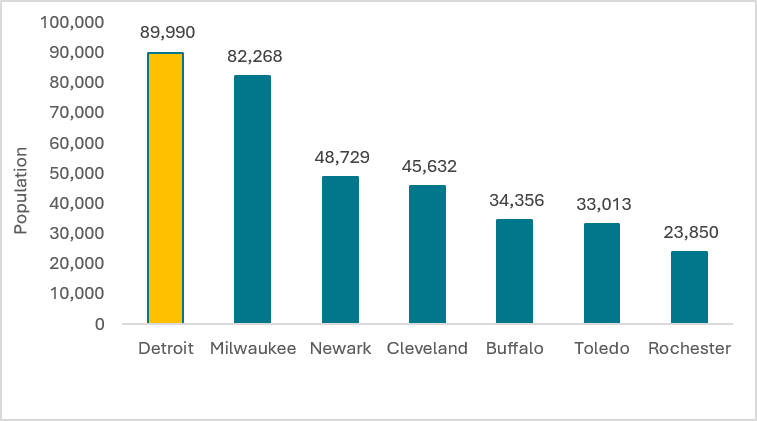
Detroit’s 10- to 19-year-old population totals 89,900, representing 14 percent of Detroit’s total population, according to the 2024 American Community Survey (ACS). Among Detroit’s peer cities, Detroit has the largest group of 10–19-year-olds (see Chart 1).
Chart 1
2024 Detroit and Peer Cities Population of 10- to 19-Year-Olds
Source: U.S. Census Bureau
Drivers of Youth Crime
Youth crime is multi-faceted. As documented by a recent systematic review, youth crime is influenced at multiple levels through individual, social, community, family, and relationship factors. It is beyond the scope of this paper to discuss in detail all these factors; however, below we discuss several major theories on youth crime.
Developmental theory argues that adolescent development is characterized by poor self-control, peer influence, and immediate rewards. According to a 2013 paper from the National Academy of Sciences, antisocial behaviors are part of adolescence development. Adolescence development is defined as a “transient period of development that involves disruption of an old, secure state in favor of an uncertain but exciting new state.” Anti-social behaviors such as lawbreaking and risky behaviors serve to disrupt ties with parents and authority figures and explore exciting states that support assuming the tasks of adulthood. Research has shown that adolescence development is characterized by a heightened preference for risk-taking behaviors such as unprotected sex, shoplifting, and smoking due to the key features of adolescent development such as the still developing ability for self-regulation, sensitivity to peer pressure and immediate rewards, and poor or impaired judgements regarding future states. Development theory is supported by criminology studies that have consistently observed a robust relationship between age and crime where crime increases at early adolescence and peaks in the early to mid-20s due to both biological and social factors.
Social control theory posits that juvenile delinquency is more likely to occur in the context of weak or absent social bonds. Juvenile delinquency is more likely when attachment to parents, school, and peers are weak. According to the theory, juveniles who are strongly attached to their parents are more likely to care about their parents expectations which can curb delinquent behavior. Delinquency behavior will be more likely if parental-child bonds are weak. Social commitments, involvement in conventional activities, strength in moral beliefs, and attachments to conventional society all influence the likelihood of juvenile delinquency under this theory.
Multiple studies have shown that juvenile or youth crime is influenced by multiple factors. For example, an umbrella review of risk and protective factors of youth crime from 2024 found it highly suggestive or suggestive that youth crime is influenced by individual, family, school, and social factors. However, individual factors were more strongly linked to youth crime which include substance use, previous history of crime, moral development, psychopathology, and adverse childhood experiences. Protective factors have not been as well studied as risk factors. Protective factors include supportive school environments and effective parental supervision and familial relationships. The review also noted that most predictors of youth crime can be modified and that youth crime prevention should be comprehensive and incorporate multiple settings. A separate meta-analysis found an association between poor parental attachment and delinquency across multiple studies.
Trend and Peer City Comparisons
We examined trends in youth crime in Detroit and peer cities using FBI data on larceny-theft and aggravated assault for the 10- to 19-year-old population from 2005 to 2024. To account for population differences across cities, we calculated a crime rate per 10,000 of the 10- to 19-year-old population in each city.
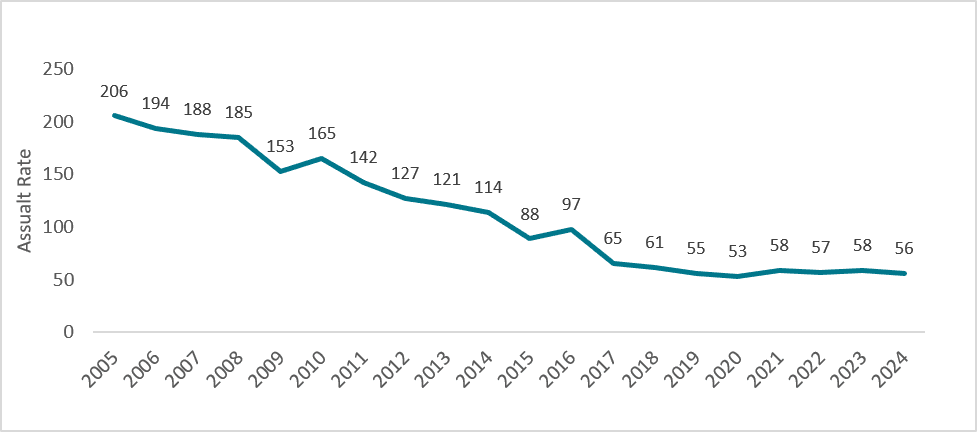
Detroit’s assault rate for youth has been steadily declining since 2005, dropping from 205 assaults per 10,000 youths in 2005 to 56 assaults per 10,000 youths in 2024, a decline of 73 percent (see Chart 2). In recent years, youth assaults have largely plateaued, hovering just under 60 assaults per 10,000 since 2019.
Of the total 6,121 aggravated assaults reported by the Detroit Police Department (DPD) in 2024, only eight percent of those assaults are known to have been committed by youth offenders. Another 28 percent of total aggravated assaults were committed by 20- to 29-year-olds and 32 percent were committed by 30- to 39-year-olds. Please note that not all assaults that occur in the city are reported to police, and there are crime incidences where the age of the offender is unknown.
Chart 2
Detroit Youth Aggravated Assaults Per 10,000 Youths, 2005 to 2024
Source: FBI Uniform Crime Reporting; U.S. Census Bureau
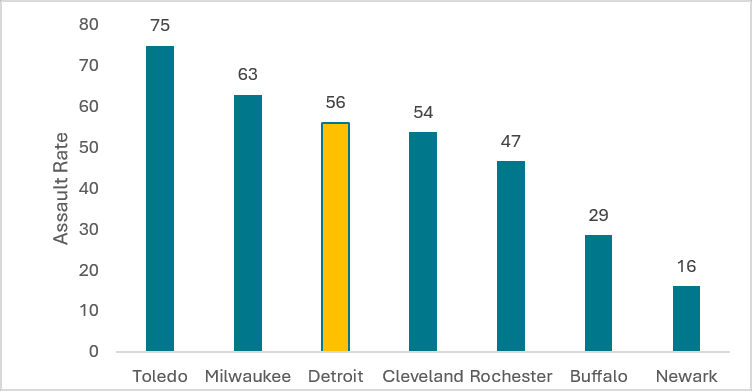
Detroit’s youth assault rate is still quite high relative to peer cities. In 2024, Detroit had the third highest youth assault rate among the six peer cities with similar social and demographic characteristics (see Chart 3). Detroit’s assault rate is comparable to Cleveland’s and Milwaukee’s but higher than Buffalo and Newark who have at least 50 percent fewer youth assaults than Detroit.
Chart 3
2024 Youth Aggravated Assaults Per 10,000 Youths, Detroit and Its Peer Cities
Source: FBI Uniform Crime Reporting; U.S. Census Bureau
Many of Detroit’s peer cities did not consistently report crime data over time. As a result, our trend analysis over time is limited to just Cleveland and Milwaukee who have recorded larcenies and assaults since 2005.
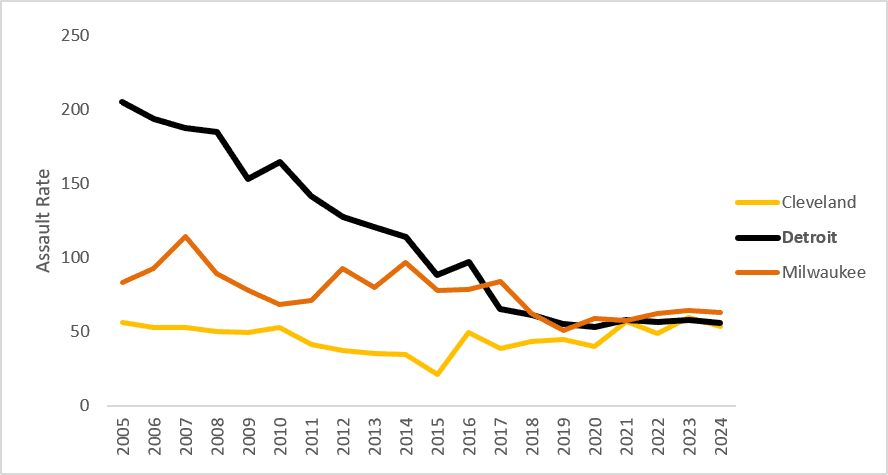
Historically, Detroit’s youth assault rate has been higher than Cleveland and Milwaukee. More recently, however, Detroit’s youth aggravated assault rate has largely plateaued matching rates observed in Cleveland and Milwaukee (see Chart 4).
Chart 4
Aggravated Assaults Per 10,000 Youths for Detroit, Cleveland, and Milwaukee, 2005 to 20241
Source: FBI Uniform Crime Reporting; U.S. Census Bureau
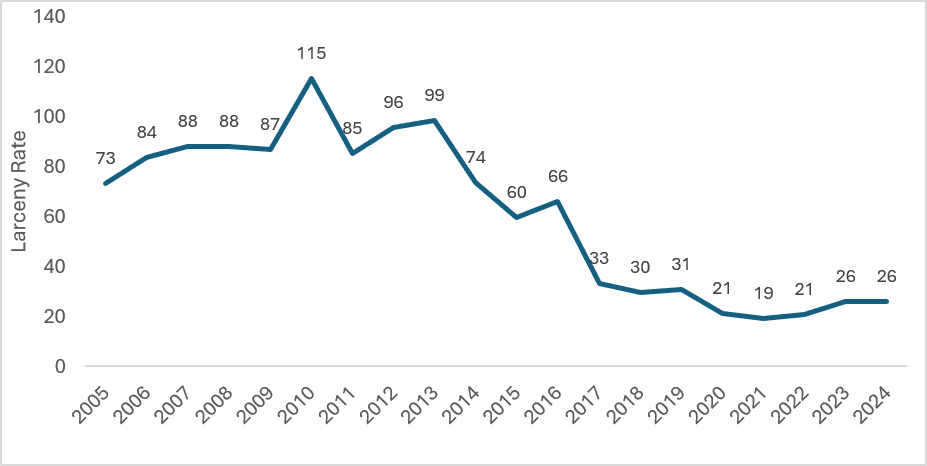
Detroit’s youth larceny rate has declined steadily from historic highs. In 2024, Detroit’s youth larceny rate was 26 larcenies per 10,000 youths, a 77 percent decline from its peak in 2010 (see Chart 5).
Chart 5
Detroit Youth Larcenies Per 10,000, 2015 to 2024
Source: FBI Uniform Crime Reporting; U.S. Census Bureau
Among the 3,232 total larcenies reported by DPD in 2024, only seven percent of those were committed by offenders ages 10 to 19. The majority of larcenies in 2024 were committed by 30- to 39-year-olds (34 percent) and 20- to 29-year-olds (27 percent). Please note that the age of the offender is not always known in every crime incident, and not all larceny-thefts are reported to police.
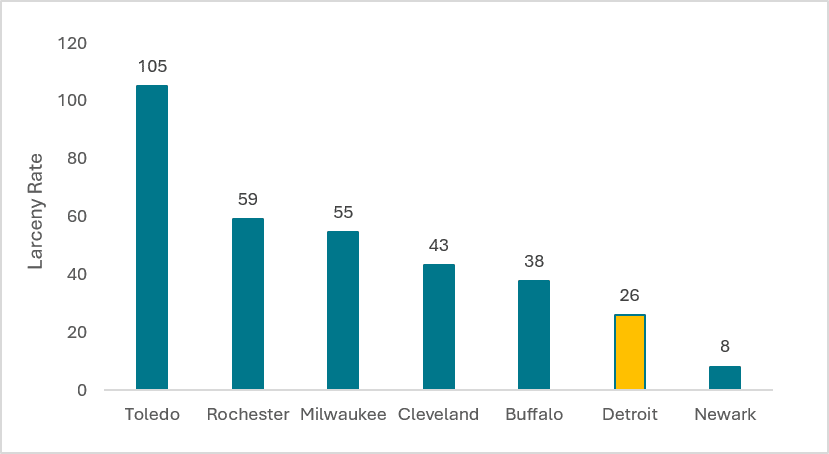
Detroit’s youth larceny rate is far lower than most of its peer cities based on recent data. In 2024, only Newark had a lower youth larceny rate compared to Detroit’s rate (see Chart 6). Toledo, Rochester, and Milwaukee all have youth larceny rates that were more than twice that of Detroit’s.
Chart 6
2024 Youth Larcenies Per 10,000 Youths, Detroit and Its Peer Cities
Source: FBI Uniform Crime Reporting; U.S. Census Bureau
Detroit’s youth larceny rate has been declining over time. In 2024, the Detroit youth larceny rate was 55 larcenies per 10,000 youth, a 64 percent decline from its 2005 rate.
Again, due to limited data, we can only examine larceny trends among Cleveland, Milwaukee, and Detroit from 2005 to 2024.
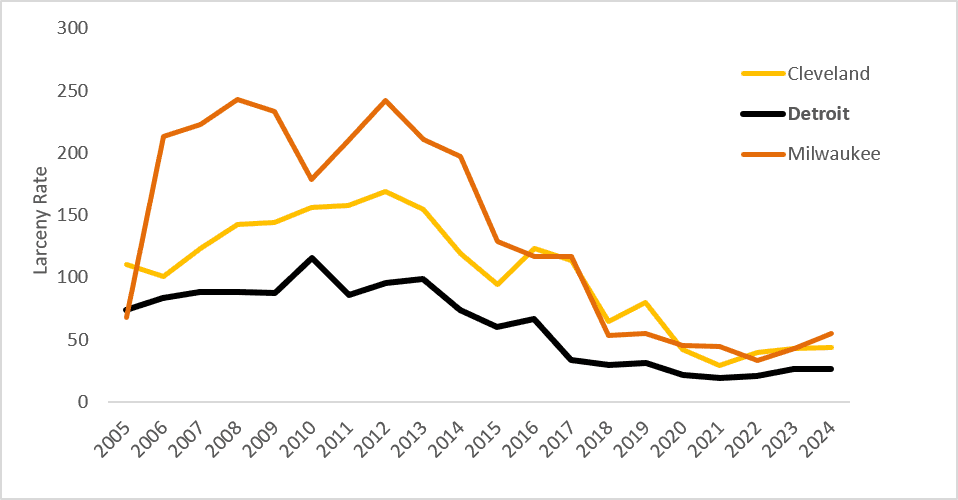
Detroit has historically had a lower youth larceny rate than Cleveland and Milwaukee since 2006. In 2006, Detroit’s youth larceny rate was lower than both Cleveland and Milwaukee with Detroit having 61 percent fewer larcenies than Milwaukee and 17 percent fewer larcenies than Cleveland (see Chart 7).
Chart 7
Youth Larcenies Per 10,000 Youths for Detroit, Cleveland, and Milwaukee, 2005-20242
Source: FBI Uniform Crime Reporting; U.S. Census Bureau
Discussion
Despite sustained coverage of “teen takeovers” in the news, historically, youth crime in Detroit has been on the decline and Detroit crime rates are on par with two peer cities. Both youth crime rates for larceny-theft and aggravated assault are considerably much lower in 2024 than in 2005. For example, Detroit’s youth aggravated assault rate in 2024 is 73 percent lower than its 2005 rate. While Detroit historically had more youth aggravated assaults compared to Cleveland and Milwaukee, the youth aggravated assault rate is now trending at a similar rate to these peers. Detroit has also historically reported fewer youth larcenies compared to Cleveland and Milwaukee. Benchmarking in 2024 indicates that Detroit is similar to most of its peers on youth aggravated assault and has a much lower rate of youth larceny compared to most peer cities. Due to limited data, we cannot compare trends in crime rates for youth over time among peer cities.
While youth crime rates are historically down in Detroit, the Sheffield Administration still has the opportunity to address youth crime through comprehensive policies that address the multiple risk domains that influence youth crime in multiple settings. In particular, individual risk factors such as substance use and previous history of crime are strongly correlated with criminal behavior and should be considered in any prevention plans or programs. Effective interventions at the individual-level include enhancing moral development, providing mental health support, reducing substance use, and strengthening family bonds (e.g., improved parental supervision). As the social-level, creating supportive school environments and addressing peer pressure may also be effective.
While expanded recreation hours and Midnight Basketball seem like positive steps that can help youth stay out of trouble, a multilevel meta-analysis in 2016 analyzing 51 studies found no overall significant association between sports participation and juvenile delinquency. This provides compelling evidence that expanded recreational hours and other sports-related youth programming may not have much influence in preventing youth crimes in Detroit.
