

Subscribe
July 29, 2026

Accelerating Michigan’s Path to Prosperity

In a Nutshell

  • Michigan’s path to prosperity is not only formidable, but also multifaceted. Attracting capital investment, developing a skilled workforce, improving educational attainment, and building thriving communities are all strategies widely recognized as essential to improving upward mobility for the state’s residents.
  • The most effective tactics are aligned with the specific circumstances in individual communities. Identifying which communities require which interventions is crucial for maximizing policy impact. State policymakers should take on the analysis, share strategies, and assist local community leaders with implementing locally-tailored programs for greatest success.
  • Recently developed tools provide access to data that give insights into which strategies would most benefit a particular community. Michigan community leaders can design smarter policies using these data analysis tools and replicate effective programs to accelerate economic mobility across communities. By building greater upward mobility from the local level up, Michigan has the opportunity to grow the state’s economy and ensure that growth is shared broadly among its residents.

The message that Michigan is losing its economic edge was reiterated recently during an annual gathering of civic leaders on Mackinac Island. Changemakers were called upon to focus on improving the state’s prosperity – for the families and businesses who live in Michigan now, and to encourage others to make this state home in the future.

The path to prosperity is not only formidable, but also multifaceted. Improvements in upward mobility will take several approaches. Attracting capital investment, developing a skilled workforce, improving educational attainment, and building thriving communities must all be part of the overall strategy. Several respected organizations have articulated broad approaches from the state’s perspective to improving prosperity – Michigan Future Inc.’s recommendations to restore shared prosperity, Business Leaders for Michigan’s vision for Michigan in a New Era, in addition to the Citizens Research Council’s Path to a Prosperous Future. However, effort should be focused on fixing the root causes of the decline in the state’s overall wealth and on determining which communities need the most attention. To achieve success, policy developers should tap into recently available data-analytical tools to identify the communities with greatest need and potential to apply targeted programs that will achieve the most success. This will support a more granular, data-driven approach to program implementation.

Opportunity Insights, a research group based at Harvard University, has developed two relevant platforms, the Opportunity Atlas and the Social Capital Atlas. These analytical tools offer policymakers access to historical data in an understandable format. By investigating trends using these data, policymakers have the capability to apply recommended tactics with greater precision by drawing on historical evidence of improvements in personal/family wealth, or what economists refer to as economic mobility. These tools compile geographically-disaggregated data on economic mobility and social relationships using anonymized tax records, U.S. Census data, and privacy-protected social connection data. While such data cannot fully separate outcomes due to the choices families have made, individual agency, or isolate the causal effects of specific policies, they provide a valuable resource for understanding patterns of upward mobility and can inform policy development.

Michigan’s economic challenges are well-documented:  stagnant personal income, relatively low educational attainment, and a shortage of higher-wage jobs. However, less attention has been given to the variation across the state’s communities. Interventions or state-wide policies are often developed without accounting for the unique circumstances in regions, cities, or even neighborhoods. Data tools, such as the Opportunity Atlas, could help by identifying community-level differences and highlighting areas where targeted interventions may yield the greatest returns. They may also facilitate the identification of successful local practices that could be replicated elsewhere. This will help state policymakers analyze trends and best practices used successfully to design programs that give struggling communities the tools and resources they need to improve their residents’ economic mobility. By building greater upward mobility from the local level up, prosperity across the state can be shared more broadly.

Identifying communities and populations with greatest potential growth

Household income[i] is a key measure of economic health. In its vision document, Business Leaders for Michigan reports that the state ranks 50th in real median household income growth over the past 25 years. While increasing income overall is an overriding objective, the factors contributing to low income growth vary across communities and require tailored policy responses.

Educational attainment represents another critical factor. As the research by Michigan Future shows, individuals with a four-year degree earn higher wages. Michigan needs to improve educational outcomes. It must also encourage postsecondary education among those who do not yet see the benefit of that investment, or who may not have access to or the encouragement to take on more education beyond high school.

In addition, income growth is closely linked to the availability of higher-wage employment. The mix of Michigan’s type of employment and earnings has been relatively consistent over the past decade. A change in the overall wealth of Michigan households will require an expansion of higher-wage employment opportunities.

These challenges will take time to address, and the results will not be immediate. Given this long-term horizon, the Opportunity Atlas can help policy formulation. By examining historical economic mobility trends, programs for Michigan communities could be designed more precisely, targeting specific areas to accelerate growth where it is needed the most. With limited resources and a sense of urgency, it is best to make sure that state policies are focused on programs that will improve a local situation.

For instance, comparing data across several Michigan metropolitan areas reveals persistent disparities in outcomes for children raised in low- and middle-income households.[ii] This observation confirms that households in different communities across Michigan experience differences in upward mobility opportunity.

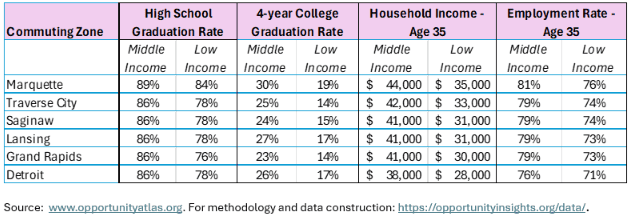
Table 1 shows the high school graduation rate, four-year college graduation rate, household income at age 35, and employment at age 35 for two cohorts of children born in 1978 for six Michigan metropolitan areas: those growing up in middle-income households and those growing up in low-income households. Across all communities, the children growing up in a low-income household were less likely to graduate from a four-year college. However, the variation across the cities where these children grew up was notable. In Marquette, for example, those from low-income households had higher college completion rates and higher mid-career earnings than their peers from Grand Rapids. These differences suggest that local strategies or community resources may be contributing to better outcomes – insights that could inform interventions in areas with less historical success. For example, offering a program for improving high school graduation rates for lower income students in Grand Rapids would be important for improving their upward mobility. However, offering the same in Marquette may not address upward mobility as effectively as a different program, given the higher graduation rates for their lower-income students.


[i] Household income is the combined gross income (wages, investments, public transfers) of all people aged 15 or older sharing the same housing unit

[ii] The database was initially compiled using longitudinal data for children of high-, middle-, and low-income households with other metrics:  Census Data from 2020, 2010, and US population linked to federal tax returns from 1979-2019. More recent data has been added.

Table 1
Economic Mobility Metrics in Six Michigan Communities
Factoring Social Connections into Economic Mobility

A subsequent 2024 Opportunity Insights study examined changes in economic mobility between children in two cohorts, those born in 1978 and those born in 1992. Economic mobility trends varied across regions. While for some economic mobility improved, for others it declined. This finding underscored the importance of the community environment where the children grew up. The study also revealed that mobility could improve in a short time frame. The Opportunity Insights team pointed to Grand Rapids as an example of one area in the country that had notable improvements in upward mobility for children born in 1992 compared to those born in 1978. The Grand Rapids metropolitan area ranked 5th out of the 50 largest metropolitan areas in the country for improvements in income for adults born into low-income households, behind only Brownsville, TX, Austin, TX, Charlotte, NC, and Nashville, TN.

A key finding of this study was that a child’s economic outcomes improved when they were raised in a community with higher levels of adult employment. Exposure to employed adults, regardless of their own family situation, had a positive impact on upward mobility for children growing up in low-income households.

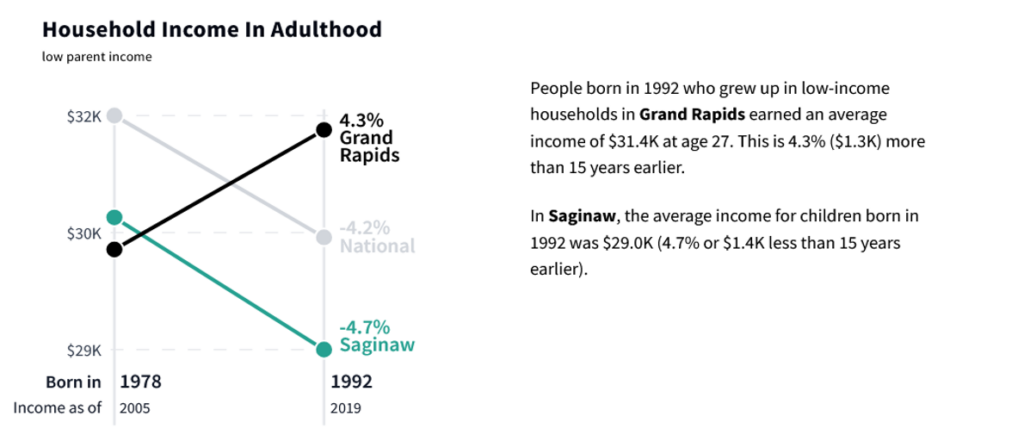
A comparison of Grand Rapids to Saginaw provides a Michigan-specific illustration of how using data can help inform more targeted policy interventions. Nationally, children from low-income households born in 1992 earned 4.2 percent less on average at age 27 than those born in 1978. In the six Michigan metropolitan areas identified above, only two metropolitan areas saw improvements in income for those raised in low-income households. Adults, born in 1992 and raised in Grand Rapids, had an improvement of 4.3 percent in household income over those born in 1978; Traverse City’s low-income youth born in 1992 were nearly on par with their 1978 counterparts at a 0.92 percent increase in household income in adulthood. The other metropolitan areas, Marquette, Lansing, and Detroit, saw a decline, with Saginaw’s 1992 cohort experiencing the greatest decline in income, at 4.7 percent lower than its 1978 cohort.

Figure 1
Household Income at Age 27 – Low-Income Children Raised in Grand Rapids v. Saginaw
Source : https://www.opportunityatlas.org/

Figure 1 compares the growth of household income in adulthood for children born in low-income households in Grand Rapids and in Saginaw compared to the national average over the same period. The spread in outcomes for adults raised in low-income households in these two different metropolitan areas is noteworthy and can help inform next steps in improving Michigan’s prosperity. While the data does not parse out exactly what accounts for the differences in income growth between Grand Rapids and Saginaw for those born in 1992, it does encourage more investigation as to why. Incomes are rising in Grand Rapids, even while the state is losing ground overall. State policy leaders should seek to identify what tactics Grand Rapids may have employed. They should offer communities learning and resources to help each community to select local programs and initiatives that will provide the best path to greater upward mobility for their own residents.

Improvements in Grand Rapids’ economic mobility may be a result of their region’s emphasis on their community-based initiative that combined financial investment with place-based strategies. Neighborhoods of Focus. The Neighborhoods of Focus program was designed to strengthen both social and economic networks. Programs of this type may be in part what is supporting the Opportunity Insights Team’s 2024 findings that community social connections – outside the immediate household – in the environment where children grow up can positively affect their economic mobility.

Observations such as these invite further inquiry into potentially better paths to improving upward mobility. Could local programs that increase access to financial resources and education be complemented by efforts that enhance social connections? Strengthening community environments by fostering networks and access opportunities could amplify the impact of more traditional statewide economic mobility strategies as is recommended in the recent analyses of Michigan’s decline in prosperity. [i]


[i] Note, this overview does not analyze outcomes by race or gender, though those dimensions are available within the data tools for further exploration.

Moving Upward

Leaders across Michigan are calling for action to reverse the state’s decline in prosperity. Achieving lasting progress will require more than broad strategies. It will demand targeted, evidence-based approaches that give support and resources to local communities to pursue the most beneficial local pathway to help the state reach its overall goal of a prosperous state.

Data-analytical tools like the Opportunity Atlas offer valuable observations and can assist in building a path forward. They allow policymakers to identify successful tactics while also pinpointing where interventions are most needed. While factors such as family values and individual choices play a role, analyzing patterns of success, particularly among low-income populations, can provide valuable guidance in designing programs for long term success.

By leveraging these insights, Michigan’s policymakers can design smarter policies, replicate effective programs, and accelerate upward mobility across communities. The opportunity exists not only to grow the state’s economy, but to ensure that growth is shared more widely among its residents.

Senior Research Associate - Local Affairs

About The Author

Madhu Anderson

Senior Research Associate - Local Affairs

Madhu held several leadership positions in state government and the non-profit sector prior to joining the Citizens Research Council in 2024. Her expertise is in local and state taxation, government finance, and regulatory policy. In addition to working on landmark tax, school finance, and pension reforms, she helped Michigan earn a AAA bond rating as Chief Deputy State Treasurer. Under her directorship of CEPI, Michigan became one of the first states to offer web-based performance metrics for school districts. Madhu also served as a Deputy Director at the Department of Environmental Quality and at the Michigan Agency for Energy. Her non-profit experience includes Director of Government Relations for the Michigan chapter of The Nature Conservancy, and Treasurer for a local ceramics cooperative.

Accelerating Michigan’s Path to Prosperity

In a Nutshell

  • Michigan’s path to prosperity is not only formidable, but also multifaceted. Attracting capital investment, developing a skilled workforce, improving educational attainment, and building thriving communities are all strategies widely recognized as essential to improving upward mobility for the state’s residents.
  • The most effective tactics are aligned with the specific circumstances in individual communities. Identifying which communities require which interventions is crucial for maximizing policy impact. State policymakers should take on the analysis, share strategies, and assist local community leaders with implementing locally-tailored programs for greatest success.
  • Recently developed tools provide access to data that give insights into which strategies would most benefit a particular community. Michigan community leaders can design smarter policies using these data analysis tools and replicate effective programs to accelerate economic mobility across communities. By building greater upward mobility from the local level up, Michigan has the opportunity to grow the state’s economy and ensure that growth is shared broadly among its residents.

The message that Michigan is losing its economic edge was reiterated recently during an annual gathering of civic leaders on Mackinac Island. Changemakers were called upon to focus on improving the state’s prosperity – for the families and businesses who live in Michigan now, and to encourage others to make this state home in the future.

The path to prosperity is not only formidable, but also multifaceted. Improvements in upward mobility will take several approaches. Attracting capital investment, developing a skilled workforce, improving educational attainment, and building thriving communities must all be part of the overall strategy. Several respected organizations have articulated broad approaches from the state’s perspective to improving prosperity – Michigan Future Inc.’s recommendations to restore shared prosperity, Business Leaders for Michigan’s vision for Michigan in a New Era, in addition to the Citizens Research Council’s Path to a Prosperous Future. However, effort should be focused on fixing the root causes of the decline in the state’s overall wealth and on determining which communities need the most attention. To achieve success, policy developers should tap into recently available data-analytical tools to identify the communities with greatest need and potential to apply targeted programs that will achieve the most success. This will support a more granular, data-driven approach to program implementation.

Opportunity Insights, a research group based at Harvard University, has developed two relevant platforms, the Opportunity Atlas and the Social Capital Atlas. These analytical tools offer policymakers access to historical data in an understandable format. By investigating trends using these data, policymakers have the capability to apply recommended tactics with greater precision by drawing on historical evidence of improvements in personal/family wealth, or what economists refer to as economic mobility. These tools compile geographically-disaggregated data on economic mobility and social relationships using anonymized tax records, U.S. Census data, and privacy-protected social connection data. While such data cannot fully separate outcomes due to the choices families have made, individual agency, or isolate the causal effects of specific policies, they provide a valuable resource for understanding patterns of upward mobility and can inform policy development.

Michigan’s economic challenges are well-documented:  stagnant personal income, relatively low educational attainment, and a shortage of higher-wage jobs. However, less attention has been given to the variation across the state’s communities. Interventions or state-wide policies are often developed without accounting for the unique circumstances in regions, cities, or even neighborhoods. Data tools, such as the Opportunity Atlas, could help by identifying community-level differences and highlighting areas where targeted interventions may yield the greatest returns. They may also facilitate the identification of successful local practices that could be replicated elsewhere. This will help state policymakers analyze trends and best practices used successfully to design programs that give struggling communities the tools and resources they need to improve their residents’ economic mobility. By building greater upward mobility from the local level up, prosperity across the state can be shared more broadly.

Identifying communities and populations with greatest potential growth

Household income[i] is a key measure of economic health. In its vision document, Business Leaders for Michigan reports that the state ranks 50th in real median household income growth over the past 25 years. While increasing income overall is an overriding objective, the factors contributing to low income growth vary across communities and require tailored policy responses.

Educational attainment represents another critical factor. As the research by Michigan Future shows, individuals with a four-year degree earn higher wages. Michigan needs to improve educational outcomes. It must also encourage postsecondary education among those who do not yet see the benefit of that investment, or who may not have access to or the encouragement to take on more education beyond high school.

In addition, income growth is closely linked to the availability of higher-wage employment. The mix of Michigan’s type of employment and earnings has been relatively consistent over the past decade. A change in the overall wealth of Michigan households will require an expansion of higher-wage employment opportunities.

These challenges will take time to address, and the results will not be immediate. Given this long-term horizon, the Opportunity Atlas can help policy formulation. By examining historical economic mobility trends, programs for Michigan communities could be designed more precisely, targeting specific areas to accelerate growth where it is needed the most. With limited resources and a sense of urgency, it is best to make sure that state policies are focused on programs that will improve a local situation.

For instance, comparing data across several Michigan metropolitan areas reveals persistent disparities in outcomes for children raised in low- and middle-income households.[ii] This observation confirms that households in different communities across Michigan experience differences in upward mobility opportunity.

Table 1 shows the high school graduation rate, four-year college graduation rate, household income at age 35, and employment at age 35 for two cohorts of children born in 1978 for six Michigan metropolitan areas: those growing up in middle-income households and those growing up in low-income households. Across all communities, the children growing up in a low-income household were less likely to graduate from a four-year college. However, the variation across the cities where these children grew up was notable. In Marquette, for example, those from low-income households had higher college completion rates and higher mid-career earnings than their peers from Grand Rapids. These differences suggest that local strategies or community resources may be contributing to better outcomes – insights that could inform interventions in areas with less historical success. For example, offering a program for improving high school graduation rates for lower income students in Grand Rapids would be important for improving their upward mobility. However, offering the same in Marquette may not address upward mobility as effectively as a different program, given the higher graduation rates for their lower-income students.


[i] Household income is the combined gross income (wages, investments, public transfers) of all people aged 15 or older sharing the same housing unit

[ii] The database was initially compiled using longitudinal data for children of high-, middle-, and low-income households with other metrics:  Census Data from 2020, 2010, and US population linked to federal tax returns from 1979-2019. More recent data has been added.

Table 1
Economic Mobility Metrics in Six Michigan Communities

Factoring Social Connections into Economic Mobility

A subsequent 2024 Opportunity Insights study examined changes in economic mobility between children in two cohorts, those born in 1978 and those born in 1992. Economic mobility trends varied across regions. While for some economic mobility improved, for others it declined. This finding underscored the importance of the community environment where the children grew up. The study also revealed that mobility could improve in a short time frame. The Opportunity Insights team pointed to Grand Rapids as an example of one area in the country that had notable improvements in upward mobility for children born in 1992 compared to those born in 1978. The Grand Rapids metropolitan area ranked 5th out of the 50 largest metropolitan areas in the country for improvements in income for adults born into low-income households, behind only Brownsville, TX, Austin, TX, Charlotte, NC, and Nashville, TN.

A key finding of this study was that a child’s economic outcomes improved when they were raised in a community with higher levels of adult employment. Exposure to employed adults, regardless of their own family situation, had a positive impact on upward mobility for children growing up in low-income households.

A comparison of Grand Rapids to Saginaw provides a Michigan-specific illustration of how using data can help inform more targeted policy interventions. Nationally, children from low-income households born in 1992 earned 4.2 percent less on average at age 27 than those born in 1978. In the six Michigan metropolitan areas identified above, only two metropolitan areas saw improvements in income for those raised in low-income households. Adults, born in 1992 and raised in Grand Rapids, had an improvement of 4.3 percent in household income over those born in 1978; Traverse City’s low-income youth born in 1992 were nearly on par with their 1978 counterparts at a 0.92 percent increase in household income in adulthood. The other metropolitan areas, Marquette, Lansing, and Detroit, saw a decline, with Saginaw’s 1992 cohort experiencing the greatest decline in income, at 4.7 percent lower than its 1978 cohort.

Figure 1
Household Income at Age 27 – Low-Income Children Raised in Grand Rapids v. Saginaw

Source : https://www.opportunityatlas.org/

Figure 1 compares the growth of household income in adulthood for children born in low-income households in Grand Rapids and in Saginaw compared to the national average over the same period. The spread in outcomes for adults raised in low-income households in these two different metropolitan areas is noteworthy and can help inform next steps in improving Michigan’s prosperity. While the data does not parse out exactly what accounts for the differences in income growth between Grand Rapids and Saginaw for those born in 1992, it does encourage more investigation as to why. Incomes are rising in Grand Rapids, even while the state is losing ground overall. State policy leaders should seek to identify what tactics Grand Rapids may have employed. They should offer communities learning and resources to help each community to select local programs and initiatives that will provide the best path to greater upward mobility for their own residents.

Improvements in Grand Rapids’ economic mobility may be a result of their region’s emphasis on their community-based initiative that combined financial investment with place-based strategies. Neighborhoods of Focus. The Neighborhoods of Focus program was designed to strengthen both social and economic networks. Programs of this type may be in part what is supporting the Opportunity Insights Team’s 2024 findings that community social connections – outside the immediate household – in the environment where children grow up can positively affect their economic mobility.

Observations such as these invite further inquiry into potentially better paths to improving upward mobility. Could local programs that increase access to financial resources and education be complemented by efforts that enhance social connections? Strengthening community environments by fostering networks and access opportunities could amplify the impact of more traditional statewide economic mobility strategies as is recommended in the recent analyses of Michigan’s decline in prosperity. [i]


[i] Note, this overview does not analyze outcomes by race or gender, though those dimensions are available within the data tools for further exploration.

Moving Upward

Leaders across Michigan are calling for action to reverse the state’s decline in prosperity. Achieving lasting progress will require more than broad strategies. It will demand targeted, evidence-based approaches that give support and resources to local communities to pursue the most beneficial local pathway to help the state reach its overall goal of a prosperous state.

Data-analytical tools like the Opportunity Atlas offer valuable observations and can assist in building a path forward. They allow policymakers to identify successful tactics while also pinpointing where interventions are most needed. While factors such as family values and individual choices play a role, analyzing patterns of success, particularly among low-income populations, can provide valuable guidance in designing programs for long term success.

By leveraging these insights, Michigan’s policymakers can design smarter policies, replicate effective programs, and accelerate upward mobility across communities. The opportunity exists not only to grow the state’s economy, but to ensure that growth is shared more widely among its residents.

  • Permission to reprint this blog post in whole or in part is hereby granted, provided that the Citizens Research Council of Michigan is properly cited.

  • Recent Posts

  • Stay informed of new research published and other Citizens Research Council news.
    [ctct form="10424" show_title="false"]
    Senior Research Associate - Local Affairs

    About The Author

    Madhu Anderson

    Senior Research Associate - Local Affairs

    Madhu held several leadership positions in state government and the non-profit sector prior to joining the Citizens Research Council in 2024. Her expertise is in local and state taxation, government finance, and regulatory policy. In addition to working on landmark tax, school finance, and pension reforms, she helped Michigan earn a AAA bond rating as Chief Deputy State Treasurer. Under her directorship of CEPI, Michigan became one of the first states to offer web-based performance metrics for school districts. Madhu also served as a Deputy Director at the Department of Environmental Quality and at the Michigan Agency for Energy. Her non-profit experience includes Director of Government Relations for the Michigan chapter of The Nature Conservancy, and Treasurer for a local ceramics cooperative.

    Latest Research Posts

    Back To Top

    Join our email/text message lists to stay connected with the Citizens Research Council. In addition to a weekly newsletter, you will receive emails notifying you of new publications, event invitations, and related information. We promise not to overburden your inbox.

    Preference(Required)
    How do you prefer to receive information?