



 Lansing
October 22, 2026
In a Nutshell:
- A mix of federal policies and industry-wide cost pressures have driven up the cost of health insurance in Michigan and will produce a higher uninsured rate going into the new year.
- People paying more for health care and/or foregoing care due to rising costs has significant consequences for individual health and well-being, and the overall prosperity of the state.
- The state’s new leaders must find ways to address the immediate term health care affordability crunch, while also considering how the state can make itself less vulnerable to shifting federal policies in the future.
Governor-elect Jocelyn Benson and Michigan’s 104th Legislature will face several key challenges and opportunities when they take office in January. One of the biggest issues is the state of health insurance coverage in Michigan and its impact on the state’s residents and economy.
As the Research Council has documented, federal changes to Medicaid and the Affordable Care Act (ACA) have impacted and will significantly impact people with health insurance coverage and the cost of coverage for those who maintain their coverage in the new year. On top of those changes, other forces are also driving up health care costs.
Each of these forces is noteworthy, but the most important takeaway for state policymakers and the public heading into 2027 is that these forces are converging and will feed into each other in a way that has the potential to drive up costs and destabilize health care in Michigan.
The governor-elect and her counterparts in the legislature will have to contend with a higher rate of uninsured individuals and an economy weighed down by higher premiums and health care costs. The problem is national in scope, but states must be prepared to find solutions locally.
The Forces Disrupting Health Insurance and Health Care in Michigan
A few key forces are driving changes to the health insurance and health care landscape in Michigan going into 2027. These forces include the expiration of enhanced federal Affordable Care Act (ACA) tax credits, changes to Medicaid, inflation, tariffs, GLP-1 medications, and artificial intelligence (AI).
Factors Directly Impacting Coverage Rates
In July 2025, major federal legislation known as the “One Big Beautiful Bill Act” (OBBBA) was enacted to extend significant portions of the 2017 Tax Cuts and Jobs Act. Congress paired these tax cuts with reductions in federal spending to allow the bill to proceed toward passage without the possibility of a filibuster. A major source of these spending reductions came in the form of changes to Medicaid, including the creation of work requirements for the Medicaid Expansion population and more frequent eligibility redeterminations. Other provisions in the OBBBA affected states’ ability to levy provider taxes, putting further pressure on state budgets. The new Medicaid work requirements and redetermination frequency go into effect in January, so while the state has been preparing for the last 18 months, the full effects have not arrived. (The Research Council previously examined both issues, see here and here.)
While OBBBA extended many tax credits and breaks that were due to expire at the end of 2025, it did not extend a key tax credit related to the ACA’s private marketplaces. Congress ultimately did not act to extend those credits, allowing them to expire for calendar year 2026 and beyond.
Factors Directly Impacting Cost of Service
Aside from the direct changes in federal policy related to Medicaid and the ACA, the health care sector is dealing with rising costs due to inflation and tariffs, which are driving up prices industry wide. Pharmaceutical ingredients and medical supplies are often manufactured outside of the United States and impacted by the global supply chain, so it is not surprising that tariffs have led to price increases in both categories. Similarly, the rise in the utilization of GLP-1 medications specifically is also driving up costs for insurers, as these medications are currently expensive, even if the long-term cost-benefit analysis of wider GLP-1 uptake could be positive. Prescription drug costs grew almost 13 percent in 2025 and are rising again in 2026, with increases driven in large part by increased GLP-1 utilization.
Reports also indicate that increased AI utilization in the health insurance and health care fields could be driving up costs. One way this is manifesting is through AI scribes (i.e., when an AI tool is documenting the visit for the doctor) documenting conversations between patients and doctors in such a way that they shift visits out of the “preventative” category and into higher billing tiers. While insurers are also using AI to find processing efficiencies, some have raised concerns that insurers are using AI to deny claims, creating additional costs for patients.
What Disruption Looks Like
In total, Michigan is experiencing and will continue to experience a higher uninsured rate and higher premiums for those with marketplace and employer-based health insurance plans. These impacts will likely also show up in worse health outcomes and suppressed wage growth.
Fewer People Have Coverage and More Coverage Declines are Coming
As the Research Council warned last fall, allowing the ACA enhanced premium tax credits to expire led many enrollees to decline to renew their coverage in 2026. The effective cost of an ACA plan went up significantly in 2026, as the baseline plan cost increased and the federal tax credits that offset some, or all, of these costs were reduced or eliminated for many people.
Between February 2025 and February 2026, ACA coverage in Michigan fell by 27 percent, or about 130,000 people, which was proportionately one of the largest declines nationwide (see Chart 1). Further ACA marketplace enrollment declines are certainly possible as well, as people who decided to enroll this year despite the higher costs could ultimately decide the expense is unsustainable at some point in the future, especially as costs continue to go up.
Chart 1
Effectuated Affordable Care Act Marketplace Enrollment in February in Michigan, 2016 to 2026
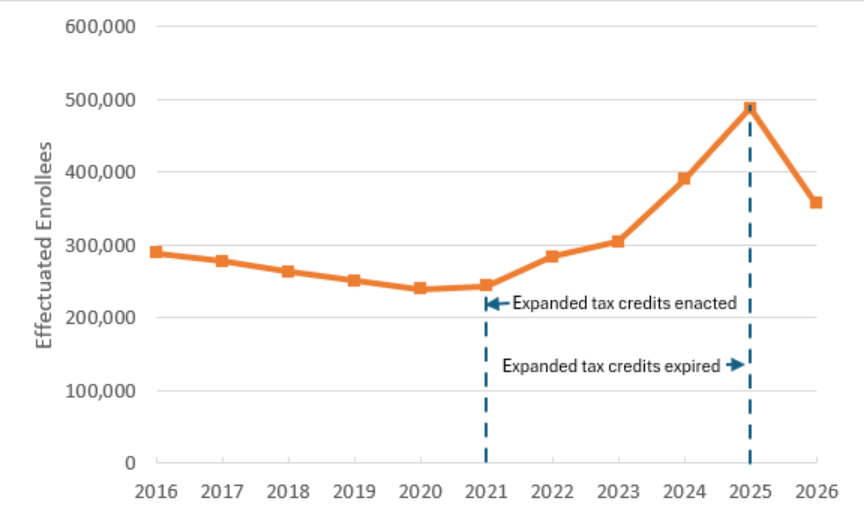
Source: Centers for Medicare and Medicaid Services, Health Insurance Exchanges Monthly Effectuated Enrollment. Note: Effectuated enrollment is the number of people who enrolled and paid their premium to activate coverage. Some analyses will cite “open enrollment” figures which are higher because they include people who sign up for a plan during open enrollment and decide to not actually enroll in coverage when it comes time to pay their first premium for one reason or another.
On the Medicaid side, enrollment is down about 200,000 people since last summer, including roughly 60,000 fewer people in the expansion pool (see Chart 2). These declines pre-date the major changes to the program which go into effect in January – the work requirements and redetermination changes. It is not yet clear in the data if these Medicaid enrollment declines in the last year reflect people shifting out of Medicaid status because their economic condition improved or if they lost eligibility due to problems processing their enrollment.
When the new requirements go into effect, the state will see an additional decline in enrollment. The most recent estimates place Michigan’s Medicaid expansion population at approximately 660,000. Estimates vary about how much Medicaid enrollment will decline in the state as the changes are implemented, but the low end of the estimates is in the 100,000 to 150,000 range.
Chart 2
Monthly Medicaid and CHIP Enrollment, with Expansion Subset, Michigan, January 2020 to June 2026
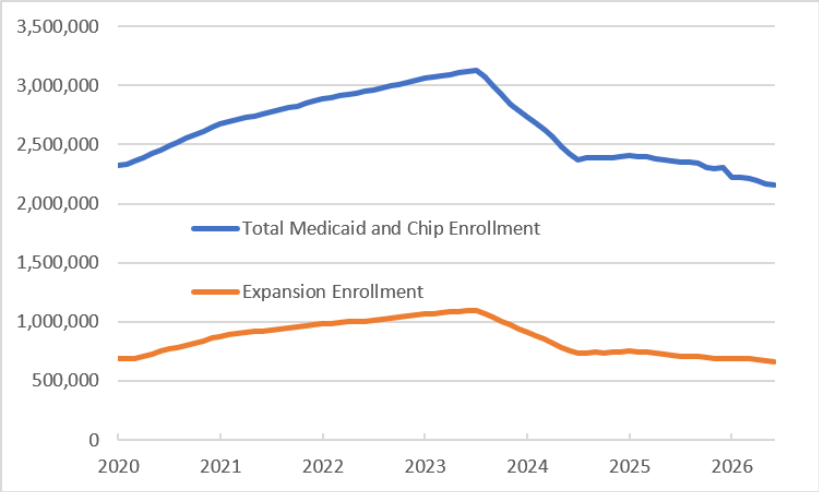
Sources: Georgetown University Center for Families and Children, KFF State Health Facts, and Centers for Medicare and Medicaid Services. Note: The decline in 2023 into 2024 was due to a return to pre-COVID enrollment procedures.
A conservative estimate, therefore, would suggest the ACA and Medicaid changes will lead to at least 250,000 fewer people covered by publicly-supported plans in 2027 relative to early 2025, although that number could be much higher depending on how ACA enrollment evolves and the Medicaid work requirements are implemented.
The Cost of Health Insurance is Going Up
The cost of coverage is going up for those people that do have some form of private insurance. As alluded to above, the cost of plans on the ACA marketplace has increased over the last few years for a variety of reasons. One set of reasons is related to the general cost pressures of things like inflation, tariffs, prescription drugs, and AI that are increasing costs in general. But ACA marketplace premiums are also going up because of the changes to the country’s health insurance paradigm.
The ACA enhanced premium tax credits expiring meant that the out-of-pocket cost on the ACA marketplaces went up in 2026 above and beyond the base rate increases that were caused by other factors. Because those effective premium rates went up, some people were expected to opt out of coverage because it was no longer economically feasible or worthwhile for them. On average, the people who declined to purchase coverage were likely to be those who were healthier and less costly to insure, meaning that the average cost of coverage for the people remaining in the pool increased.
Putting actual dollar amounts to the cost increase is a bit complicated because a variety of different plan tiers are available on the marketplace. Analysts often try to compare “apples-to-apples” with a “benchmark plan.” Between 2025 and 2026, the benchmark plan increased by 29 percent in Michigan, and it is going up another 14 percent in 2027 (see Chart 3).
Chart 3
Monthly Per Person Cost of Benchmark ACA Marketplace Plan in Michigan, 2014 to 2027
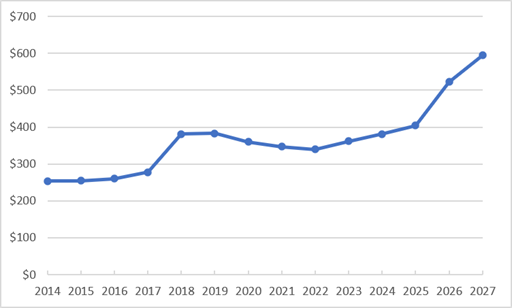
Source: KFF State Health Facts.
In reality, the cost picture is more complicated because people select plans other than the benchmark plan and the non-enhanced premium tax credit that remains operates on a sliding scale based on household income. The average per-person monthly plan cost $657 in Michigan in 2026, although after tax credits the average cost was $222 per month. For comparison, in 2025, those figures were $540 and $131 per month, respectively. This suggests that the average cost of a plan went up 22 percent in Michigan from 2025 to 2026, but the effective out-of-pocket cost went up 70 percent.
ACA marketplace enrollment may not fall by the same amount in 2027 as it did in 2026, but it is reasonable to expect the rising premiums could lead to further enrollment declines. The impact will likely be smaller than the first year following expiration, however. One reason for this is because the benchmark premium increases are smaller in 2027 than they were in 2026.
Another reason to expect smaller declines in 2027 is because one cohort of people who left the marketplace in 2026 did so because their tax credit went to $0, creating a significant spike in effective costs for a subset of consumers that will not re-occur each year even as prices rise. This occurred because the enhanced premium tax credit temporarily removed the maximum income limit for ACA tax credit eligibility (400 percent of the federal poverty line). As a result, people with incomes above that threshold received tax credits on the regular sliding scale between 2021 and 2025 that were completely eliminated rather than reduced like they were for people under that threshold.
While the premium increases on the ACA marketplaces have received considerable public attention, employer-based small group plans are also seeing cost increases. Survey data suggests that employer-based plans saw premiums increased at least five percent from 2025 to 2026, but reports indicate that increases in 2027 could be closer to nine percent. Analyzing employer-based plans is less of an exact science because group-based plans do not generate the same kind of comprehensive data as the ACA exchanges, and employers often adjust their plan features and cost-sharing structures to adapt to underlying costs, which can make it hard to zero in on the exact shifts. Instead of paying higher premiums, some employers opt to reduce coverage or increase employee cost sharing as an alternative response. Regardless of the precise numbers, it is clear that employer-based small group plans are getting more expensive, but at a slower rate than the ACA plans.
The costs of these plans are again driven in part by the general cost pressures such as inflation, tariffs, prescription medication, and AI, but also because of the dynamics in the health insurance arena. With Medicaid and ACA enrollment declining, insurers who operate in all three of those coverage streams will have to spread their fixed costs across a smaller number of enrollees. Similarly, the uninsured population is guaranteed treatment in emergency rooms under federal law and hospitals will have to absorb more of that uncompensated care as a result. Those costs get passed onto those who do have insurance, which drives up costs for those covered by all types of plans.
The State’s Options to Respond
With all of this coming into focus, Michigan’s new policymakers will need to put health care affordability near the top of the agenda in the new year. The problems are not Michigan specific, but the state’s residents are already dealing with lagging health outcomes and a tough economic situation. In this sense, the urgency to respond may be higher. The state cannot necessarily reverse the negative pressure entirely, but options exist to blunt some of the impact.
Minimize Medicaid Losses
The new Medicaid work requirements and more frequent eligibility determinations for the Expansion populations are certain to lead to enrollment declines that are costly to the state. However, the size of those declines will be, in part, a product of how effectively the state is able to manage the work requirement documentation and verification process.
The state has been preparing for this implementation for nearly 18 months., A process that works well and limits the coverage losses to the minimal estimates would be very valuable. The state needs to mount a strong public outreach campaign to make sure the people are aware of the changes to the program, but it also needs to prepare its internal processes to handle what is coming in the new year.
Part of that effort requires preparing its internal systems to automatically verify people using sources of information the state already has, but beyond that it will require more personnel who can process claims, send notices, and communicate with potential enrollees about issues in their paperwork before it impacts their coverage.
The Fiscal Year (FY)2027 state budget provided only about half of what the Executive Recommendation asked for to implement OBBBA. Another issue is that the new employee positions created as part of this funding were designated as “temporary” in the budget boilerplate language. While not binding on future budget negotiations, labeling these essential positions as temporary may have a negative impact on the state’s ability to recruit for these roles, potentially hindering effective implementation. Committing more resources to implementation infrastructure and personnel as soon as possible could give Michigan a better shot at hitting the low end of the Medicaid enrollment decline estimate.
A State ACA Tax Credit
A central reason why ACA marketplace enrollment has declined is because in 2026 the federal government decreased the subsidy it was providing to individuals who bought their coverage through the marketplaces. Some states have stepped up to offer their own tax credits to incentivize people to purchase coverage. Michigan could consider this path. The state probably cannot find the full $300 million in lost federal support without cuts to other programs or raising additional revenue, but it is likely that some people would continue to purchase coverage even with a smaller subsidy amount than what exists under current federal law. Since the subsidy would only be available to those who purchase coverage, the state could make it small enough to fit whatever money it wants to allocate for this purpose. Additionally, if it turns out that the incentive is too small to move the needle on enrollment, the money would not be lost beyond the administrative cost of the program, keeping the risk relatively low.
This kind of support could be particularly effective, as it would reduce the out-of-pocket costs for the people buying the plan, but getting more people into the market would also drive down the price of coverage per person across the board, which can produce a virtuous cycle.
Basic Health Plan
An option related to the idea of a state ACA tax credit, and a possible bridge for those losing Medicaid coverage in the coming year, would be the creation of a state Basic Health Plan. Under federal law, states can offer their own plan targeted at lower-income people who do not qualify for Medicaid. A basic health plan essentially functions as a competitor for ACA marketplace plans and receives federal funding equivalent to whatever ACA tax credits remain available to the individuals considering the plan. The value to the state in this case is that it can capture that federal support while also absorbing some of the remaining cost.
Three states and Washington, D.C., operate Basic Health Plans, and it is likely something other states will be considering in the coming years. While it would take time to implement and may not be an immediate solution, having a program that the state can scale up and down to meet the current state of support for health insurance coverage and the underlying economic conditions might offer it a way to manage coverage losses and price increases.
Other Support
In general, fewer people with coverage and more expensive coverage means the state should look for options to subsidize low-cost preventive care, medications, and/or immunizations in the hopes of avoiding an increase in emergency room visits and uncompensated care for hospitals. This is especially relevant given recent changes to federal vaccination policies.
It is also worth revisiting approaches to managing prescription drug costs and GLP-1, as well as considering how the state might regulate the use of AI in the health care industry.
The Broader Context of Health Care Policy in the United States
Given the federal nature of the U.S. health care system, the state is often constrained by actions at the federal level. For example, the health care system in Michigan was operating on the expectation that the Medicaid Expansion program was going to continue to operate a certain way, but OBBBA has upended that. To a lesser extent, the ACA enhanced premium tax credits became part of the fabric of the system over the last few years, but then they were allowed to expire.
Given the results of the recent congressional elections and the possibility that the next presidential administration could result in a Democratic trifecta, the federal government could end the Medicaid work requirements and expand ACA subsidies as early as 2029, but that is far from a guarantee. The state could take an approach that assumes an injection of federal money is two and half years away and it needs to simply build a bridge to that date. But inherent in that expectation is the idea that federal policy on these kinds of major programs is becoming less predictable. As Michigan considers how it intends to weather the present storm, the state should also be thinking about how to create policies that are designed to be resilient to fluctuations in federal funding for these programs.
Conclusion
Health insurance will be costlier than ever in Michigan in 2027 and the uninsured rate figures to be the highest it has been in many years. This dynamic will impact the state’s residents, economy, and health care sector and will be central to the state’s work in the coming year.
Michigan is not the only state facing these challenges, but it faces a particular urgency to address them to ensure that the state’s lagging health outcomes and economic conditions do not worsen.
With so many different factors converging at once to create these problems, the state can pull a variety of different levels and make some impact. The state needs to invest as much as it can in implementing Medicaid work requirements, but it also ought to consider ways to inject financial support into the private health insurance market to push people to keep their private plans rather than going uninsured. The state also needs to be ready to support lower cost preventative care and potentially aid struggling providers.
Michigan will likely not be able to prevent the coming disruption entirely, but every effort should be made to keep people covered, minimize the growth in insurance premiums, and mitigate the impact on the health care sector and broader economy.
