Subscribe
October 7, 2026

Assessing the Budget Outlook for FY2028

In a Nutshell

  • Michigan’s incoming governor and new cohort of legislators will face a GF/GP budget shortfall of at least $500 million when FY2028 budget deliberations begin next March
  • That shortfall could grow to nearly $700 million if policymakers want to maintain existing funding covering a wage uplift for direct care workers and the operations of Certified Community Behavioral Health Centers; policymakers maintained support for these in FY2027 but designated them as “one-time” appropriations
  • A recent Senate Fiscal Agency revenue update suggests the GF/GP revenue picture may be gloomier than expected, so new revenue estimates in January are unlikely to help with the budget outlook. That means the new governor and legislature will face tough choices involving some combination of significant budget cuts and/or tax increases to raise new revenue right out of the gate next year.

Next March, the first Executive Budget recommendation proposed by Michigan’s new governor will be released. That Fiscal Year (FY)2028 budget proposal will be received by a newly seated legislature, one that could bring changes in partisan leadership across the House and Senate following the upcoming November elections. Regardless of any changes to these political dynamics, however, one thing is clear: the FY2028 budget will be tight, particularly for discretionary General Fund/General Purpose (GF/GP) appropriations, which drive much of the debate during annual budget deliberations.

FY2028 Budget Will Face $500 Million GF/GP Challenge

State law requires that state budgets be based on revenue projections established through regular Consensus Revenue Estimating Conferences (CRECs) involving economists within the Department of Treasury and the two non-partisan legislative fiscal agencies – the House Fiscal Agency (HFA) and the Senate Fiscal Agency (SFA). The most recent conference, held in May, projects GF/GP revenue to grow by $391 million between FY2027 and FY2028, reflecting roughly 2.8 percent annual growth.

Taken alone, that is relatively good news. However, the revenue forecast covers only one side of the budget ledger. State costs are expected to grow even faster than GF/GP revenue for two key reasons. First, state appropriations must account for normal inflationary pressures, including Medicaid, other social services caseloads, and state employee payroll costs. Our July state budget report assumes roughly $380 million in new GF/GP costs from these adjustments.

Second, beyond those traditional cost pressures, Michigan is likely to incur additional GF/GP costs related to the Supplemental Nutrition Assistance Program (SNAP), which provides public assistance to low-income households to help cover food costs. SNAP benefit costs have traditionally been fully covered by the federal government, but the federal One Big Beautiful Bill Act (OBBBA) enacted in 2025 requires states to begin contributing toward these costs in FY2028. Each state’s cost share is tied to its most recent SNAP error rate for SNAP benefits, as determined by federal program audits. Based on the most recent published error rate data, Michigan will need to cover 10 percent of SNAP benefit payments to Michigan households, or about $320 million.

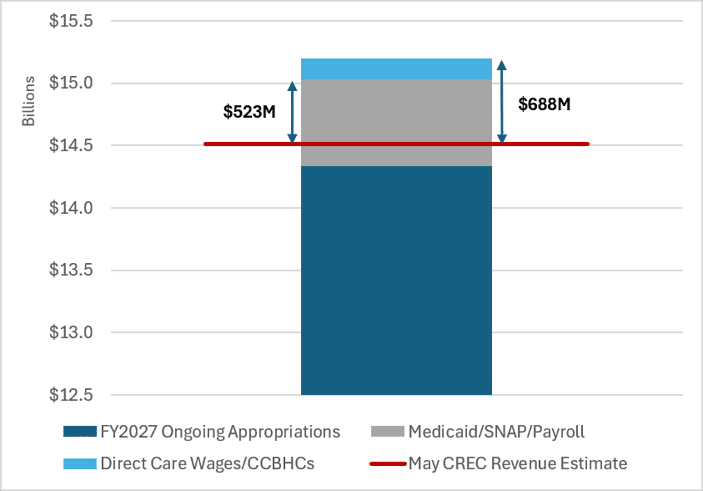
Adding those anticipated cost increases to ongoing GF/GP appropriations that would carry into the FY2028 state budget, our July report estimated that GF/GP appropriations would exceed ongoing GF/GP revenue by $523 million in FY2028. That means budget deliberations start out with hard decisions: either cut $523 million from existing FY2027 GF/GP appropriations (roughly a 3.5 percent reduction) or increase GF/GP revenues, most likely through tax increases, to achieve FY2028 budget balance.

The Challenge Could Be Even Larger

This $523 million estimated shortfall, however, relies on another important assumption. Each annual budget includes both “ongoing” appropriations (those that are part of the permanent base budget that would be reconsidered during the next budget cycle) and “one-time” appropriations (those designated as temporary and needed only during the current fiscal year). The estimated $532 million budget gap assumes that all one-time GF/GP appropriations within the FY2027 budget will go away in FY2028. It is important to note, however, that the FY2027 budget included shifts of what had traditionally been ongoing GF/GP appropriations for two major program initiatives to “one-time” funding.

The first shift concerns appropriations to cover a wage uplift for direct care workers who serve Medicaid clients. Direct care workers encompass a broad range of people who assist elderly and/or disabled individuals with personal care and daily living activities. This care can be provided in the home of the person receiving care or in a residential setting (e.g., nursing home, assisted living facilities).

The FY2027 budget includes $352 million (of which $119 million comes from GF/GP revenue) to support the continuation of an existing wage add-on for these workers and to recognize the costs of the state’s minimum wage increase that becomes effective in 2027 and statutorily required sick leave payments for these workers. However, that funding was included as part of the FY2027 one-time appropriations.

The same is true for a portion of state appropriations for Certified Community Behavioral Health Clinics (CCBHCs). CCBHCs provide behavioral health and substance use care to individuals regardless of their ability to pay for these services. Certification as a CCBHC requires the clinic to provide nine core services, either directly or indirectly,  to ensure its ability to provide comprehensive care to clients. The FY2027 budget includes $916 million in total funding ($165 million from GF/GP revenue) to support the operations of CCBHCs across the state as part of a federal demonstration project. However, just over 25 percent of that funding ($242 million total, $46 million GF/GP) was designated as a “one-time” appropriation.

Notably, neither of these programs faced any budget reductions when the FY2027 budget was enacted. Yet designating these as one-time rather than ongoing appropriations was imperative to ensure the FY2027 budget met at least the first criterion for being “structurally sound”: that ongoing GF/GP appropriations included in the FY2027 budget fit within expected FY2028 GF/GP revenue.

It also means that policymakers effectively passed the budget-balancing baton to the next governor and legislature, who will either have to absorb these reductions in their budget next year or find a different path to keeping the FY2028 budget in balance.

If Michigan’s new governor and legislature want to keep current funding intact for these initiatives in the FY2028 budget, they will need to add back $165 million in GF/GP appropriations.  Chart 1 summarizes the GF/GP budget outlook, accounting for both the known cost pressures discussed above and the potential costs of maintaining funding for these two programs.  Maintaining total FY2027 funding for the direct care worker wage adjustments and CCBHCs raises the budget shortfall facing policymakers in FY2028 from $523 million to $688 million.

Chart 1
Potential GF/GP Spending Relative to May Revenue Estimate
Source: Research Council calculations based on conference report and fiscal agency analyses for General Omnibus budget (SB 878). Revenue estimate from May 2026 Consensus Revenue Estimating Conference Executive Summary.

January Revenue Adjustments Probably Won’t Plug the GF/GP Hole

The projected shortfall, importantly, is based on revenue forecasts from the May 2026 CREC. The FY2028 Executive Budget, released next March, will instead be based on revised forecasts agreed to at next January’s CREC. If the revenue picture improves, any additional GF/GP revenue would help mitigate the expected shortfall.  Conversely, downgraded revenue projections will make matters worse. 

Fortunately, both HFA and SFA publish monthly revenue reports that are useful for monitoring changes in revenue trends between CREC meetings. However, there is a new wrinkle this year in interpreting these reports that both agencies have acknowledged; one that is tied to the bi-partisan road funding plan enacted in 2025.

A key element of that plan was exempting motor fuel from the sales tax but, at the same time, raising the motor fuel tax by 20 cents per gallon to yield an equivalent amount of revenue (around $1 billion annually). Since motor fuel tax revenue is primarily dedicated to road maintenance and repairs, this allowed policymakers to boost state road funding without significantly altering the overall tax burden at the pump.

Eliminating the sales tax on motor fuel, however, created other revenue challenges. More than 73 percent of sales tax revenue goes to the School Aid Fund (SAF) to fund public education. To address concerns from school groups about the revenue loss facing the SAF, the road funding legislation requires a direct transfer from GF/GP revenue to reimburse the SAF for any such revenue decline due to the new motor fuel exemption.  That transfer for FY2026 was estimated at $610 million at the May CREC, an amount that was baked into the resulting GF/GP and SAF estimates.

Here’s the new wrinkle: the fiscal agencies receive monthly reports from the Department of Treasury on total state revenue collections, but these reports reflect actual collections prior to the required GF/GP to SAF transfer.  In HFA and SFA monthly revenue reports, both agencies traditionally compare realized year-to-date revenues with what was expected under their CREC estimates for GF/GP and SAF through that reporting month. However, the required transfer means that approach no longer provides a reasonable apples-to-apples comparison.

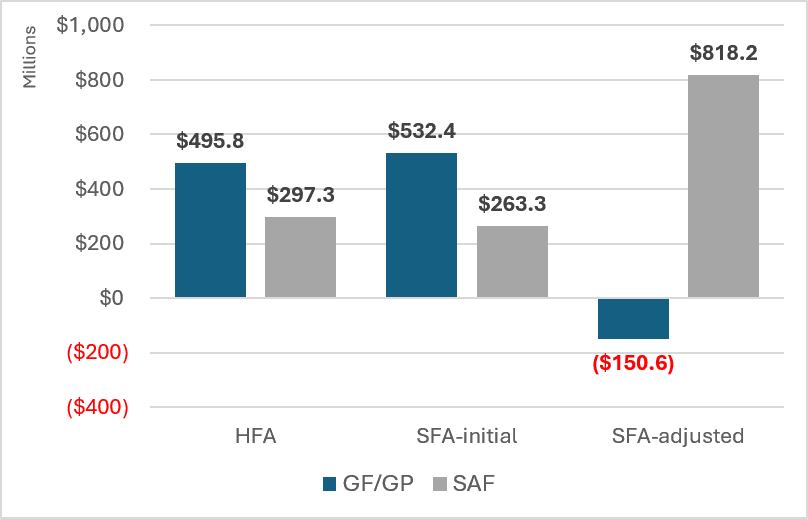
Chart 2 examines figures from recent fiscal agency reports covering revenue through August. HFA estimated that year-to-date GF/GP revenue was $496 million above its May estimate for that period. An initial report from SFA pegged the difference at $532 million. This sounds like good news on revenue, but in reality, it is not. Revenues are coming in above the May CREC estimate because that estimate was reduced by the estimated transfer to the SAF. The revenue reports used by the fiscal agencies aggregate total revenue before any transfer is effectuated. In short, these reports overstate the GF/GP gain and understate the SAF gain relative to the May estimates.

Both agencies noted this complicating factor in their reports, but a few weeks ago, the SFA went a step further by republishing its initial analysis and adjusting the year-to-date comparison to account for the required transfer.  Their conclusion: GF/GP was actually down by $151 million from the May estimate, and SAF was up by $818 million.  That is a huge swing from their initial estimates shown in Chart 2.

Chart 2
Actual Revenue Collections Relative to May Estimates through August 2026
Source: Compiled from  House Fiscal Agency and Senate Fiscal Agency monthly revenue reports for August 2026.

To be sure, these revenue estimates are always subject to a margin of error as they rely on each agency’s forecast of the timing of revenue collections across all 12 months of the fiscal year, and that timing shifts from year to year. The analytical challenge of controlling for the new required GF/GP to SAF transfer adds yet another layer of uncertainty.

Still, the SFA’s initial attempt at an apples-to-apples comparison paints a much gloomier picture for GF/GP revenue in FY2026. The revenue trends through August suggest that GF/GP revenue will, at best, be near what was projected in May and, at worst, will be adjusted further downward.

Re-Evaluating the FY2028 Budget Shortfall

Given these factors, the $532 million GF/GP shortfall facing the incoming governor and new cohort of state lawmakers next year should be considered a lower-bound estimate. If, through the budgeting process, they decide to preserve the wage uplift for direct care workers and maintain full funding for CCBHCs consistent with the FY2027 enacted budget, GF/GP needs would increase by about $165 million.  Further, while any changes to GF/GP revenue estimates won’t be formalized until January, the best available analysis suggests the risk of a revenue downgrade is greater than the likelihood of an improvement in the GF/GP forecast.

The new administration and legislature should prepare to face a GF/GP shortfall in the range of $500 million to $800 million (roughly 3 to 5 percent of the overall GF/GP budget) when they begin work in March on the FY2028 budget.  That means some combination of significant budget cuts and/or tax increases to raise new revenue right out of the gate.

While the SAF revenue picture looks much stronger, K-12 school advocates will need to wait and see whether some of that revenue growth will be tapped for what has become a common strategy in dealing with GF/GP budget challenges: tapping additional SAF revenue for public universities to replace current GF/GP-funded operating support for those institutions.

The November election will determine the political make-up of both the gubernatorial and legislative leadership for the next two years.  Budget challenges await the victors.

About The Author

Bob Schneider

Assessing the Budget Outlook for FY2028

In a Nutshell

  • Michigan’s incoming governor and new cohort of legislators will face a GF/GP budget shortfall of at least $500 million when FY2028 budget deliberations begin next March
  • That shortfall could grow to nearly $700 million if policymakers want to maintain existing funding covering a wage uplift for direct care workers and the operations of Certified Community Behavioral Health Centers; policymakers maintained support for these in FY2027 but designated them as “one-time” appropriations
  • A recent Senate Fiscal Agency revenue update suggests the GF/GP revenue picture may be gloomier than expected, so new revenue estimates in January are unlikely to help with the budget outlook. That means the new governor and legislature will face tough choices involving some combination of significant budget cuts and/or tax increases to raise new revenue right out of the gate next year.

Next March, the first Executive Budget recommendation proposed by Michigan’s new governor will be released. That Fiscal Year (FY)2028 budget proposal will be received by a newly seated legislature, one that could bring changes in partisan leadership across the House and Senate following the upcoming November elections. Regardless of any changes to these political dynamics, however, one thing is clear: the FY2028 budget will be tight, particularly for discretionary General Fund/General Purpose (GF/GP) appropriations, which drive much of the debate during annual budget deliberations.

FY2028 Budget Will Face $500 Million GF/GP Challenge

State law requires that state budgets be based on revenue projections established through regular Consensus Revenue Estimating Conferences (CRECs) involving economists within the Department of Treasury and the two non-partisan legislative fiscal agencies – the House Fiscal Agency (HFA) and the Senate Fiscal Agency (SFA). The most recent conference, held in May, projects GF/GP revenue to grow by $391 million between FY2027 and FY2028, reflecting roughly 2.8 percent annual growth.

Taken alone, that is relatively good news. However, the revenue forecast covers only one side of the budget ledger. State costs are expected to grow even faster than GF/GP revenue for two key reasons. First, state appropriations must account for normal inflationary pressures, including Medicaid, other social services caseloads, and state employee payroll costs. Our July state budget report assumes roughly $380 million in new GF/GP costs from these adjustments.

Second, beyond those traditional cost pressures, Michigan is likely to incur additional GF/GP costs related to the Supplemental Nutrition Assistance Program (SNAP), which provides public assistance to low-income households to help cover food costs. SNAP benefit costs have traditionally been fully covered by the federal government, but the federal One Big Beautiful Bill Act (OBBBA) enacted in 2025 requires states to begin contributing toward these costs in FY2028. Each state’s cost share is tied to its most recent SNAP error rate for SNAP benefits, as determined by federal program audits. Based on the most recent published error rate data, Michigan will need to cover 10 percent of SNAP benefit payments to Michigan households, or about $320 million.

Adding those anticipated cost increases to ongoing GF/GP appropriations that would carry into the FY2028 state budget, our July report estimated that GF/GP appropriations would exceed ongoing GF/GP revenue by $523 million in FY2028. That means budget deliberations start out with hard decisions: either cut $523 million from existing FY2027 GF/GP appropriations (roughly a 3.5 percent reduction) or increase GF/GP revenues, most likely through tax increases, to achieve FY2028 budget balance.

The Challenge Could Be Even Larger

This $523 million estimated shortfall, however, relies on another important assumption. Each annual budget includes both “ongoing” appropriations (those that are part of the permanent base budget that would be reconsidered during the next budget cycle) and “one-time” appropriations (those designated as temporary and needed only during the current fiscal year). The estimated $532 million budget gap assumes that all one-time GF/GP appropriations within the FY2027 budget will go away in FY2028. It is important to note, however, that the FY2027 budget included shifts of what had traditionally been ongoing GF/GP appropriations for two major program initiatives to “one-time” funding.

The first shift concerns appropriations to cover a wage uplift for direct care workers who serve Medicaid clients. Direct care workers encompass a broad range of people who assist elderly and/or disabled individuals with personal care and daily living activities. This care can be provided in the home of the person receiving care or in a residential setting (e.g., nursing home, assisted living facilities).

The FY2027 budget includes $352 million (of which $119 million comes from GF/GP revenue) to support the continuation of an existing wage add-on for these workers and to recognize the costs of the state’s minimum wage increase that becomes effective in 2027 and statutorily required sick leave payments for these workers. However, that funding was included as part of the FY2027 one-time appropriations.

The same is true for a portion of state appropriations for Certified Community Behavioral Health Clinics (CCBHCs). CCBHCs provide behavioral health and substance use care to individuals regardless of their ability to pay for these services. Certification as a CCBHC requires the clinic to provide nine core services, either directly or indirectly,  to ensure its ability to provide comprehensive care to clients. The FY2027 budget includes $916 million in total funding ($165 million from GF/GP revenue) to support the operations of CCBHCs across the state as part of a federal demonstration project. However, just over 25 percent of that funding ($242 million total, $46 million GF/GP) was designated as a “one-time” appropriation.

Notably, neither of these programs faced any budget reductions when the FY2027 budget was enacted. Yet designating these as one-time rather than ongoing appropriations was imperative to ensure the FY2027 budget met at least the first criterion for being “structurally sound”: that ongoing GF/GP appropriations included in the FY2027 budget fit within expected FY2028 GF/GP revenue.

It also means that policymakers effectively passed the budget-balancing baton to the next governor and legislature, who will either have to absorb these reductions in their budget next year or find a different path to keeping the FY2028 budget in balance.

If Michigan’s new governor and legislature want to keep current funding intact for these initiatives in the FY2028 budget, they will need to add back $165 million in GF/GP appropriations.  Chart 1 summarizes the GF/GP budget outlook, accounting for both the known cost pressures discussed above and the potential costs of maintaining funding for these two programs.  Maintaining total FY2027 funding for the direct care worker wage adjustments and CCBHCs raises the budget shortfall facing policymakers in FY2028 from $523 million to $688 million.

Chart 1
Potential GF/GP Spending Relative to May Revenue Estimate

Source: Research Council calculations based on conference report and fiscal agency analyses for General Omnibus budget (SB 878). Revenue estimate from May 2026 Consensus Revenue Estimating Conference Executive Summary.

January Revenue Adjustments Probably Won’t Plug the GF/GP Hole

The projected shortfall, importantly, is based on revenue forecasts from the May 2026 CREC. The FY2028 Executive Budget, released next March, will instead be based on revised forecasts agreed to at next January’s CREC. If the revenue picture improves, any additional GF/GP revenue would help mitigate the expected shortfall.  Conversely, downgraded revenue projections will make matters worse. 

Fortunately, both HFA and SFA publish monthly revenue reports that are useful for monitoring changes in revenue trends between CREC meetings. However, there is a new wrinkle this year in interpreting these reports that both agencies have acknowledged; one that is tied to the bi-partisan road funding plan enacted in 2025.

A key element of that plan was exempting motor fuel from the sales tax but, at the same time, raising the motor fuel tax by 20 cents per gallon to yield an equivalent amount of revenue (around $1 billion annually). Since motor fuel tax revenue is primarily dedicated to road maintenance and repairs, this allowed policymakers to boost state road funding without significantly altering the overall tax burden at the pump.

Eliminating the sales tax on motor fuel, however, created other revenue challenges. More than 73 percent of sales tax revenue goes to the School Aid Fund (SAF) to fund public education. To address concerns from school groups about the revenue loss facing the SAF, the road funding legislation requires a direct transfer from GF/GP revenue to reimburse the SAF for any such revenue decline due to the new motor fuel exemption.  That transfer for FY2026 was estimated at $610 million at the May CREC, an amount that was baked into the resulting GF/GP and SAF estimates.

Here’s the new wrinkle: the fiscal agencies receive monthly reports from the Department of Treasury on total state revenue collections, but these reports reflect actual collections prior to the required GF/GP to SAF transfer.  In HFA and SFA monthly revenue reports, both agencies traditionally compare realized year-to-date revenues with what was expected under their CREC estimates for GF/GP and SAF through that reporting month. However, the required transfer means that approach no longer provides a reasonable apples-to-apples comparison.

Chart 2 examines figures from recent fiscal agency reports covering revenue through August. HFA estimated that year-to-date GF/GP revenue was $496 million above its May estimate for that period. An initial report from SFA pegged the difference at $532 million. This sounds like good news on revenue, but in reality, it is not. Revenues are coming in above the May CREC estimate because that estimate was reduced by the estimated transfer to the SAF. The revenue reports used by the fiscal agencies aggregate total revenue before any transfer is effectuated. In short, these reports overstate the GF/GP gain and understate the SAF gain relative to the May estimates.

Both agencies noted this complicating factor in their reports, but a few weeks ago, the SFA went a step further by republishing its initial analysis and adjusting the year-to-date comparison to account for the required transfer.  Their conclusion: GF/GP was actually down by $151 million from the May estimate, and SAF was up by $818 million.  That is a huge swing from their initial estimates shown in Chart 2.

Chart 2
Actual Revenue Collections Relative to May Estimates through August 2026

Source: Compiled from  House Fiscal Agency and Senate Fiscal Agency monthly revenue reports for August 2026.

To be sure, these revenue estimates are always subject to a margin of error as they rely on each agency’s forecast of the timing of revenue collections across all 12 months of the fiscal year, and that timing shifts from year to year. The analytical challenge of controlling for the new required GF/GP to SAF transfer adds yet another layer of uncertainty.

Still, the SFA’s initial attempt at an apples-to-apples comparison paints a much gloomier picture for GF/GP revenue in FY2026. The revenue trends through August suggest that GF/GP revenue will, at best, be near what was projected in May and, at worst, will be adjusted further downward.

Re-Evaluating the FY2028 Budget Shortfall

Given these factors, the $532 million GF/GP shortfall facing the incoming governor and new cohort of state lawmakers next year should be considered a lower-bound estimate. If, through the budgeting process, they decide to preserve the wage uplift for direct care workers and maintain full funding for CCBHCs consistent with the FY2027 enacted budget, GF/GP needs would increase by about $165 million.  Further, while any changes to GF/GP revenue estimates won’t be formalized until January, the best available analysis suggests the risk of a revenue downgrade is greater than the likelihood of an improvement in the GF/GP forecast.

The new administration and legislature should prepare to face a GF/GP shortfall in the range of $500 million to $800 million (roughly 3 to 5 percent of the overall GF/GP budget) when they begin work in March on the FY2028 budget.  That means some combination of significant budget cuts and/or tax increases to raise new revenue right out of the gate.

While the SAF revenue picture looks much stronger, K-12 school advocates will need to wait and see whether some of that revenue growth will be tapped for what has become a common strategy in dealing with GF/GP budget challenges: tapping additional SAF revenue for public universities to replace current GF/GP-funded operating support for those institutions.

The November election will determine the political make-up of both the gubernatorial and legislative leadership for the next two years.  Budget challenges await the victors.

  • Permission to reprint our Briefs in whole or in part is hereby granted, provided that the Citizens Research Council of Michigan is properly cited.

  • Recent Posts

  • Stay informed of new research published and other Citizens Research Council news.
    [ctct form="10424" show_title="false"]

    About The Author

    Bob Schneider

    Latest Research Posts

    Back To Top

    Join our email/text message lists to stay connected with the Citizens Research Council. In addition to a weekly newsletter, you will receive emails notifying you of new publications, event invitations, and related information. We promise not to overburden your inbox.

    Preference(Required)
    How do you prefer to receive information?