
Subscribe
  • Permission to reprint this blog post in whole or in part is hereby granted, provided that the Citizens Research Council of Michigan is properly cited.

  • Recent Posts

  • Stay informed of new research published and other Citizens Research Council news.
    April 9, 2026

    The Good News of Detroit’s Reduced Homicide Rates, but Peer City Analysis Shows More Work to be Done

    In A Nutshell

    • FBI data show that Detroit’s homicide rate in 2024 was 31.4 homicides per 100,000 residents. It has declined significantly from a recent high of 49.5 homicides per 100,000 residents in 2022. Even with this decline, it has consistently been higher than homicides rates of its peer cities since 2016. Three (out of six) peer cities and Detroit have had sizable declines in their homicide rate from 2019 to 2024.
    • Despite historic declines in Detroit homicides, continued progress reducing Detroit’s homicide rate must be a focus if the city wishes to achieve rates of homicide similar to or better than those observed in peer cities.
    • While the city launched several public safety programs aimed at reducing crime, for long lasting improvements the Research Council recommends that the Sheffield Administration focus on addressing the social determinants of homicide, which include poverty, income inequality, and family disruption/divorce based on this analysis and existing homicide research.

    Homicide is a serious crime and a key measure of violent crime. Homicide can be viewed as both a social problem, as it is a threat to community order, and a public health problem that needs to be prevented through violence prevention and reduction of risk factors.

    The current narrative across the nation is that homicides are hitting historic lows. Detroit homicides in 2025 were the lowest recorded since 1964, which Mayor Sheffield attributed to a “holistic approach” the city has taken on crime. This mirrors the national trend where the U.S. violent crime rate has declined since peaking in the early 1990s.

    Detroit is tackling the problem of criminal homicides in several ways. The city’s last four annual budgets devoted the largest share of its general operating fund to its police department. Additionally, a slew of public safety programs were launched during the Duggan Administration such as Shotspotter, a $7 million gun detection technology that alerts the Detroit Police Department (DPD) of gunshot activity using audio sensors in neighborhoods with high gun rates. Other public safety programs include the Community Violence InterventionProject Green Light, and the Summer Teen Safety Prevention Plan. Mayor Sheffield has signaled that violence prevention is a priority through her recent executive order to establish a new Office of Neighborhood and Community Safety focused on violence prevention and community safety.

    The prioritization of public safety by residents and the heavy spending of taxpayer funds on policing underscores the need to examine Detroit crime as a major public policy issue and identify policy options that can sustain Detroit’s continued revitalization.

    However, beyond the focus on public safety and the programs intended to mitigate crime and create a greater sense of safety, the city’s policy efforts should focus on addressing the social determinants of homicide that foster cultures of crime, incentivize risk-taking behaviors, and weaken informal social control in neighborhoods. This includes efforts to address poverty, income inequality, family disruption, and social disorganization. Addressing these social determinants will pay long-term dividends in many social and economic ways beyond the goal of reducing homicide rates.

    This is the Research Council’s second report in a series about crime in Detroit and across peer cities. Future reports will examine property crime, other forms of violent crime, the public safety budget, and differences in crime rates across the state, metro area, and neighborhood-level.  

    Background

    Homicide is part of a broader universe of criminal activity that includes property crime, delinquency, and other violent crime like assault. Based on legal definitions, homicide is when one person causes the death of another. Homicide can be both unlawful and lawful. For example, murder is the unlawful killing of another person and is a category of homicide. First-degree murder and second-degree murder are intentional homicide crimes. Manslaughter is homicide where a person kills another person and where there may not have been intent, but the person’s actions still lead to another person’s death. Justifiable homicide is when a person kills in self-defense. Felony murder is when a person dies while the preparator is committing a violent felony, even if they did not cause the death. For the purposes of this paper, any reference to homicide refers to the Federal Bureau of Investigation (FBI) definition of criminal homicide which includes murder and nonnegligent manslaughter and excludes homicide from negligence, suicide, and justifiable homicide.  

    Homicide falls into three major typologies or classifications. According to the United Nations (UN) Global Study on Homicide, homicides include three major categories:

    • homicide related to criminal groups or criminal activities such as robbery,
    • interpersonal homicide related to intimate partners, family members, or interpersonal relationships such as acquaintances, and
    • sociopolitical homicide related to social prejudice, political aims, and sociopolitical agendas (e.g., killings by police and terrorist groups).

    The UN Global Study also notes the role of criminal groups, men, and guns in relation to homicide. For example, men are disproportionately the perpetrators and victims of homicide globally. Additionally, guns can increase the speed and scale of homicide, and weak oversight and control and impunity of firearm use are determinants of lethal violence. Criminal groups often resort to violence, but in some countries the presence of organized crime does not impact homicide rates.

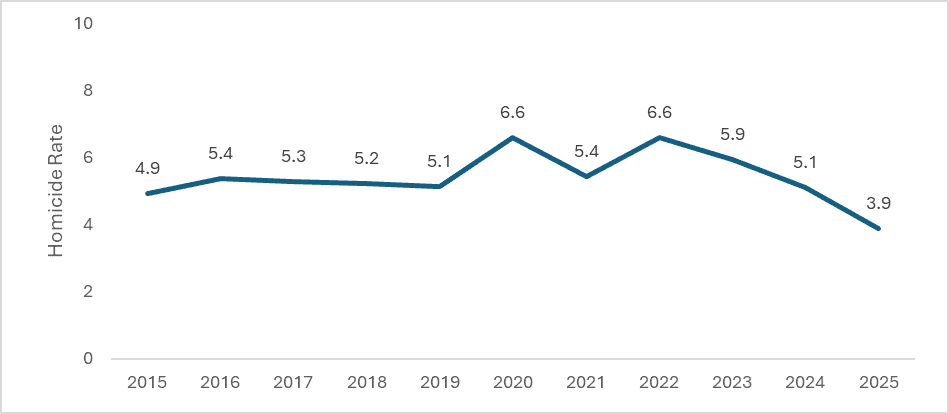
    Nationally, homicides have returned to pre-pandemic levels and are trending down. FBI homicide data from 2015 to 2025 shows that the U.S. homicide rate returned to its pre-pandemic level in 2024 (see Chart 1). According to the Council on Criminal Justice (CCJ), the average homicide rate among 35 large U.S. cities in 2025 was 21 percent lower than in 2019. The report also notes that 2025 may be the lowest homicide rate ever recorded. This conclusion is supported by 2025 FBI homicide data and U.S. Census Bureau population estimates which indicate that the 2025 homicide rate is 3.9 homicides per 100,000 people. Based on a 1975 Centers for Disease Control and Prevention report, the homicide rate in 1910 was above 4.0 homicides per 100,000 population.  Potential factors behind this decline may include young people spending more time at home and declines in substance use but further research is needed to understand this trend.

    Chart 1
    U.S. Homicide Rate Per 100,000 population, 2015 to 20251
    Source: FBI Uniform Crime Reporting; American Community Survey 5-Year Estimates Data Profiles; Population Estimates Program

    Social Determinants of Homicide

    Many studies have linked homicide with both poverty and income inequality. The driving theory behind this relationship is resource deprivation; when individuals or groups lack resources and are in a state of material disadvantage. The theory asserts that income inequality or resource deprivation leads to feelings of frustration and resentment, which in turn increases the likelihood of violence and burglary. A 2023 paper expanded on resource deprivation as it relates to homicide by grounding it in general evolutionary theory. The theory posits that “individuals with limited wealth and income may have incentives to undertake high-risk activities – including those that lead to lethal violence – in order to access material and social capital.” In short, resource deprivation plays a strong role in the cost and benefits of risk-taking behaviors that lead to homicide and violent crime.

    Family disruption or divorce is another major predictor of homicide. According to a 2011 paper, family disruption can have impacts on individuals, families, and communities. Divorce makes conflicts more likely, which can lead to interpersonal violence and adverse impacts on children, including higher levels of delinquency. Family disruption can weaken informal social control in communities and allow violent crime to flourish in neighborhoods. Family disruption is a strong predictor of higher homicide rates in states, counties, metro areas, and cities.

    Social disorganization, another major theory of crime, posits that the breakdown of social cohesion in communities impacts rates of crime, including rates of violence and homicide. Both family disruption and poverty can weaken social cohesion and informal social control in communities, which can allow crime to become more common. A 1997 paper analyzing the effect of collective efficacy or social cohesion in Chicago neighborhoods found that social control and social cohesion were robust predictors of lower rates of violence.

    While beyond the scope of this paper to discuss every determinant of homicide, suffice to say that homicide is a “multifactorial event.” Other major factors of homicide are psychological, developmental, physiological, and developmental. Some research also links homicide rates with ambient temperature, city greenness, firearms, and structural racism. For the purposes of this paper, we focus on major social determinants or predictors of homicide.

    Trend and Peer City Comparisons

    Our earlier paper, Crime in the City – Identifying Detroit’s Peer Cities, identified six peer cities to compare Detroit and its criminal activity. We used homicide data from the FBI UCR program and calculated homicides per 100,000 people using population data from the American Community Survey (ACS).

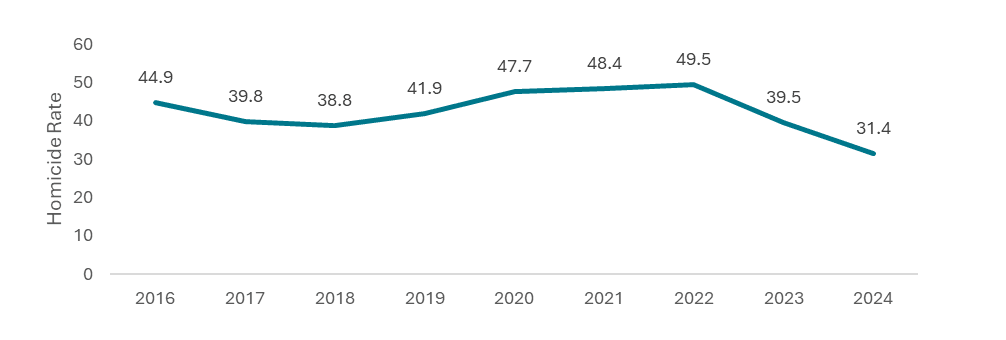
    Detroit’s homicide rate has been on a steady decline since its peak during the COVID-19 pandemic, mirroring national trends. According to FBI data, Detroit’s homicide rate in 2024 was 31.4 per 100,000 people, a 37 percent decline from 2022 (see Chart 2). Assuming little-to-no population growth, Detroit is on track in 2025 to have the lowest homicide rate observed in the last decade. The U.S. homicide rate in 2024 was 5.1 per 100,000 people, a 23 percent decline from 2022 (see Chart 1).

    Chart 2
    Detroit Homicides Per 100,000 People, 2016 to 2024
    Source: FBI Uniform Crime Reporting; American Community Survey 1-Year and 5-Year Estimates Data Profiles

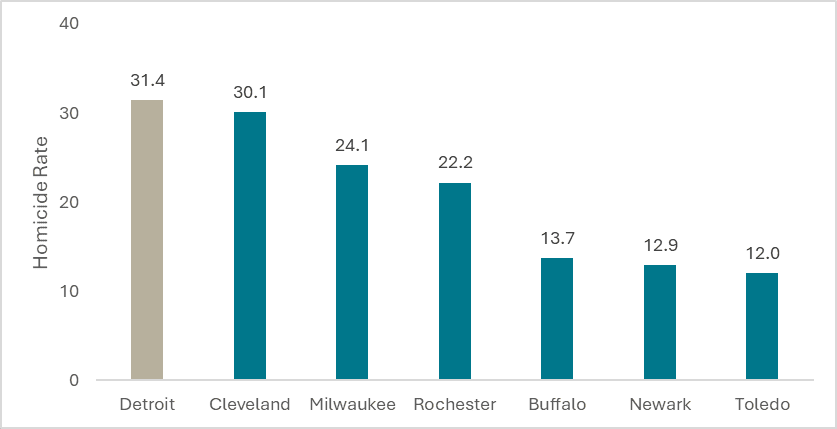
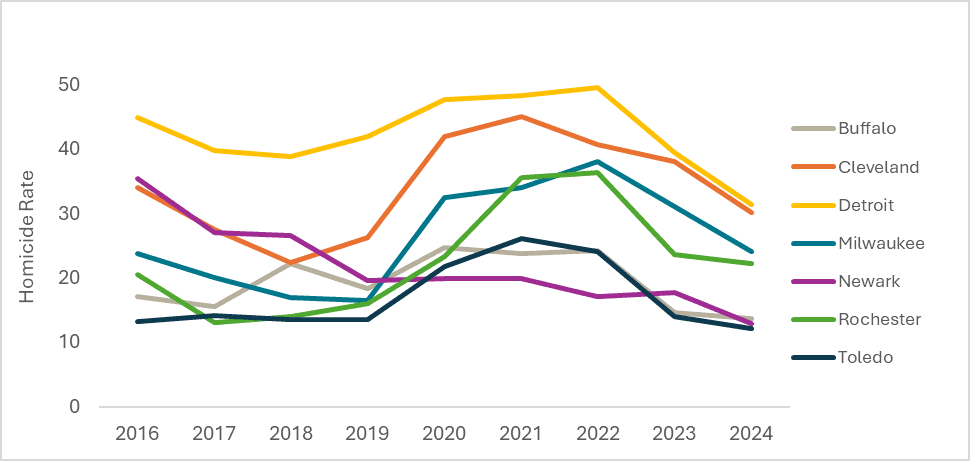
    While there is positive news looking at Detroit’s homicide rate over time, that picture of progress changes when we compare Detroit to its peer cities. Detroit’s homicide rate is the highest among six peer cities with similar social and demographic characteristics. Detroit’s homicide rate is more than twice the rate of Buffalo, Newark, and Toledo (see Chart 3). Milwaukee and Rochester have rates that are at least seven homicides per 100,000 population less compared to Detroit. Cleveland’s homicide rate of 30.1 per 100,000 people is the only peer city that falls into a similar range as Detroit. As shown in Chart 4, Detroit’s homicide rate has consistently remained above the homicide rates of peer cities.

    Chart 3
    Detroit Homicides Per 100,000 People Compared to Peer Cities, 2024
    Source: FBI Uniform Crime Reporting; American Community Survey 1-Year Estimates Data Profiles

    Chart 4
    Homicide Rate Per 100,000 People for Detroit and Peer Cities, 2016 to 2024
    Source: FBI Uniform Crime Reporting; American Community Survey 1-Year and 5-Year Estimates Data Profiles

    Between 2016 to 2024, the homicide rates in Detroit and its peer cities have been on the decline after  rising at the onset of the pandemic in 2020. In Chart 4, we can see that Detroit’s homicide rate declined rapidly beginning in 2022, but it continues to be consistently higher than peer cities.

    In 2024, Detroit and its peer cities experienced homicide rate declines ranging from 5.7 to 27 percent. Detroit’s homicide rate declined by 20.4 percent in 2024, similar to Cleveland (20.9 percent), Milwaukee (22.1 percent), and Newark (27 percent). Nationally, the homicide rate declined by 13.9 percent in 2024. In that regard, Detroit homicides in 2024 are declining similarly to peer cities and declining faster than the national homicide rate.

    From 2019 to 2024, Detroit’s homicide rate fell by 25 percent. Peer cities of Newark (31.8 percent) and Buffalo (25.4 percent) experienced similar declines. Toledo had a smaller decline (11.2 percent) over this period, while Cleveland, Milwaukee, and Rochester had large increases. In short, half of the peer cities and Detroit have had sizable declines in their homicide rate since 2019 while the remaining three peer cities experienced increases.

    Discussion

    While Detroit has experienced a rapid decline in its homicide rate since 2022, the city still has more work to do if it wants to match the homicide rates its peers. Since 2016, Detroit’s homicide rate has been consistently higher than all peer cities we examined and much higher than the national homicide rate. Only Cleveland’s homicide rate came close to Detroit’s.

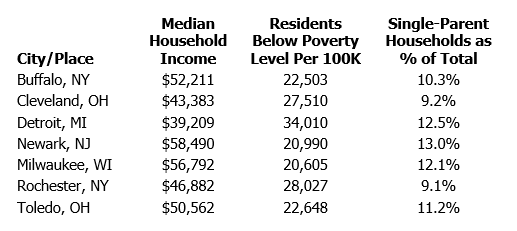
    As discussed, poverty and income inequality are social determinants of homicide. Among the peer cities, Detroit has both the lowest median household income and the highest share of residents living in poverty line (see Table 1). Detroit still has progress to be made to reduce poverty and income inequality of its residents. Addressing these structural determinants of homicide will likely reduce violence in the city. As leading criminology experts discuss, strategies beyond informal social control and policing should be considered to address the social and ecological challenges faced in cities. For example, there is some evidence that housing vouchers that move youth out of high-poverty neighborhoods can reduce violent crime arrests and cash-transfers to youth in high-risk of violence can support healthier behaviors.

    Table 1
    Poverty Indicators and Single-Parent Households in Peer Cities
    The latest Detroit Economic Outlook report demonstrates that the Detroit economy is resilient and that steady gains in employment, wages, and household income are forecasted. However, a sizable gap is expected to remain between average wages earned at Detroit establishments and Detroit residents’ average wages. Thus, wage inequality is forecasted to be a persistent problem in Detroit. Two seminal books on racial inequality suggest that addressing income inequality in Detroit is not just a matter of economic development but also a matter of addressing racial segregation and intergenerational poverty.

    Family disruption and divorce are major predictors of homicide, likely exacerbating the homicide rate in Detroit. Among the peer cities, Detroit has the second highest share of single-parent households with children (see Table 1). Research has established a relationship between divorce and higher levels of interpersonal violence. Additionally, divorce has adverse impacts on children and can weaken informal social control at the community-level.

    In short, this suggests that a priority for the Sheffield Administration should be family stability. A report from the Institute of Family Studies found that violent crime is lower in cities with more two-parent families and recommends realigning “material and cultural incentives in our cities to favor marriage and stable families”. Their policy recommendations included strengthening education and workforce development prior to parenthood and guiding young adults not on a college track towards vocation and apprenticeship programs.

    The Sheffield Administration must address the social determinants of homicide when it comes to tackling violent crime and homicide in Detroit. While policing is often the focus of public safety efforts, the data and research on homicide suggests that structural factors such as poverty and family disruption are driving Detroit’s higher homicide rate. Addressing these structural factors will be key to creating safer neighborhoods.


    Footnotes

    1. ↩︎

    The 2025 American Community Survey was not available at the time of writing this report. Therefore, the U.S. Census Bureau’s Population Estimates Program was used to calculate a homicide rate for 2025 using the estimate for the U.S. total resident population. 

    About The Author

    Douglas Ortiz

    The Good News of Detroit’s Reduced Homicide Rates, but Peer City Analysis Shows More Work to be Done

    In A Nutshell

    • FBI data show that Detroit’s homicide rate in 2024 was 31.4 homicides per 100,000 residents. It has declined significantly from a recent high of 49.5 homicides per 100,000 residents in 2022. Even with this decline, it has consistently been higher than homicides rates of its peer cities since 2016. Three (out of six) peer cities and Detroit have had sizable declines in their homicide rate from 2019 to 2024.
    • Despite historic declines in Detroit homicides, continued progress reducing Detroit’s homicide rate must be a focus if the city wishes to achieve rates of homicide similar to or better than those observed in peer cities.
    • While the city launched several public safety programs aimed at reducing crime, for long lasting improvements the Research Council recommends that the Sheffield Administration focus on addressing the social determinants of homicide, which include poverty, income inequality, and family disruption/divorce based on this analysis and existing homicide research.

    Homicide is a serious crime and a key measure of violent crime. Homicide can be viewed as both a social problem, as it is a threat to community order, and a public health problem that needs to be prevented through violence prevention and reduction of risk factors.

    The current narrative across the nation is that homicides are hitting historic lows. Detroit homicides in 2025 were the lowest recorded since 1964, which Mayor Sheffield attributed to a “holistic approach” the city has taken on crime. This mirrors the national trend where the U.S. violent crime rate has declined since peaking in the early 1990s.

    Detroit is tackling the problem of criminal homicides in several ways. The city’s last four annual budgets devoted the largest share of its general operating fund to its police department. Additionally, a slew of public safety programs were launched during the Duggan Administration such as Shotspotter, a $7 million gun detection technology that alerts the Detroit Police Department (DPD) of gunshot activity using audio sensors in neighborhoods with high gun rates. Other public safety programs include the Community Violence InterventionProject Green Light, and the Summer Teen Safety Prevention Plan. Mayor Sheffield has signaled that violence prevention is a priority through her recent executive order to establish a new Office of Neighborhood and Community Safety focused on violence prevention and community safety.

    The prioritization of public safety by residents and the heavy spending of taxpayer funds on policing underscores the need to examine Detroit crime as a major public policy issue and identify policy options that can sustain Detroit’s continued revitalization.

    However, beyond the focus on public safety and the programs intended to mitigate crime and create a greater sense of safety, the city’s policy efforts should focus on addressing the social determinants of homicide that foster cultures of crime, incentivize risk-taking behaviors, and weaken informal social control in neighborhoods. This includes efforts to address poverty, income inequality, family disruption, and social disorganization. Addressing these social determinants will pay long-term dividends in many social and economic ways beyond the goal of reducing homicide rates.

    This is the Research Council’s second report in a series about crime in Detroit and across peer cities. Future reports will examine property crime, other forms of violent crime, the public safety budget, and differences in crime rates across the state, metro area, and neighborhood-level.  

    Background

    Homicide is part of a broader universe of criminal activity that includes property crime, delinquency, and other violent crime like assault. Based on legal definitions, homicide is when one person causes the death of another. Homicide can be both unlawful and lawful. For example, murder is the unlawful killing of another person and is a category of homicide. First-degree murder and second-degree murder are intentional homicide crimes. Manslaughter is homicide where a person kills another person and where there may not have been intent, but the person’s actions still lead to another person’s death. Justifiable homicide is when a person kills in self-defense. Felony murder is when a person dies while the preparator is committing a violent felony, even if they did not cause the death. For the purposes of this paper, any reference to homicide refers to the Federal Bureau of Investigation (FBI) definition of criminal homicide which includes murder and nonnegligent manslaughter and excludes homicide from negligence, suicide, and justifiable homicide.  

    Homicide falls into three major typologies or classifications. According to the United Nations (UN) Global Study on Homicide, homicides include three major categories:

    • homicide related to criminal groups or criminal activities such as robbery,
    • interpersonal homicide related to intimate partners, family members, or interpersonal relationships such as acquaintances, and
    • sociopolitical homicide related to social prejudice, political aims, and sociopolitical agendas (e.g., killings by police and terrorist groups).

    The UN Global Study also notes the role of criminal groups, men, and guns in relation to homicide. For example, men are disproportionately the perpetrators and victims of homicide globally. Additionally, guns can increase the speed and scale of homicide, and weak oversight and control and impunity of firearm use are determinants of lethal violence. Criminal groups often resort to violence, but in some countries the presence of organized crime does not impact homicide rates.

    Nationally, homicides have returned to pre-pandemic levels and are trending down. FBI homicide data from 2015 to 2025 shows that the U.S. homicide rate returned to its pre-pandemic level in 2024 (see Chart 1). According to the Council on Criminal Justice (CCJ), the average homicide rate among 35 large U.S. cities in 2025 was 21 percent lower than in 2019. The report also notes that 2025 may be the lowest homicide rate ever recorded. This conclusion is supported by 2025 FBI homicide data and U.S. Census Bureau population estimates which indicate that the 2025 homicide rate is 3.9 homicides per 100,000 people. Based on a 1975 Centers for Disease Control and Prevention report, the homicide rate in 1910 was above 4.0 homicides per 100,000 population.  Potential factors behind this decline may include young people spending more time at home and declines in substance use but further research is needed to understand this trend.

    Chart 1
    U.S. Homicide Rate Per 100,000 population, 2015 to 20251

    Source: FBI Uniform Crime Reporting; American Community Survey 5-Year Estimates Data Profiles; Population Estimates Program

    Social Determinants of Homicide

    Many studies have linked homicide with both poverty and income inequality. The driving theory behind this relationship is resource deprivation; when individuals or groups lack resources and are in a state of material disadvantage. The theory asserts that income inequality or resource deprivation leads to feelings of frustration and resentment, which in turn increases the likelihood of violence and burglary. A 2023 paper expanded on resource deprivation as it relates to homicide by grounding it in general evolutionary theory. The theory posits that “individuals with limited wealth and income may have incentives to undertake high-risk activities – including those that lead to lethal violence – in order to access material and social capital.” In short, resource deprivation plays a strong role in the cost and benefits of risk-taking behaviors that lead to homicide and violent crime.

    Family disruption or divorce is another major predictor of homicide. According to a 2011 paper, family disruption can have impacts on individuals, families, and communities. Divorce makes conflicts more likely, which can lead to interpersonal violence and adverse impacts on children, including higher levels of delinquency. Family disruption can weaken informal social control in communities and allow violent crime to flourish in neighborhoods. Family disruption is a strong predictor of higher homicide rates in states, counties, metro areas, and cities.

    Social disorganization, another major theory of crime, posits that the breakdown of social cohesion in communities impacts rates of crime, including rates of violence and homicide. Both family disruption and poverty can weaken social cohesion and informal social control in communities, which can allow crime to become more common. A 1997 paper analyzing the effect of collective efficacy or social cohesion in Chicago neighborhoods found that social control and social cohesion were robust predictors of lower rates of violence.

    While beyond the scope of this paper to discuss every determinant of homicide, suffice to say that homicide is a “multifactorial event.” Other major factors of homicide are psychological, developmental, physiological, and developmental. Some research also links homicide rates with ambient temperature, city greenness, firearms, and structural racism. For the purposes of this paper, we focus on major social determinants or predictors of homicide.

    Trend and Peer City Comparisons

    Our earlier paper, Crime in the City – Identifying Detroit’s Peer Cities, identified six peer cities to compare Detroit and its criminal activity. We used homicide data from the FBI UCR program and calculated homicides per 100,000 people using population data from the American Community Survey (ACS).

    Detroit’s homicide rate has been on a steady decline since its peak during the COVID-19 pandemic, mirroring national trends. According to FBI data, Detroit’s homicide rate in 2024 was 31.4 per 100,000 people, a 37 percent decline from 2022 (see Chart 2). Assuming little-to-no population growth, Detroit is on track in 2025 to have the lowest homicide rate observed in the last decade. The U.S. homicide rate in 2024 was 5.1 per 100,000 people, a 23 percent decline from 2022 (see Chart 1).

    Chart 2
    Detroit Homicides Per 100,000 People, 2016 to 2024

    Source: FBI Uniform Crime Reporting; American Community Survey 1-Year and 5-Year Estimates Data Profiles

    While there is positive news looking at Detroit’s homicide rate over time, that picture of progress changes when we compare Detroit to its peer cities. Detroit’s homicide rate is the highest among six peer cities with similar social and demographic characteristics. Detroit’s homicide rate is more than twice the rate of Buffalo, Newark, and Toledo (see Chart 3). Milwaukee and Rochester have rates that are at least seven homicides per 100,000 population less compared to Detroit. Cleveland’s homicide rate of 30.1 per 100,000 people is the only peer city that falls into a similar range as Detroit. As shown in Chart 4, Detroit’s homicide rate has consistently remained above the homicide rates of peer cities.

    Chart 3
    Detroit Homicides Per 100,000 People Compared to Peer Cities, 2024

    Source: FBI Uniform Crime Reporting; American Community Survey 1-Year Estimates Data Profiles

    Chart 4
    Homicide Rate Per 100,000 People for Detroit and Peer Cities, 2016 to 2024

    Source: FBI Uniform Crime Reporting; American Community Survey 1-Year and 5-Year Estimates Data Profiles

    Between 2016 to 2024, the homicide rates in Detroit and its peer cities have been on the decline after  rising at the onset of the pandemic in 2020. In Chart 4, we can see that Detroit’s homicide rate declined rapidly beginning in 2022, but it continues to be consistently higher than peer cities.

    In 2024, Detroit and its peer cities experienced homicide rate declines ranging from 5.7 to 27 percent. Detroit’s homicide rate declined by 20.4 percent in 2024, similar to Cleveland (20.9 percent), Milwaukee (22.1 percent), and Newark (27 percent). Nationally, the homicide rate declined by 13.9 percent in 2024. In that regard, Detroit homicides in 2024 are declining similarly to peer cities and declining faster than the national homicide rate.

    From 2019 to 2024, Detroit’s homicide rate fell by 25 percent. Peer cities of Newark (31.8 percent) and Buffalo (25.4 percent) experienced similar declines. Toledo had a smaller decline (11.2 percent) over this period, while Cleveland, Milwaukee, and Rochester had large increases. In short, half of the peer cities and Detroit have had sizable declines in their homicide rate since 2019 while the remaining three peer cities experienced increases.

    Discussion

    While Detroit has experienced a rapid decline in its homicide rate since 2022, the city still has more work to do if it wants to match the homicide rates its peers. Since 2016, Detroit’s homicide rate has been consistently higher than all peer cities we examined and much higher than the national homicide rate. Only Cleveland’s homicide rate came close to Detroit’s.

    As discussed, poverty and income inequality are social determinants of homicide. Among the peer cities, Detroit has both the lowest median household income and the highest share of residents living in poverty line (see Table 1). Detroit still has progress to be made to reduce poverty and income inequality of its residents. Addressing these structural determinants of homicide will likely reduce violence in the city. As leading criminology experts discuss, strategies beyond informal social control and policing should be considered to address the social and ecological challenges faced in cities. For example, there is some evidence that housing vouchers that move youth out of high-poverty neighborhoods can reduce violent crime arrests and cash-transfers to youth in high-risk of violence can support healthier behaviors.

    Table 1
    Poverty Indicators and Single-Parent Households in Peer Cities

    The latest Detroit Economic Outlook report demonstrates that the Detroit economy is resilient and that steady gains in employment, wages, and household income are forecasted. However, a sizable gap is expected to remain between average wages earned at Detroit establishments and Detroit residents’ average wages. Thus, wage inequality is forecasted to be a persistent problem in Detroit. Two seminal books on racial inequality suggest that addressing income inequality in Detroit is not just a matter of economic development but also a matter of addressing racial segregation and intergenerational poverty.

    Family disruption and divorce are major predictors of homicide, likely exacerbating the homicide rate in Detroit. Among the peer cities, Detroit has the second highest share of single-parent households with children (see Table 1). Research has established a relationship between divorce and higher levels of interpersonal violence. Additionally, divorce has adverse impacts on children and can weaken informal social control at the community-level.

    In short, this suggests that a priority for the Sheffield Administration should be family stability. A report from the Institute of Family Studies found that violent crime is lower in cities with more two-parent families and recommends realigning “material and cultural incentives in our cities to favor marriage and stable families”. Their policy recommendations included strengthening education and workforce development prior to parenthood and guiding young adults not on a college track towards vocation and apprenticeship programs.

    The Sheffield Administration must address the social determinants of homicide when it comes to tackling violent crime and homicide in Detroit. While policing is often the focus of public safety efforts, the data and research on homicide suggests that structural factors such as poverty and family disruption are driving Detroit’s higher homicide rate. Addressing these structural factors will be key to creating safer neighborhoods.


    Footnotes

    1. ↩︎

    The 2025 American Community Survey was not available at the time of writing this report. Therefore, the U.S. Census Bureau’s Population Estimates Program was used to calculate a homicide rate for 2025 using the estimate for the U.S. total resident population. 

  • Permission to reprint this blog post in whole or in part is hereby granted, provided that the Citizens Research Council of Michigan is properly cited.

  • Recent Posts

  • Stay informed of new research published and other Citizens Research Council news.
    [ctct form="10424" show_title="false"]

    About The Author

    Douglas Ortiz

    Latest Research Posts

    Back To Top

    Join our email/text message lists to stay connected with the Citizens Research Council. In addition to a weekly newsletter, you will receive emails notifying you of new publications, event invitations, and related information. We promise not to overburden your inbox.

    Preference(Required)
    How do you prefer to receive information?