


September 29, 2026
In a Nutshell
- Detroit residents have identified public safety as a top priority for the new Mayor. Public safety also plays a large role in the city’s general operating budget. Given its importance to residents and city finances, the Research Council is engaged in a multi-part, inter-city comparative research effort to examine public safety and crime. This first report uses a data-informed approach to establish Detroit’s peer cities for comparisons.
- The Research Council selected peer cities based on objective criteria that influence crime in urban areas including large population size, low median household income, prevalent poverty, and low employment. Detroit’s six peer cities for comparison on crime trends are Milwaukee, Newark, Buffalo, Rochester, Toledo, and Cleveland.
- These peer cities will be used in future analyses of Detroit trends such as types of crime, approaches to combat crime, and public safety budgets. The intent of this research effort is to yield new insights into crime and public safety in the city, while providing future public and local policy discussions with data to inform decision making around this very important topic.
Importance of Public Safety in Detroit
Detroit is entering a new era with Mayor Mary Sheffield who took office on January 1, 2026, after 12 years under three-term Mayor Mike Duggan. The Sheffield Administration will set a new direction for the City of Detroit and hopefully build on the successes of the prior Administration which include 12 consecutive balanced budgets since exiting bankruptcy in 2014, strong financial reserves, declines in violent crime, and thousands of demolitions targeting blight across the city.
Detroit residents and voters have identified crime as a major priority for the Sheffield Administration. A recent survey of Detroiters’ views on the greatest challenges facing their households revealed that crime or safety was their most frequently cited concern, followed by neighborhood conditions and employment. Additionally, a poll of likely Detroit voters last fall found that their highest priority for the next Mayor was fighting crime, drugs, and guns followed by affordable housing and homelessness and neighborhood improvement.
Policing and fighting crime are a large part of the City of Detroit’s finances. The Detroit Police Department (DPD) alone accounts for a quarter of the entire General Fund budget. It has the largest departmental budget and employs the most people among executive agencies. Trends in police and crime-fighting spending should be monitored to ensure that Detroit taxpayer dollars are utilized effectively, efficiently, and transparently.
Perceptions of crime can often shape public safety initiatives adopted by policymakers. According to Pew Research, around six in ten U.S. adults hold the view that reducing crime should be a priority for the President and Congress. Americans also tend to believe that crime is worsening nationally, even when the data shows that crime has been trending down historically.
We can see these national trends play out in Detroit in several ways. The city’s last four annual budgets devoted the largest share of its general operating fund to its police agency. Additionally, there has been a slew of public safety programs launched during the Duggan Administration including Shotspotter, the Community Violence Intervention, Project Green Light, and the Summer Teen Safety Prevention Plan.
These numerous public safety programs and the massive taxpayer investment in DPD show that the City of Detroit has been prioritizing public safety over the past several years, in response to resident concerns about crime and safety in their neighborhoods. In that regard, Detroit is not an outlier in placing such great emphasis on public safety.
The prioritization of public safety by residents and voters and the heavy spending of taxpayer funds on policing underscores the need for the Research Council to examine Detroit crime as a major public policy issue and identify policy options that can sustain Detroit’s continued revitalization. Through a series of reports, the Research Council will explore crime issues and create recommendations based on evidence. Potential topics may include comparing Detroit crime rates to peer cities, the metro area, and statewide as well as examining the police budget, state and federal resources for public safety, and differences in crime across neighborhoods and downtown.
This initial report presents a method for comparing Detroit to peer cities based on factors associated with crime, such as population, poverty, and income This method will allow for a data-informed comparison of Detroit crime based on cities that share similar characteristics.
Background
A considerable amount of the research examining crime in cities focuses on comparing crime data across major U.S. cities and metro areas. For example, a 2011 report on City and Suburban Crime Trends in Metropolitan America analyzed crime data and U.S. Census Bureau data from 1990 to 2008 in cities, towns, and counties of the 100 largest U.S. metropolitan areas. Another report from 2018 analyzed crime data from the 30 largest cities in the U.S., and a 2022 report published by the Council on Criminal Justice used data on larger U.S. cities (greater than 200,000) based on crime data such as homicide, residential burglary, and gun assault.
Also, it is important to acknowledge that crime is influenced by a variety of factors that vary across different dimensions of cities beyond basic population size. Crime is also associated with the population density, educational attainment, resident age, and degree of poverty of a city. Neighborhood poverty and related structural factors are associated with multiple crime outcomes such as exposure to violence and risk of victimization. Similarly, criminal behavior tends to increase in early adolescence and peaks in the early to mid-20s age, and crime is also associated with higher, more dense populated areas. As a result, crime will vary based on the unique characteristics of different places.
For this reason, inter-city crime-related policy analysis should endeavor to account for these differences to the greatest extent possible when engaging in “apples-to-apples” comparisons. In short, there does not appear to be considerable research that examines how a specific city, such as Detroit, compares to similar cities on crime trends. Future reports from the Research Council will attempt to address that gap.
Major Factors Influencing Crime
Research has established a strong link between crime and poverty and income inequality. In a 1993 meta-analysis, 34 studies on poverty, income inequality, and violent crime were analyzed and the majority of measures of violent crime reported were positively associated with either poverty or income inequality. In a recent study from 2023, looking at federal sources across all 50 U.S. states for several years, researchers found that poverty and income inequality explain close to half of the variation in state-level homicide rates. Several theories explain how poverty and income inequality affect crime. As such, the literature suggests that cities with higher levels of income inequality and poverty, such as Detroit, will likely have more crime than those with less poverty and income inequality.
The driving theory is resource deprivation when individuals or groups lack resources and are in a state of material disadvantage. The theory asserts that income inequality or resource deprivation leads to feelings of frustration and resentment, which in turn increases the likelihood of violence and burglary. Resource deprivation is also expanded by general strain theory that argues that strains or stresses can also include non-economic strains including failure to achieve expected outcomes and exposure to undesirable circumstances.
Social disorganization, another major theory of crime, posits that the breakdown of social cohesion in communities impacts rates of crime. This relates to poverty and income inequality given that these factors can weaken social cohesion and encourage hostility and distrust in society. As described by two leading scholars on criminology, dimensions of social control and cohesion can include the ability of a community to supervise and control teenage peer groups, local friendship networks, and local participation in formal and voluntary organizations. If these theories hold true, cities like Detroit cannot expect to tackle crime without tackling poverty, income inequality, lack of opportunity for residents, and weakened community and family structures.
Criminology has shown that the relationship between age and crime is “one of the most robust relationships in all of criminology.” Generally, crime increases in adolescence or early adulthood and then declines with age. This relationship is often referred to as the “age-crime curve.” It has been recognized for decades and is not disputed. However, there is debate whether the age-crime curve holds true across all crime and time periods and distinct groups. Recent research suggests that the peak age for criminal offenses might be trending older; the peak age of overall arrests reported to the FBI occurred at age 32 as compared to the early to mid-20s in early adulthood. This body of research solidified that age is a key factor that impacts crime in cities and neighborhoods.
Empirical studies have established a positive relationship between the population size of a place and crime levels. A 2005 meta-analysis of 214 empirical studies from 1960 to 1999 found that population size or urbanism was a mid-strength predicator of crime. A more recent study from 2025 of 760 U.S. cities observed a superlinear relationship between population and crime where crime is increasing faster than population, meaning that a 100 percent increase in population may generate a greater than 100 percent increase in crime. However, larger cities, like Detroit, had either a significant linear relationship (crime growing proportionally with population) or sublinear relationship (crime growing slower than population), suggesting that the crime rate does not grow faster than population in larger cities. In short, empirical research points to a positive association between crime and population but other factors like poverty are stronger predictors of crime and the strength of the relationship may vary with a city’s population size.
The relationship between crime and population is not simply more people equals more crime. Social disorganization theory suggests that residential mobility or people moving in and out of a neighborhood can erode social control and increase the likelihood of crime. Routine activities theory suggests that areas with more offenders and suitable targets will provide more opportunities for crime. Subcultural theory posits that large population concentrations can facilitate “unconventional subcultural values,” which may increase motivation towards crime. These theories suggest population and crime have complex dynamics and should be considered in any analysis of crime across jurisdictions like cities.
Research into the relationship between educational attainment (e.g., high school completion) and crime has shown that more schooling is associated with reduced crime. For example, a 1985 study following a Philadelphia birth cohort found that high school dropout status was positively associated with later criminal activity as compared to high school graduates. There was even a significant positive effect when controlling for social status, race, marriage, age, and unemployment. A 2004 study found that schooling significantly reduces criminal activity based on an analysis of individual-level incarceration data, state-level data on arrests, and self-report data on crime and incarceration. As we consider how Detroit stacks up to other cities on crime, it will be important to consider how education levels in other cities compare to Detroit.
Several theories suggest why education may have an impact on crime. Human capital theory suggests that education increases human capital, which increases the returns of legal work and increases the opportunity costs of crime (i.e., the forgone benefit from legitimate work). The incapacitation theory suggests education may reduce crime by keeping youth busy in school and thereby reducing the time available for criminal activities. Lastly, a third theory suggests that education influences crime through its effect on patience and risk aversion. In short, these theories all point to education playing a significant role across cities, towns, and jurisdictions. A city that is more educated on average could be less prone to crime.
Selecting Detroit’s Peer Cities
The Research Council examined data from the 2024 American Community Survey (ACS) to identify Detroit’s peer cities for comparison on crime trends. Detroit is one of 657 places each with a population of 65,000 or more.
Additionally, we obtained 2019 Population Estimates from the U.S. Census Population Estimates Program (PEP) to add population density (average population per square mile). The PEP and ACS datasets were merged, reducing the universe of places from 657 to 606. This merged dataset was used to determine Detroit’s peer cities for comparison on crime.
To identify Detroit’s peer cities, selection criteria were developed in reference to the body of research on crime. The selection criteria aimed to select cities and places that share characteristics including population, education, employment, income, and age.
Detroit’s ranking or percentile (i.e., position in the data) on each of these measures was identified and used to determine the appropriate threshold for each selection variable. Our professional judgement was used to establish the thresholds for each variable to narrow down the group of possible peer comparison cities.
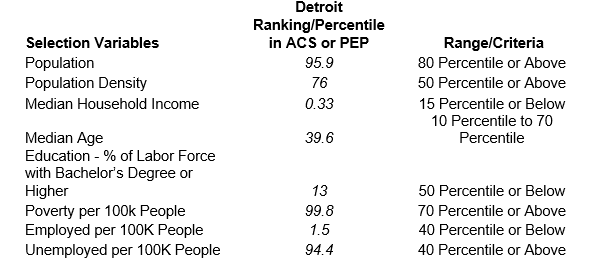
Detroit’s peer cities were determined using the criteria in Table 1.
Table 1
Selection Criteria, Thresholds, and Results for Detroit’s Peer Cities
Six peer cities, shown in Table 2, were identified based on the selection criteria. These peer cities include three in the Midwest: Cleveland, Toledo, and Milwaukee and three in the Mid-Atlantic: Rochester, Buffalo, Newark.
Table 2
Detroit Crime Peer Cities
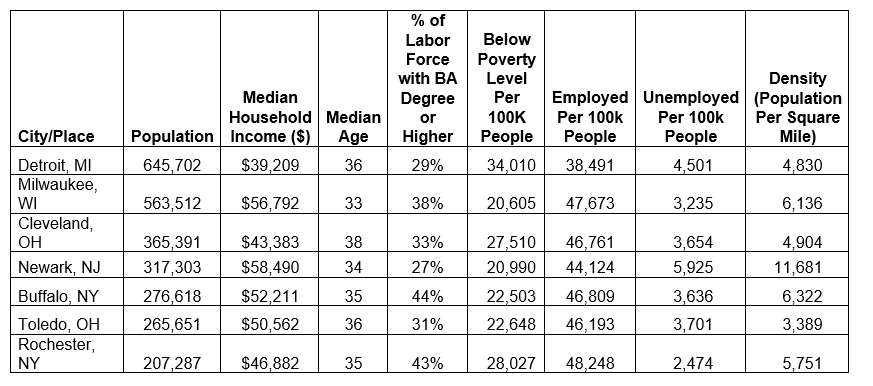
Source: 2024 American Community Survey 1-Year Detailed Tables, 2019 Population Estimates
Overall, these cities are similar to Detroit in terms of population, poverty, income, age, education, and employment. Like Detroit, all of them are large cities, specifically in the 80th percentile or higher of all places.
Detroit ranks shockingly low on median household income (bottom 1st percent among cities/places) and poverty per 100,000 people (top 99th percentile in poverty per 100,000) in the dataset. Therefore, we selected cities that also have lower median household income (15 percentile or below) and higher levels of poverty (70 percentile or above) among U.S. cities and places.
Detroit’s median resident age is 36 years old and falls in the middle of the pack among cities and places in the 40th percentile. The median age of selected cities was between the 10th percentile and 70th percentile, an age range between 32 and 39. While the range of selection for median age is large among the data, selected peer cities do not have a median age that is greater than or less four years of Detroit’s median age.
Detroit also ranked exceptionally low on employment (bottom 2nd percentile), unemployment (top 94th percentile), and educational attainment (the bottom 13th percentile) among cities/places. To generate enough comparable peer cities, we were more generous with selection criteria for these measures. Our selected peer cities rank at the 40th percentile or lower on employment per 100,000 people, the 40th percentile or above in terms of unemployment per 100,000 people, and the 50th percentile or below on share of the labor force with a bachelor’s degree or higher. While not identical to Detroit, these cities have the closest set of characteristics among U.S. cities/places with populations of 65,000.
Cleveland, Toledo, and Milwaukee are cities we would expect to be like Detroit given their proximity in the Midwest and their history as rust belt cities, but they also share many economic and demographic characteristics. For example, Cleveland ($43,383 vs. $39,209) and Toledo ($50,562 vs. $39,209) have median household income similar to Detroit. Milwaukee’s median household income of $56,792 falls near our cutoff for income at the 15th percentile, but this still places Milwaukee in the bottom tier of U.S. cities/places on income.
All three of the Midwest peers are large cities with populations over 200,000 putting them at the top 80th percentile. Cleveland and Toledo have a median age of 38 and 36 compared to Detroit’s median age of 36. They also have higher levels of unemployment. Cleveland has 3,654 unemployed per 100,000 people and Toledo has 3,701 per 100,000 compared to Detroit’s 4,501 unemployed per 100,000. These Midwest cities are more comparable to Detroit than Chicago (median household income is twice the amount of Detroit’s) or Indianapolis (population density that is almost half of Detroit’s).
The remaining peer cities are in the Mid-Atlantic and include Newark, Buffalo, and Rochester. Like the three Midwest cities, the Mid-Atlantic cities are above the 80th percentile in population and dense (top 75th percentile). They are at the bottom 15th percentile on median household income and the 70th percentile on poverty per 100,000 people. Their median ages range between 34 to 35 years old compared to Detroit’s median age of 36.
They are in the bottom 50th percentile on share of labor force with a bachelor’s degree or higher and rank in the bottom 40th percentile on employment and the upper 60th percentile on unemployment. In short, these peer cities are comparable to Detroit on various demographic and economic factors such as poverty, income, and population.
Some cities that one might expect to show up on a Detroit peer listing were not selected because they did not meet the thresholds for one or more crime-related factors. This includes many of those that we would typically consider peers given shared industrial history or location in the Midwest. For example, Pittsburgh was excluded because its median household income is high at $88,761, nearly in the 60th percentile among places/cities, and more than twice that of Detroit’s. Proximity to Detroit is also not something that we would consider a crucial factor for identifying crime trends. Grand Rapids is the second largest city in Michigan, but its population did not break the 80th percentile among U.S. cities. Furthermore, its median household income of about $75,000 easily exceeds our median household income threshold of $60,000. Our selection criteria ensure that we are selecting the most comparable cities for Detroit’s peer cities based on data and factors that are relevant for crime trends.
This data-informed peer city selection approach was developed given the Federal Bureau of Investigation’s guidance that ranking cities on the basis of crime trends can create misleading perceptions. As discussed previously, many reports on crime trends in cities simply review the largest cities in the U.S or the largest metro areas. Our approach was developed to compare Detroit to cities that are similar in terms of many factors such as median age, income, poverty, employment, and population which can yield a more useful comparison on crime trends. We plan to use this method to analyze how Detroit’s crime rates compare to those cities. Perhaps, there are lessons to be learned in how these cities approach crime. Or vice versa, Detroit could be a model for other cities.
Limitations
While identifying peer cities can provide better insight into how Detroit’s crime reduction and public safety efforts are doing, it is important to acknowledge that many structural factors at play influence crime in urban areas and that drivers of crime in each city are unique. These structural factors include poverty, economic disparities, community resources, family structure, education, unemployment, inequality, population, and age. As a result, any progress in Detroit will need to address these unique structural factors. Notably, Detroit ranks incredibly low in the ACS on median household income, poverty, and employment.
