



 Livonia
September 22, 2026
In a Nutshell
- Michigan’s 2025 transportation funding package was billed as delivering over $1 billion in new road funding in Fiscal Year (FY)2026. However, road agencies have experienced over a 15 percent decrease in distributions of state funding in the months following adoption of the package.
- This discrepancy between a promised funding increase and realized funding decrease is due largely to differences in formal state accounting and timing of distribution of funding to road agencies. Additional delays and uncertainties are imposed by statutory details and bureaucratic complexities related to new funding sources provided by the 2025 transportation funding package.
- Road agencies will see funding increases beginning in April 2026 (the seventh month of the state’s FY2026). However, the funding increases in the final six months of FY2026 are likely to be less than the decreases seen in the first six months. While the official state budget may reflect over a $1 billion increase in road funding in FY2026, road agencies may actually receive less funding than in FY2025. The promised FY2026 funding increase will likely be distributed to agencies in FY2027, but the exact timing and amount of this funding remains unclear.
Update: April 8, 2026.
Since initial publication of this Research Brief, the Michigan Department of Transportation has published the revenue and distributions from the Michigan Transportation fund for February 2026. The motor fuel tax increase is reflected in the February data. Total MTF revenue is up 12.6 percent. Distributions to road agencies are up 10.8 to 11.2 percent. The County Road Association of Michigan has stated that they expected February revenue to be distributed in March. The analysis provided in this brief relies on MDOT documentation suggesting that the February revenue would be distributed in April. It remains unclear if road agencies began seeing funding increases beginning in March or April. The original post has not been further updated to reflect this confusion.
Introduction
The 2025 transportation funding package (TFP) was a notable outcome of Michigan’s contentious Fiscal Year (FY)2026 budget deliberations. The 2025 TFP was celebrated as a successful bipartisan road funding solution that would provide over $1 billion in new road funding in FY2026, increasing to over $2 billion by FY2030.
But the reality facing road agencies in FY2026 is very different. Because of timing mismatches between state accounting and when revenue is actually distributed to road agencies, the total amount of funding that agencies will receive in FY2026 will likely decline slightly compared to FY2025. The confusion and uncertainty surrounding new road funding are causing short-term cash-flow and planning problems for Michigan’s road agencies.
Transportation Funding Changes in the FY2026 Budget
The 2025 TFP made multiple changes in how Michigan’s roads are funded, providing three new road funding sources:
- An increase in the motor fuel excise tax effective January 1, 2026, estimated to provide $716 million in FY2026. The Michigan Constitution requires that at least 90 percent of this revenue be used on road and bridge infrastructure, while Public Act 51 of 1951 dictates that this revenue shall be deposited in the Michigan Transportation Fund (MTF) for subsequent distribution to road agencies.
- A new earmark of $688 million of Corporate Income Tax (CIT) revenue for FY2026 to be deposited in the Neighborhood Roads Fund (NRF), a new fund created by the 2025 TFP.
- A new Marijuana Wholesale Tax (MWT), effective January 1, 2026, that is fully earmarked for road funding – estimated to provide $315 million in FY2026 to the new NRF.1
The 2025 TFP also repealed a couple of funding sources. One relatively minor source was a sales tax earmark to the Comprehensive Transportation Fund (CTF) for public transit services. In terms of road funding specifically, the main impact was:
- Repeal of a $600 million Individual Income Tax earmark, previously deposited in the MTF for subsequent distribution to road agencies.
The net change in transportation funding for FY2026 – as determined by the state budget – is estimated at $1.086 billion (see Chart 1).
Chart 1
Anticipated Gross and Net Impact of 2025 TFP on Official Fiscal Year 2026 Transportation Funding

Source: Citizens Research Council using data from Michigan House Fiscal Agency
As shown in Chart 1, the 2025 TFP is anticipated to provide over $1 billion in new road funding in FY2026. However, this does not reflect how much road funding Michigan’s road agencies will actually receive in FY2026.
Why the State’s Accounting does not Reflect Funding Reality
The discrepancy between the accounting rules used to determine when state revenue is recognized and the reality of when funding is received by road agencies is complicated. Even a basic understanding requires considering each individual funding component of the 2025 TFP separately:
- The increase in the motor fuel excise tax was applied to fuel sales beginning January 1, 2026, three months into FY2026. This increased revenue is not reported by the fuel distributors to the Michigan Department of Treasury until February 2026. This delay was accounted for in the state budget fiscal analyses. However, the fiscal analyses ignore the additional two months of delay between when fuel tax revenues are deposited in the Treasury until when they are distributed to road agencies. The increased fuel tax revenue resulting from the 2025 TFP will not increase funding for road agencies until April 2026, the seventh month of the state’s fiscal year. Thus, the official FY2026 budget estimate for increased fuel tax revenue is based on eight months of annualized $1.07 billion in new revenue ($715.6 million), but the revenue distributed to road agencies within FY2026 will be only half of the annualized estimate ($537 million).
- The $688 million Corporate Income Tax (CIT) earmark also comes with a contingency. The first $1.25 billion in CIT revenue is dedicated to higher-priority uses (primarily the state General Fund). Only after that $1.25 billion is collected does any revenue go to the NRF. Considering complicated issues regarding fiscal year revenue estimation and distribution procedures for the new road funding earmark, the Michigan Department of Treasury may not transfer this revenue to the Neighborhood Roads Fund (NRF) for distribution to road agencies until after the end of FY2026. Under formal accounting rules, this revenue accrues to FY2026 and will appear as increased road funding in the State of Michigan FY2026 budget but may not actually be available for road funding until after FY2026 has ended. It is possible that CIT earmark distributions will be available in the final months of FY2026, but it is too soon to predict.
- The Marijuana Wholesale Tax (MWT), created by the 2025 TFP, is currently being challenged in court. The Department of Treasury may not deposit whatever tax is collected into the Neighborhood Roads Fund until legal challenges are concluded. It remains unclear when road agencies will begin recieving any funding through the NRF.
While the sources of new revenue require complicated explanations to describe how the amount of road funding reflected in the FY2026 state budget will differ from the actual amount of funding sent to agencies, the earmarked funding repealed by the 2025 TFP is much more straightforward:
- The repeal of the $600 million Individual Income Tax earmark is effective for the entirety of FY2026. As a result, monthly distributions of state revenue sharing to road agencies are reduced by $50 million throughout FY2026.
Here’s the upshot: As a result of the 2025 TFP, the total state funding distributed to road agencies in FY2026 (October 2025 through September 2026) will likely be about $63 million less than the funding distributed to road agencies in FY2025.2 The increased motor fuel excise tax revenue will provide about $537 million in new funding, distributed over the final six months of the fiscal year through the MTF. But this does not make up for the loss of the repealed $600 million Individual Income Tax earmark.
The new revenue distributed through the NRF– the CIT earmark and new marijuana wholesale tax – will very likely not be distributed to road agencies before the end of the fiscal year (September 30, 2026).
Although the 2025 TFP was estimated to provide over $1 billion in new revenue in FY2026, Michigan’s road agencies have in fact been hit with a temporary but unexpected funding cut, creating near-term cash flow issues.3
Actual FY2026 Funding Impact
The idea that actual available road funding will decrease in FY2026 is not a hypothetical mathematical exercise. Michigan’s 2026 fiscal year began October 1, 2025. Funding distribution reports are available for the first four months of FY2026:
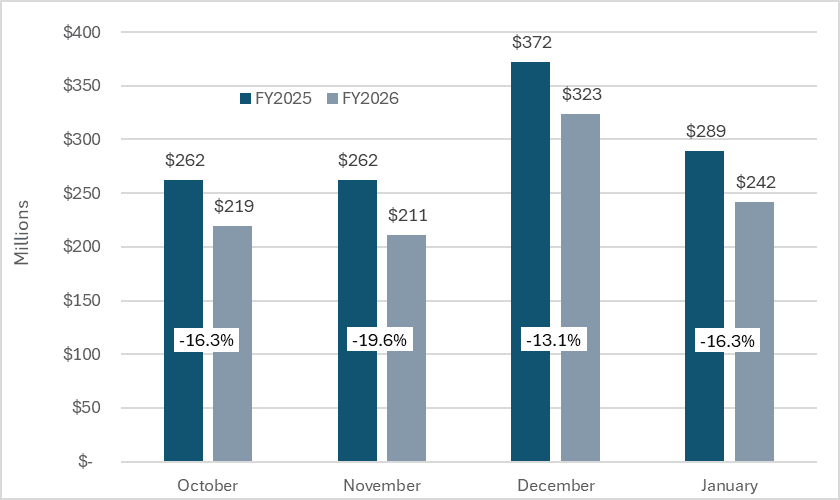
- In October 2025, the first month of FY2026 (and the first month affected by the 2025 TFP), total MTF revenues were down 18.9 percent from the previous month (September 2025). Total MTF revenues were down 13.0 percent year-over-year from October 2024. Net MTF revenues distributed to road agencies in October were down 16.3 percent year-over-year.
- In November 2025, total MTF revenues were down 16.7 percent year-over-year from November 2024. Net MTF revenues distributed were down 19.6 percent year-over-year.
- In December 2025, total MTF revenues were down 11.3 percent year-over-year from December 2024. Net MTF revenues distributed to road agencies were down 13.1 percent year-over-year.
- In January 2026, net MTF revenues distributed to road agencies were down 16.3 percent year-over-year. For the 12-month period ending January 31, 2026, total distributions to counties and cities/villages are down 2.5 percent and 2.6 percent, respectively, from the 12-month period ending one year prior.
Chart 2 summarizes the change in net funding distributed to road agencies in the first four months of FY2026 compared to the first four months of FY2025.
Chart 2
Net Monthly MTF Funding Distributed to Road Agencies
Source: Citizens Research Council using MDOT Distribution Reports
Note: December distributions are larger than other months due to a retail marijuana excise tax earmark distributed as a one-time annual sum in this month.
Policy Implications
Michigan’s approach to road funding has become so complicated that it is practically impossible to understand. As recently as January 21, 2026, it was reported that “Michigan has 30% more to spend on local road repair in 2026.” This is a misunderstanding based on official fiscal analyses of the 2025 TFP that reflect fiscal year accounting of Michigan’s state tax revenues rather than the actual distribution of funding within FY2026.
In the near-term, state officials should communicate to Michigan’s road agencies the actual, practical impact on funding as affected by the 2025 TFP (to the extent such things are known).
We now know definitively that for the first four months of FY2026, road funding decreased by over 15 percent. We can confidently estimate that funding will be similarly reduced in February and March 2026.
Road funding will finally increase in April of 2026 (reflecting the increased fuel tax distributed through the MTF), but likely only by about 15 percent. By the time FY2026 has concluded, the funding distributed through the MTF in these 12 months is likely to be less than the 12 months of FY2025.
The new funding from CIT and MWT revenues, distributed through the new Neighborhood Roads Fund, will not likely be available until FY2027.
Without clear communication of these issues, road agencies have been forced to spend resources trying to figure this out on their own.
The Research Council has repeatedly recommended that the Michigan Legislature direct and fund an independent assessment of the state’s roads program. In March 2025, the Research Council published an extensive report, “A Data-driven Assessment of Michigan’s Road Program,” concluding:
“There should be more research and analysis of how existing road funding is spent. Evidence suggests there are multiple inefficiencies in our current system. Allocating more funding to roads without addressing these inefficiencies may reinforce systemic problems without making much progress in fixing the roads.”
Unfortunately, the 2025 TFP threw more funding into Michigan’s roads program without addressing any inefficiencies. In fact, the 2025 TFP made the road program substantially more complicated, less comprehensible, and almost certainly less efficient.
Meaningful reform of Michigan’s roads program is now both more difficult and more necessary.4
The Michigan Legislature should:
- Stop amending the state roads program and funding mechanisms without understanding how the current program works.
- Appropriate at least $5 million to a Michigan Roads Program Evaluation Study. Allow at least three years from bid letting to submittal of final deliverables.
- Identify or create a body that can independently and objectively draft a Request for Proposal and administer the study. This could be a group of legislators or an independent agency such as the Michigan Department of Technology, Management and Budget. (It is critical to manage the influence of individual interest groups.)
- Mandate that the study team be given full access to all relevant data and files possessed by MDOT and TAMC.
- Require the study to address the following issues:
- Factors that impose life-cycle costs to roads and bridges across Michigan
- Annualized funding required to maintain statewide network, evaluated by jurisdiction and national functional classification
- Evaluation of appropriateness of functional classification of federal aid network as a basis for funding distribution
- Sources of waste and inefficiency in Michigan’s roads program
- Additional data required to answer any of the above questions that are currently unanswerable
Summary
The 2025 transportation funding package provided a significant increase in state road funding. However, the new funding is available to road agencies on a delayed and uncertain schedule.
Road agencies are now experiencing an unexpected decrease in funding that will proceed through March 2026. Funding will increase in April 2026, but overall funding in FY2026 is likely to decline year-over-year compared to FY2025. Funding will substantially increase in FY2027, but the timing issues and uncertainty around this funding are creating short-term cash-flow and planning problems for Michigan’s road agencies.
These problems demonstrate the generally confusing and inefficient nature of Michigan’s state roads program. Fundamental reform is needed to ensure that road funding is being put to good use.
Footnotes
- Technically, the 2025 TFP directs the Department of Treasury to deposit both the CIT and MWT revenue in a new fund called the Comprehensive Road Funding Fund. However, all but $3 million is then transferred to the NRF for distribution. ↩︎
- This assumes that no CIT revenue will be distributed before September 30, 2026 ↩︎
- For example, Barrien County Road Department has received about $500,000 less per month than expected and has arranged to borrow up to $2 million from the county treasury. (Tony Wittkowski, “Berrien County to advance up to $2 million to road department,” The Herald-Palladium, January 23, 2026.) ↩︎
- The last time the legislature attempted fundamental reform of Michigan’s road program was in 1998 with the Act 51 Transportation Funding Study Committee. While this effort did lead to some reform, results have been mixed, as described in the Research Council Brief, “The Missed Opportunity of the Act 51 Study Committee.” ↩︎
Note: This post was updated 3/12/2026 to incorporate January 2026 distribution data. This post was updated 4/8/2026 to acknowledge February 2026 distribution data.
