


September 29, 2026
In a Nutshell
- Detroit’s February 2026 REC kept General Fund revenues largely flat as compared to the September 2025 REC.
- The little recorded growth in the revenue estimates was largely due to higher estimates for wagering/casino tax revenue as compared to the September 2025 REC. Annual growth in wagering taxes has been volatile in recent fiscal years and is expected to plateau in the forecast period with no real growth.
- Annual revenue growth in the forecast from FY2026 to FY2030 is expected to be flat-to-modest. Property and income tax revenues lead forecasted annual growth, but when adjusted for inflation, income taxes revenues had virtually no real growth.
The City of Detroit held its biannual Revenue Estimating Conference (REC) on February 13, 2026, as required by state law to update and revise city revenue estimates for the current and future fiscal years. General Fund revenue estimates were largely flat from the previous September 2025 forecast. The new forecast shows flat year-over-year growth for Fiscal Year (FY)2026 and FY2027 and modest revenue growth in the remaining forecast horizon from FY2028 to FY2030.
The February REC results will guide Mayor Sheffield’s proposed budget for FY2027 which will be presented in early March. This will be Mayor Sheffield’s first budget and will set her priorities for the fiscal year that begins July 1. This brief examines the updated revenue projections and what they mean for the city’s upcoming budget cycle.
Background
The Home Rule City Act of 1909 as amended, requires that the City of Detroit to hold biannual revenue estimating conferences to establish the official economic forecast and forecast of anticipated revenues. The conference principals include the chief financial officer of the city, the state treasurer or his/her designee, and a person from a public entity such as a state institution of higher education with experience in economic forecasting and revenue projection. These principals establish the official revenue forecast by consensus.
The City of Detroit’s Office of the Treasury prepares the revenue estimates and associated data for consideration by the conference principals. The estimates include the current fiscal year (FY2026) and the four upcoming fiscal years (FY2027 through FY2030). These revenue projections are used to inform the development of the city’s annual budget and Four-Year Financial Plan, as required by state law. The revenue projections include the city’s general operating fund as well as grant, enterprise, and special revenue funds.
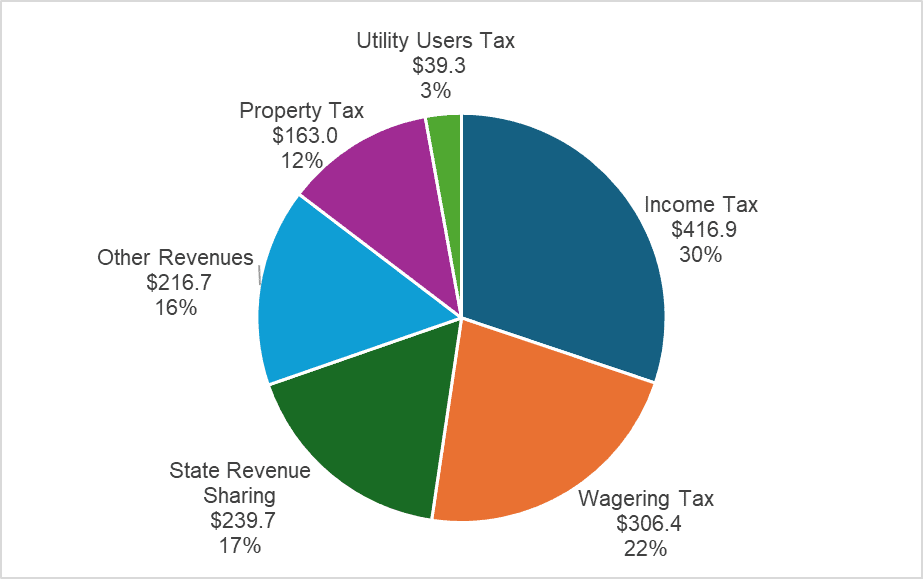
The city’s General Fund receives revenues from various city taxes, state revenue sharing, and other revenues from city fees, fines, and investment earnings (see Chart 1). General Fund revenues support a variety of city operations, programs, and services.
Chart 1
FY2025 General Fund Recurring Revenues
(In Millions)
Source: February 2026 Revenue Estimating Conference
1. General Fund Revenues Are Flat
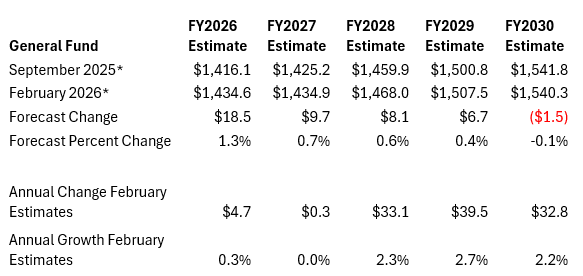
The February 2026 REC revised General Fund revenues up from the city’s September revenue conference (see Table 1). For FY2027, General Fund revenue is expected to be $9.7 million (0.7 percent) higher than was forecasted in September 2025. The average increase across the February REC forecast was largely flat as compared to the September REC. At best, the little growth in the revenue estimates is marginal in light of the city’s FY2026 $1.59 billion General Fund budget.
The new revenue forecast shows virtually no year-over-year growth for FY2027 and modest growth in the remaining forecast horizon (FY2027 to FY2030). From FY2027 to FY2030, revenues are expected to increase by an average of $35.1 million per year (2.4 percent).
Table 1
Summary of February 2026 REC Revenue Revisions, FY2026 through FY2030
(In Millions)
*Includes both recurring and non-recurring revenues
Source: February 2026 Revenue Estimating Conference
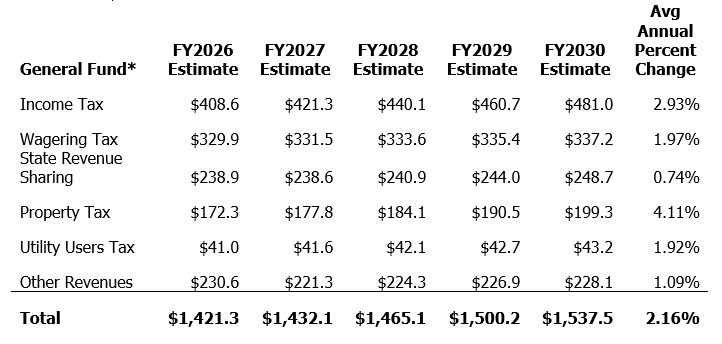
Table 2 shows that property taxes and income taxes are the main drivers of annual revenue growth over the forecast period.
Table 2
February 2026 Forecast Estimates by Revenue Source, FY2026 through FY2030
(In Millions)
*Recurring revenues only
Source: February 2026 Revenue Estimating Conference
2. Marginally Higher Revenue Estimates Driven Largely by Wagering Tax
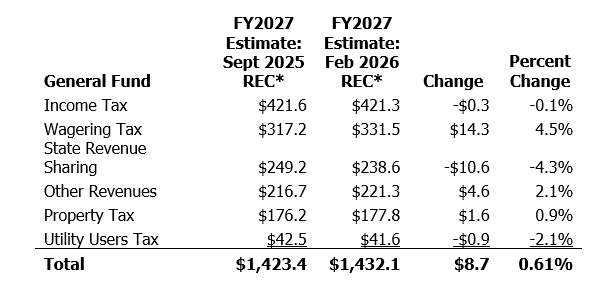
Wagering taxes drove the little recorded increase in the updated General Fund revenue estimate for FY2027 (see Table 3). Wagering taxes were revised by $14 million from the September forecast, a 4.5 percent increase. This is due to higher-than-expected revenues for internet gaming and internet sports betting.
Table 3
Adjustments to Estimated General Fund Revenue Sources for FY2027
(In Millions)
*Recurring revenue only
Source: February 2026 Revenue Estimating Conference
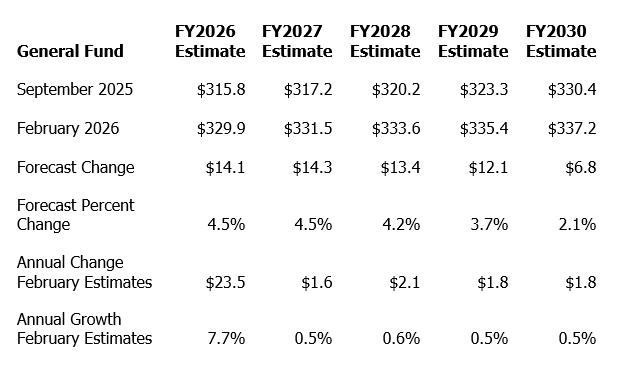
In the new February forecast, wagering/casino taxes are expected to stay flat or plateau annually. As shown in Table 4, wagering tax revenue is expected to grow less than one percent annually. Detroit’s casino industry has been in operation since 1999; however, Michigan only recently authorized online gambling and sports betting in January 2021.
Table 4
Estimated Wagering Tax Revenues, FY2026 through FY2030
(In Millions)
Source: February 2026 Revenue Estimating Conference
3. Property and Income Taxes Lead Forecasted Growth
Annual revenue growth in the February forecast was driven by both property taxes and income taxes.
Property Taxes
Nominal property taxes are expected to grow by an average of 4.6 percent annually from FY2026 to FY2030. This might be considered a modest projection given that actual tax collections have grown about 6.5 percent annually over the last five fiscal years. However, the growth projections become slightly more optimistic given a longer look back; the ten-year average for annual property tax growth was 2.7 percent between FY2016 and FY2025.
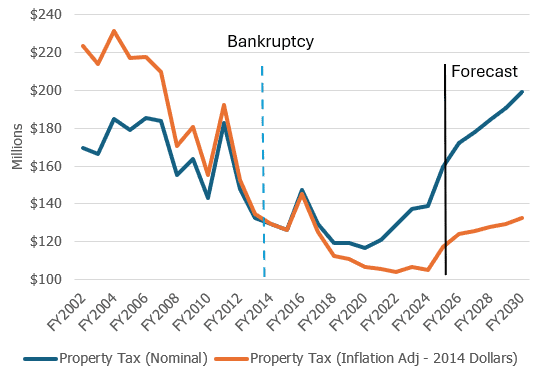
However, these growth rates do not account for purchasing power lost after adjusting for inflation. To create a more accurate picture of long-term tax revenue growth, inflation-adjusted collections (using 2014 constant dollars) are presented in Chart 2.
Since the City of Detroit exited bankruptcy at the start of FY2014, nominal property taxes revenues have increased by $29.9 million by FY2025, a 23.1 percent increase. After accounting for inflation, these gains are completely wiped out. Since FY2014, real property tax revenue declined by $12.3 million, a decrease of four percent (see Chart 2). Real growth in property taxes is not keeping pace with city spending growth. The FY2025 budget totaled $1.47 billion in General Fund expenditures which is a $352.7 million increase (a 17.7 percent increase) from the FY 2014 budget.
Chart 2
City of Detroit Property Taxes, FY2002 – FY2030
(In Millions)
Source: City of Detroit Comprehensive Annual Financial Reports, February 2026 Revenue Estimating Conference
In constant 2014 dollars, the real value of property tax revenue has grown by an average of 2.0 percent annually from FY2021 to FY2025 compared to nominal growth of 6.5 percent in the same time period. In the last ten fiscal years, property taxes averaged a decline of -0.4 percent from FY2016 to FY2025 annually compared to nominal growth of 2.7 percent.
Reviewing the February forecast in constant 2014 dollars while making a modest assumption in the inflation rate of two percent suggests that the forecast for property tax revenue is slightly optimistic at about 2.5 percent annually over the forecast horizon (FY2026 to FY2030). This is higher than the 2.0 percent average annual real property growth rate observed in the last five fiscal years and much higher than the inflation-adjusted growth rate (0.4 percent decline) experienced over the previous ten-year period.
Income Taxes
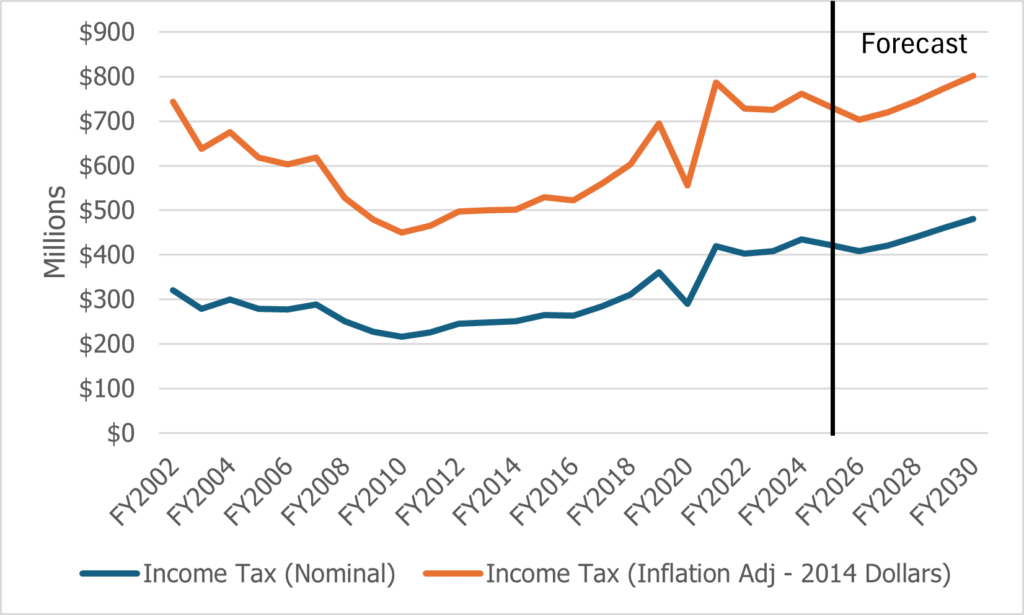
Looking at the updated revenue forecast through FY2030, nominal income tax collections are expected to grow by an average of 2.7 percent annually. This forecasted growth rate is well above the annual growth rate experienced between FY2022 to FY2025 (0.2 percent per year). When city income tax collections are adjusted for inflation, the gains to income tax revenue are more than halved (see Chart 3). Since bankruptcy in FY2014, nominal income tax revenue increased by $171.2 million in FY2025, 68.3 percent. Adjusting for inflation, however, the real increase from FY2014 to FY2025 is $59.5 million, 23.7 percent increase over the previous 12 fiscal years.
Chart 3
City of Detroit Income Tax Revenue, FY2002 – FY2030
(In Millions)
Source: City of Detroit Comprehensive Annual Financial Reports, February 2026 Revenue Estimating Conference
Reviewing the February forecast numbers while considering modest annual inflation (2 percent per year) shows little annual growth in the real value of income tax revenue at 0.7 percent. This might be considered a slightly optimistic projection given that between FY2023 and FY2025, inflation-adjusted revenues fell 4.6 percent annually.
4. Wagering Taxes are Volatile and Forecasted with No Real Growth
Wagering taxes are the third biggest driver of forecasted growth in the February REC and are forecasted conservatively. Nominal wagering tax revenue is expected to increase by an average of $11.8 million annually or 2.0 percent in the forecast.
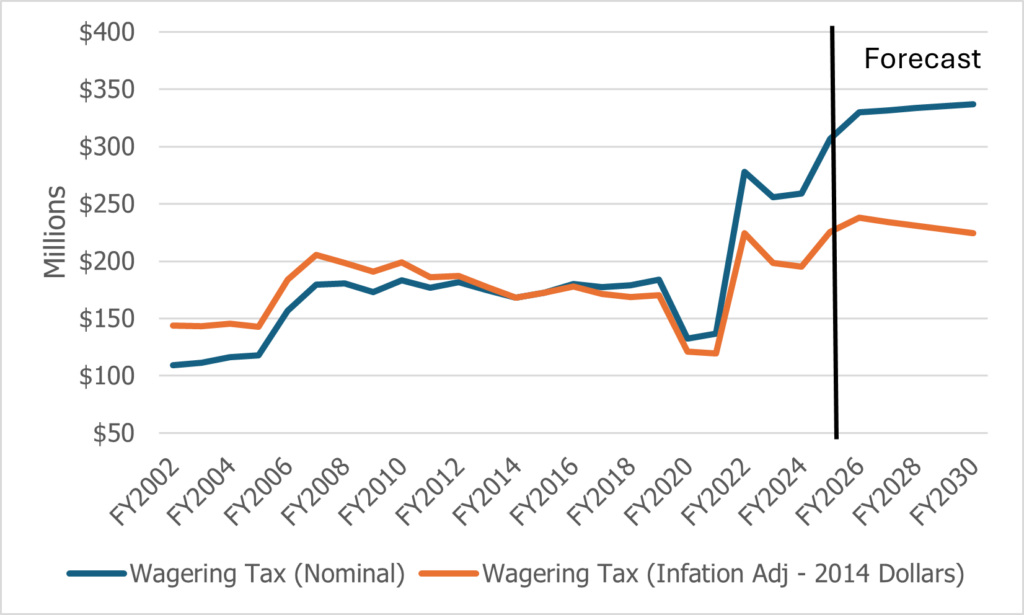
Similar to the growth path observed with income tax collections, we see that the gains to wagering tax revenue since bankruptcy in FY2014 are more than halved after adjusting for inflation (see Chart 4). Since the city’s exit from bankruptcy in FY2014, wagering tax revenue has increased by $138.5 million or 82.5 percent. However, adjusting for inflation cuts this increase to $57.4 million, real growth of 34.2 percent over the 12-year time period.
This volatility is due to the expansion of the gambling industry in Michigan and the launch of new gambling options. The launch of legal internet gambling and internet sports betting in January 2021 is a significant date that aligns with the spike of wagering tax revenue that the city received in FY2022 (July 2021 to June 2022). According to Play Michigan, a news outlet reporting on Michigan online gambling, there are now 14 different sports betting apps available, 15 different online casino providers, and three online pokers sites in Michigan. Retail sports betting was also authorized in March 2020 along with a Michigan law signed by Gov. Gretchen Whitmer in December 2020 that allowed for a multijurisdictional poker agreement that enabled internet poker players in Michigan to compete against players in three other states.
Chart 4
City of Detroit Wagering Tax Revenue, FY2002 – FY2030
(In Millions)
Source: City of Detroit Comprehensive Annual Financial Reports, February 2026 Revenue Estimating Conference
Looking ahead, there will be no real growth in the inflation-adjusted wagering tax in stark contrast to the volatility seen in the past years. This is a conservative forecast that assumes an end to the volatile wagering tax revenue observed in the last five fiscal years. For example, real wagering tax revenue adjusted for inflation increased by 88.1 percent in FY2022, declined by 11.5 in FY2023, and then increased again by 15.3% in FY2025.
Conclusion
The February 2026 REC largely held General Fund revenues flat from the September 2025 REC and supplies slightly more resources for the city’s upcoming FY2027 budget. The little recorded growth from the September REC to the February REC was driven by higher estimates for wagering tax revenue. Annual revenue growth in the forecast period is expected to be flat-to-modest driven by property taxes, incomes taxes, and wagering taxes. When these three revenue sources were adjusted for inflation, only property taxes had greater than flat real growth. General fund revenues are not forecast to keep up with annual inflation.
