



 Livonia
October 22, 2026
In a Nutshell
- Michigan’s renewable standard requires 50 percent renewable power by 2030 and 60 percent by 2035. Environmental advocates worry that data center load will trigger the law’s ‘off-ramp’ provision, which allows utilities to delay compliance if it is “not practically feasible.”
- Michigan’s two largest utilities, DTE and Consumers, have submitted plans to comply with Michigan’s renewable energy mandate while serving new data center load. However, these plans rely on rapid large-scale construction of renewable generation and battery storage. The utilities will be challenged to bring renewable energy online at the pace necessary to comply with the mandate.
- The large electric power demand from new data centers is likely to amplify the near-term challenges for utilities to comply with the renewables mandate by increasing the pace at which new infrastructure must be constructed and placed into service (potentially triggering the ‘off-ramp’). However, data centers provide substantial funding for renewable generation and offer flexible load schedules that can make better utilization of renewable energy than a typical electricity customer. In this way, data centers are likely to benefit Michigan’s renewable energy goals in the long-term.
Among the many concerns regarding data centers is their impact on climate change. Hyperscale data centers use massive amounts of electricity–equivalent to hundreds of thousands of homes. In states that have seen substantial data center construction, some utilities have opted to delay the retirement of coal power plants and/or invest in new large natural gas (methane) power plants to serve these large electrical loads. Burning fossil fuels such as coal and methane releases carbon dioxide, the greenhouse gas most responsible for climate change.
Many U.S. states have adopted goals to reduce carbon emissions from electricity generation in efforts to slow climate change, largely through transitioning from fossil fuel power plants to renewable generation (e.g., solar and wind). Michigan has adopted one of the most aggressive timelines for renewable energy adoption, requiring 50 percent renewable energy by 2030 and 60 percent by 2035. Now that hyperscale data center developers are locating in Michigan, many are concerned that the increased electricity demand will trigger a legislated ‘off-ramp,’ allowing Michigan’s electric utilities to delay compliance with the renewable energy mandate.
This Research Brief describes Michigan’s renewable energy mandate and the potential impact of data center development.
Michigan’s Renewable Energy Mandate
Michigan has required electric providers to comply with a renewable portfolio standard (RPS) since Public Act (PA) 295 of 2008 required at least 10 percent of delivered power to be generated from renewable resources by 2015. Public Act 342 of 2016 increased this requirement to at least 15 percent as of 2021. Governor Whitmer signed into law PA 235 of 2023, increasing the RPS to 50 percent as of 2030 and 60 percent by 2035.1
At an abstract level, PA 235 requires that, as of 2030, half of the power delivered to Michigan electric customers annually is generated from renewable resources, and 60 percent by 2035. In practice, RPS requirements are more nuanced.
Michigan’s RPS requires that utilities maintain a Renewable Energy Credit (REC) portfolio. A Renewable Energy Credit is “a credit granted under a certification and tracking program … which represents generated renewable energy.” In general, one megawatt hour (MWh) of generated renewable energy creates one REC. However, there are many complicated details.
For example, one MWh of renewable energy may be worth more than one REC if generated at certain times, delivered during certain times, or generated by certain facilities. Utilities may self-generate RECs through utility-owned facilities, purchase them, or otherwise obtain them through contractual agreements with independent power generators. In some cases, waste reduction credits may even be used equivalent to a REC. Additionally, RECs can be ‘banked’ for up to five years.
Effective 2030, each electric utility must apply (‘retire’) an amount of RECs from its portfolio representing 50 percent of the electricity delivered to customers in that year.2 Utilities are now banking credits as they meet the current 15 percent RPS requirement. This REC bank will help utilities to comply with future RPS requirements by retiring RECs generated in previous years. This will be especially relevant as the RPS standard jumps from 15 percent in 2029 to 50 percent in 2030. However, this is a temporary solution. In the long term (2035 and beyond), utilities will need to procure 60 percent renewable energy annually, requiring substantially more renewable energy than they are currently delivering.
Critically, PA 235 allows utilities to receive extensions from RPS compliance if it is “not practically feasible.” Factors that may make compliance not practically feasible include cost considerations, reliability impacts, and unanticipated load growth. This is the ‘off-ramp’ that environmental advocates are worried could be triggered by new data center loads.
Known Challenges to Meeting the RPS Mandate
Currently, only about 13 percent of electricity generated in Michigan is from renewable resources. Nevertheless (due to the aforementioned intricacies of RPS compliance), all of Michigan’s electric utilities have acquired and retired enough RECs to comply with the 15 percent renewable portfolio standard in place since 2021. In fact, many utilities are already generating surplus RECs that can be ‘banked’ and used to comply with the pending 50 percent RPS in 2030. However, sustainable compliance with the 2030 mandate and subsequent 2035 mandate for a 60 percent RPS would be a challenge even without needing to accommodate new demand for electric power.
This section describes some of the known challenges to meeting Michigan’s pending renewable portfolio standards.
Voluntary Green Pricing Programs
Michigan requires electric utilities to offer a volunteer green pricing (VGP) program. Customers that enroll in a VGP program pay a premium rate to receive electricity generated by renewable resources. On the utility side, electricity that is delivered under a VGP program does not count towards meeting RPS compliance. For example, a utility that meets the 2030 RPS goal of 50 percent is delivering 50 percent of electricity generated by renewable resources to non-VGP loads. VGP customers may receive up to 100 percent renewable energy, but this does not help utilities comply with the RPS mandate.
Overall, VGP increases the percentage of renewable energy delivered in Michigan. But, non-intuitively, VGP enrollment could make it more difficult for utilities to meet Michigan’s RPS mandates. Meeting the 2030/2035 RPS mandates requires rapid construction of renewable energy generation. If the new renewable energy generated from new facilities is prioritized for VGP customers, it becomes unavailable for the utility to meet RPS mandates for other customers. If data centers and other large load customers enroll in VGP programs, this could, ironically, increase the percentage of renewable energy generated and delivered in Michigan while simultaneously making it more difficult for utilities to comply with the RPS standard.3
Ongoing Legal Challenges to Renewable Generation Siting
Meeting the 2030 and 2035 RPS standards will require a substantial build-out of renewable generation facilities. Constructing an adequate amount of renewable generation was understood as a challenge even before hyperscale data centers began locating in Michigan. When Michigan’s legislature adopted the renewable energy goals in 2023, they also adopted PA 233, which provides an alternative pathway for renewable generation facilities to be approved through the Michigan Public Service Commission (MPSC), rather than the local government.
Public Act 233 was considered necessary to accelerate the build-out of renewable energy. But the law has received pushback from multiple townships and counties, who filed a lawsuit challenging details of the MPSC’s interpretation and implementation of the law. The Michigan Court of Appeals upheld the law in 2026, but imposed conditions that may extend approval and construction timelines. A group of townships have appealed this ruling seeking further control, and have filed an additional suit challenging the basic constitutionality of PA 233.
The legal challenges to PA 233 have complicated its implementation and make long-term planning of new renewable facilities uncertain.
Expiring Federal Tax Incentives
In 2022, the federal Inflation Reduction Act (IRA) provided an Investment Tax Credit (ITC) and Production Tax Credit (PTC) for renewable energy projects, allowing deductions from federal taxes.4 The Congressional Budget Office estimates that the ITC/PTC credits increased investment in renewable generation by nearly 50 percent from 2024 to 2026. However, in 2025, the One Big Beautiful Bill Act required a rapid phase-out of many of the federal tax incentives for renewable energy enabled by the IRA.
The pending loss of the tax credits changes the economics of renewable generation. Michigan may see some drop-off in investments from independent power producers, and the power that is generated will likely be more expensive.
Cost Inflation
The cost of renewable electricity generation and capacity is now undergoing unprecedented inflation pressure. Moreover, the costs of all energy generation are increasing. There are myriad causes of this, such as labor cost inflation, regulatory costs, fuel costs, material shortages, cost inflation (including costs imposed by import tariffs), and load growth (increasing electricity demand).
Data center load growth is one of the factors driving up electricity costs, but the relationship is complicated. Load growth is occurring nationally and globally, driving up costs at regional and global scales. Counterintuitively, states that host large data centers tend to be experiencing lesser rate increases, due to economies of scale in utility economics. However, in the Michigan context, serving new data center load while procuring enough renewable energy to meet RPS requirements could impose projected cost and rate increases that would trigger the renewable mandate ‘off-ramp.’
Transmission Grid Interconnection
It is difficult enough to construct large-scale renewable energy generation. Connecting that power to the grid is an additional constraint. The electric grid basically consists of transmission lines that move power across regions and distribution lines that deliver electricity to customers. New large-scale generation facilities must be connected to the transmission grid in a way that does not impose operational issues.
Transmission grids are managed by Regional Transmission Organizations (RTOs). Michigan’s RTO is MISO. Any proposed generation project must be assessed by MISO to assure that the facility can be connected to the grid without causing instability or excessive costs. The study process often takes years, and may determine that interconnection requires substantial transmission infrastructure investment that makes the proposed facility unprofitable. As a result, many proposed renewable energy generation facilities are delayed for years, or even cancelled.
Overall, this process assures that the grid is reliable, but imposes a constraint on the speed of growth and transition to new renewable resources. These constraints may contribute to delays in bringing new renewable generation online and triggering Michigan’s RPS ‘off-ramp.’
Implications of the Hyperscale Data Center Boom
As described in the previous sections, Michigan adopted an aggressive renewable portfolio standard that will be difficult to achieve in any case. When the RPS was adopted in 2023, policymakers did not anticipate rapid load growth due to hyperscale data centers. There is no inherent reason that increasing the overall amount of electric power generated and delivered makes it more difficult to increase the percentage of renewable energy generated or delivered. However, there are limits to how quickly utilities can transition from a fossil-fuel-based grid to a renewable-based grid, and increasing the overall amount of power demand could extend the timelines of such a transition.
Globally and nationally, data centers are driving a surge in power generation. This includes solar and batteries, but also fossil fuels. Even the Data Center Coalition (an industry group) acknowledges that, “accelerated growth in electricity demand … may challenge the utility’s ability to procure or develop sufficient clean energy sources, implicating statutory or regulatory clean energy and emissions reductions targets.”
Michigan’s Strategy to Date
Michigan’s legislature considered the electricity demands of hyperscale data centers and the impact on Michigan’s renewable energy goals when creating the sales/use tax exemption to attract them to the state. To qualify for the exemption, a data center must procure 90 percent “clean” energy.5 The intent of this provision appears to be assuring that hyperscale data centers would self-fund the procurement of renewable (or ‘clean’) energy and not impose additional renewable energy procurement requirements on Michigan utilities.
However, the legislation did not specify how data centers would demonstrate the procurement of clean energy, and delegated certification procedures to the Michigan Strategic Fund (MSF). The MSF guidelines state that an enterprise data center can be certified simply by contracting with an electric utility that is “actively pursuing compliance” with Michigan’s clean and renewable energy mandates. Furthermore, if the utility is non-compliant, the data center served by the utility does not lose certification. Practically speaking, this makes the 90 percent clean energy requirement a non-factor for certification and approval of the sales/use tax exemption. Considering the potential difficulty of meeting Michigan’s renewable energy goals while serving new large data center loads, this may increase the probability that Michigan utilities utilize the “off-ramp.”
Assuming that MSF does not amend certification guidelines, it falls to individual utilities (with MPSC guidance and approval) to determine how to meet Michigan’s renewable energy mandate while accommodating load growth from hyperscale data centers. Most of the proposals for hyperscale data centers are within the territory of Michigan’s two largest electric utilities: DTE and Consumers Energy. Collectively, the two electric utilities provide about 90 percent of the power to Michigan. As such, Michigan’s statewide renewable energy goals depend largely on if these two utilities will be able meet these goals.
Consumers Energy
Consumers Energy currently provides power to Michigan’s first official hyperscale data center (defined here as having more than 100 MW peak capacity). The Switch Pyramid data center in Gaines Township, south of Grand Rapids, has expanded to accommodate over 200 MW of capacity. The power purchase contract with the Switch data center helped to fund investments in wind energy. Additional data center contracts are pending local approval.
Consumers Energy’s most recent IRP filing states that the utility must accommodate around 2,000 MW of near-term load growth that was not anticipated when its previous IRP was filed in 2021. Consumers Energy must accommodate this and future load growth while retiring the 1,400 MW Campbell coal plant in Ottawa County, and having previously retired 515 MW of coal generation at the Karn plant in Saginaw in 2023. The Karn plant continues to operate 1,120 MW of natural gas and oil generation capacity, but this will be retired in 2031.
Consumers Energy will not only have to replace over 3,000 MW of fossil fuel generation, but also increase generation capacity by at least 2,000 MW. It plans to meet these challenges through a combination of strategies. It is requesting approval to construct 1,375 MW of new natural gas simple cycle “peaker” generation and to procure over 1,500 MW of natural gas and nuclear energy through new power purchase agreements. However, Consumers Energy’s long-term plan hinges on rapid construction of new renewable generation facilities.
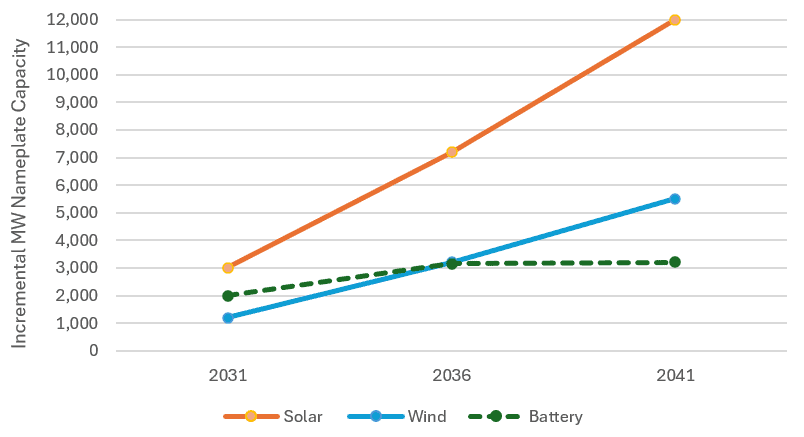
Consumers Energy’s Integrated Resource Plan includes constructing substantial incremental renewable generation. By 2031, it intends to bring online 3,000 MW of solar and 1,200 MW of wind and maintain this expansion pace through 2041 resulting in over 17,500 MW of total renewable energy capacity (Chart 1).
Chart 1
Consumers Energy Planned Renewable Capacity Additions
Source: Consumers 2026 Integrated Resource Plan
Consumers Energy’s analysts project that the proposed course of action described in their IRP and related plans will allow the company to comply with Michigan’s 2030 renewable energy mandate, as well as future goals.
DTE Electric Company
DTE has contracted to provide power to Michigan’s first two approved mega-hyperscale data centers.
The first, a 1.4 GW Oracle Stargate AI data center in Saline Township, was approved by the MPSC in December 2025. This contract included an agreement that the data center would fund 1.4 GW worth of 4-hour battery storage capacity (equivalent to the data center’s peak load). These batteries will be DTE-owned grid assets – benefiting all of DTE’s customers. Notably, battery storage enables the efficient use of renewable energy, but is not a renewable energy generation source itself. Meeting RPS requirements while serving this new load will require DTE to procure more renewable generation than it had previously planned.
The second data center, a 1.0 GW Google data center in Van Buren Township, was approved by the MPSC on October 1, 2026. Google will be enrolling 40 percent of its power requirement in DTE’s Voluntary Green Pricing (VGP) program. Google also will fund 480 MW of energy storage6 and 1,600 MW (1.6 GW) of renewable generation capacity. The renewable energy generated by the facilities funded by Google will generate RECS that will be transferred to Google, and thus will be unavailable to DTE to meet RPS requirements. However, Google will be funding completely renewable generation of 40 percent of their load through the VGP program, as well as the amount of renewable generation required for DTE to maintain RPS compliance on the entire load. DTE estimates that serving the Google data center will require about a 10.8 percent increase in the utility’s long-term RPS target.7 This will be funded through the PSCR surcharge on Google’s bills.
DTE reports that Google will overall be funding 40 percent more renewable energy than it uses – funding 100 percent of its load through the power supply cost recovery charges while reducing the RPS target for other customers through its VGP enrollment. Assuming that renewable generation can be procured on schedule, this contract will help DTE meet RPS requirements at a reduced cost to other ratepayers. Additionally, (assuming DTE achieves the 60 percent by 2035 RPS requirement) Google will be able to claim that this data center is powered by 100 percent renewable energy, meeting its own internal sustainability goals.8
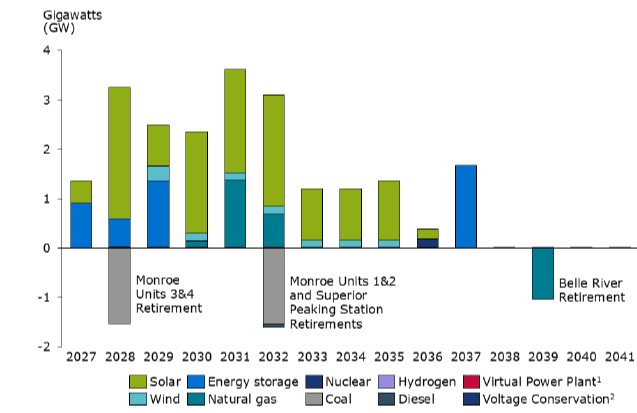
The funding of renewable energy and battery storage by these two data centers are critical components of DTE’s recently proposed Integrated Resource Plan. While the data center agreements will help add renewable resources, this also imposes substantial unanticipated load growth. DTE will be challenged to provide enough power to serve these loads while also planning to retire three GW of coal generation by 2032. DTE’s IRP presents a plan to meet this challenge and remain compliant with Michigan’s RPS mandate through a combination of strategies, including new renewable generation, battery storage, and new natural gas plants (Chart 2).
Chart2
DTE Energy Planned Capacity Changes
Source: DTE 2026 Integrated Resource Plan
DTE’s IRP filing provides a pathway to accommodate new data center load and retire all coal power. By 2041, DTE intends to construct about 15 GW of renewable generation, 4.5 GW of battery storage, as well as two new natural gas peaker plants with a combined 2.1 GW generation capacity.
Discussion and Analysis
Michigan’s two largest electric utilities, together providing about 90 percent of Michigan’s electric power, have provided plans to accommodate substantial data center load growth while meeting RPS requirements. The utility’s filings suggest that compliance is even assisted by these data centers, as they are funding substantial amounts of renewable energy and battery storage.
On the other hand, Consumers Energy and DTE have proposed constructing a combined 3.5 GW of new natural gas generation. Environmental advocates have suggested that these new natural gas plants would not be needed if the utilities did not need to serve new data center load.
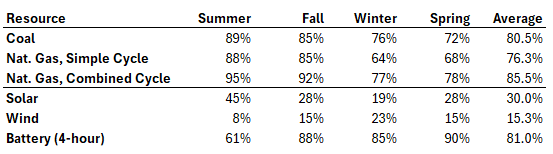
It is theoretically possible to meet current and future loads entirely with renewables and storage, but it’s also very difficult and could be unacceptably costly. Fossil fuel generation is dispatchable–it can be turned on when it is needed. Renewable generation is contingent on climate and weather. When utilities determine how much generation capacity they need to serve a load, they must account for the diminished reliability of renewable generation and make plans based on accredited capacity. Table 1 reflects average accredited capacity as a percentage of installed capacity of existing resources within the MISO region.
Table 1
Unforced capacity as a percentage of installed capacity in MISO
Source: MISO Planning year 2025-2026 Indicative Direct Loss of Load Results
Table 1 does not provide the actual factors that utilities would use to determine their accredited generation capacity, but can be used to provide a general idea of relative reliability and accredited capacity of generation resources. For example, if a utility has a 1 GW (1,000 MW) coal power plant, it can typically count on about 890 MW capacity for planning purposes during the summer. For solar generation, accredited capacity for a 1 GW solar field could range from about 190 MW to 450 MW, depending on the season. The actual calculation of accredited capacity for a specific resource is more complicated than this; real world accreditation factors for solar in Michigan are likely to be lower than these numbers.
Further complicating the issue, power transmission may be the limiting factor, rather than generation. Transmission lines have limited capacity to move electricity from one place to another. Redistributing power generation from a few large fossil fuel plants to a number of smaller renewable generation facilities could require substantial investment in transmission infrastructure – costs that are ultimately imposed on ratepayers.
This all means that if DTE and Consumers Energy did not plan to build 3.5 GW of natural gas generation, they would have to plan to build at least 10 GW of additional renewables (possibly much more), with additional battery storage and transmission infrastructure to help make that power available when and where it is needed. Michigan’s utilities are obligated to meet Michigan’s renewable goals, but they are also obligated to do so without impairing reliability or incurring excessive costs.
DTE and Consumers have presented plans that appear to meet all their regulatory obligations. But these plans may not reflect real-world constraints. These two utilities plan to add over 30 GW of solar generation capacity by 2041, plus substantial wind generation and battery storage (beyond previously planned additions that are now ‘in the pipeline’). This all appears to work out mathematically. But it is an unresolved question if these new resources can be constructed and placed into service on the schedule proposed.
Just looking at solar additions, 30 GW of solar generation would require roughly 150,000 acres of land – or 235 square miles. For reference, a standard Michigan township is 36 square miles (assuming a perfect 6 by 6 mile square). The entire city of Detroit is 139 square miles. Just identifying enough suitable land and securing leases from landowners will be difficult. Getting project approval and procuring the labor and materials to bring these sites online at required pace may prove infeasible.
Conclusion
The intent of this research brief is to determine if data center development in Michigan would make it more or less likely for Michigan to meet its renewable energy portfolio mandate. The conclusion is complicated.
In the short term, serving these loads will require rapid construction of renewable energy generation and supporting infrastructure. Meeting Michigan’s renewable energy goals was always going to be difficult. Meeting these goals in an era of substantial load growth will be even more difficult. It may always have been likely that the required pace of renewable energy additions would trigger the legislated ‘off-ramp,’ and new data center load does make this more likely.
In the long-term, it appears that serving large data center loads will assist utilities in meeting Michigan’s renewable energy goals because data centers are providing substantial funding for renewable energy and battery storage. Additionally, data center contracts have included curtailment provisions – essentially if the utility faces a capacity crunch, the data center has agreed to reduce usage. This reduces the capacity that utilities must plan to provide. While it is not intuitive, it appears that bringing data centers onto Michigan’s grid is likely to help Michigan’s utilities to meet the long-term 60 percent renewable portfolio standard, though utilities may have to delay compliance beyond the 2035 target date.
Research and drafting of this brief was supported by Elijah-Kelly Roberson. Kelly holds a BA in International Relations from Michigan State University. Kelly completed an internship with the Research Council in the Summer of 2026 while pursuing an MPP in Environment, Natural Resources, and Energy Policy at the University of Michigan.
Footnotes
- Additionally, PA 235 requires a “clean energy portfolio” of 80 percent in 2035 and 100 percent in 2040. “Clean energy” generally includes resources that may not be renewable but do not generate greenhouse gas emissions. Meeting clean energy standards will likely require carbon capture and sequestration (CCS) coupled with natural gas generation plants, a technology that has not yet proven commercially viable. Considering the difficulty of forecasting electric market dynamics a decade into the future, this post focuses on the pending RPS standards. ↩︎
- RECs may also be transferred to electric customers and retired by those customers rather than the utility, as to allow customers to meet internal sustainability goals. This dynamic will be used to transfer RECs to Google related to renewable generation that they are funding as part of the data center power purchase agreement with DTE. ↩︎
- An additional issue is that customers who enroll at least 50 percent of their load in a VGP program are exempt from compliance costs of meeting the RPS mandate. When Michigan adopted the VGP legislation in 2016, this made sense – utilities could meet RPS requirements with only 15 percent renewables. However, as of 2035, utilities will be required to meet a 60 percent RPS standard. Under existing law, an electric customer in 2035 could enroll 50 percent of their load from renewable power and avoid paying additional compliance costs, yet receive 60 percent renewable energy. This gap may require utilities to offload additional costs onto other customers if the enabling legislation is not amended. This has been a point of contention with DTE’s service agreement with Google for the Van Buren data center. To address this, DTE has proposed a novel “affordability backstop” mechanism (DTE Reply Brief p. 50). ↩︎
- Non-profit entities are able to receive a direct pay option equivalent to the tax deduction. ↩︎
- “Clean” energy is defined in Section 51 of the Clean and Renewable Energy and Energy Waste Reduction Act, 2008 PA 295, MCL 460.1051. This includes renewable energy, but also generation that does not emit CO2. This includes nuclear power as well as methane generation with carbon capture and sequestration. ↩︎
- Contract specifies up to 480 MW of energy storage, including up to 55 MW of long-duration storage. The majority will likely be 4-hour lithium-ion battery storage. ↩︎
- Analysis was provided in terms of required RECs. It is unclear how much renewable capacity will need to be procured to provide a 10.8 percent increase in RECs. This 10.8 percent increase is incremental to the additional RECs needed to serve the Oracle data center load. ↩︎
- Once DTE meets the 60 percent RPS target, Google plans to enroll its entire load in the VGP program. ↩︎
