



 Lansing
March 24, 2026
In a Nutshell:
- Online sports betting has grown into a multi-billion dollar industry in Michigan over the last six years.
- Problem gambling behaviors have increased due to ubiquitous sports betting apps, leading to financial harm, health issues, and safety concerns.
- Policymakers have options to mitigate the harm caused by gambling addiction while also respecting people’s rights to engage with sports betting as an entertainment product.
Many states, including Michigan, have legalized online gambling and sports betting in the last decade, which has led to a proliferation of the industry and significant economic impact, including tax revenues. Last month, Governor Whitmer presented her Fiscal Year 2026-27 budget recommendations, which included a series of revenue increases aimed at shoring up Medicaid in the wake of changes to federal funding. One of those proposed revenue increases included “updating the state’s internet gaming, sports betting, and online gaming tax structure” with the goal of raising approximately $190 million.
While the Governor identified increased taxes on these activities as a potential source of revenue to fund other priorities, the state’s broader policies related to online gambling and sports betting are due for reevaluation independent of any role they might play in the upcoming budget cycle.
The state-level economic considerations are in the news, but the impact of online gaming and sports betting at the individual level is also worth evaluating now that Michigan has several years of experience with them. Given some of the negative impacts arising from the proliferation of online gambling and sports betting, the state should consider policies aimed at blunting some of the harmful consequences of this aspect of modern life.
How Sports Betting Became Legal
In 1992, Congress passed the Professional and Amateur Sports Protection Act which prohibited states from authorizing sports betting. This law effectively banned betting on sports in most states, but it did not make it a federal crime to bet on sports. In 2018, the U.S. Supreme Court struck down the law on the grounds that Congress could not prohibit state-level legalization in this manner because it violated the anti-commandeering doctrine (which prohibits the federal government from forcing states to implement or enforce federal regulatory programs), opening the door to states allowing sports betting.
Many states, including Michigan in 2019, responded by authorizing some form of sports betting. Forty states currently allow sports betting, 32 allow it online. In Michigan, the Detroit-based and tribal casinos work with platform providers, including well-known national brands like FanDuel and DraftKings, to facilitate the online betting market.
Online Sports Betting Volume and Tax Revenue
Unsurprisingly, sports betting, particularly online sports betting, has become a significant industry in the wake of this wave of legalization. Roughly $150 billion worth of sports bets were recorded nationally in 2024, and the recent pattern of year-over-year growth suggests the 2025 numbers will be even higher. In Michigan, over $5 billion in online sports bets were placed in 2025, with another $130 million in bets made in person. The state collected over $27 million in taxes from online sports betting in 2025, with another $535,000 coming from in person sports bets. Separate tax revenue also goes to the City of Detroit and the federal government. This volume of bets and tax revenues is part of a larger pool of internet gaming (iGaming) that generates an additional $600 million in annual revenue to the state based on $3 billion in activity.
The volume and revenue figures also do not include the emerging “prediction markets” like Kalshi and Polymarket that currently exist outside of the traditional sports betting framework and are operating like financial markets even as they are increasingly similar to traditional gambling. Prediction markets are also noteworthy because the minimum age to participate is 18, whereas most states, including Michigan, set the minimum online sports betting age at 21.
Total Amount of Online Sports Betting Wagers in Michigan, 2021 to 2025
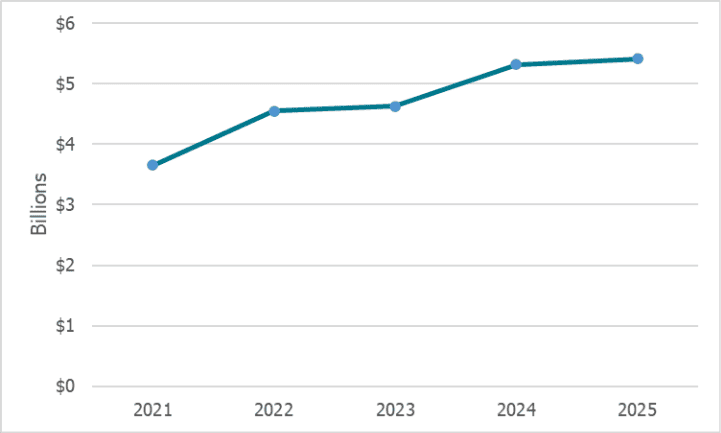
Source: Michigan Gaming Control Board
While the tax revenue generated is an important data point, the broader economic implications are worthy of consideration. The association for the industry, the American Gaming Association, reports the economic impact nationally of the entire industry is about $330 billion annually. While the association does not report individual state estimates, assuming the impact share is roughly equivalent to the amount of activity in each state, its figures imply a $10 billion economic impact in Michigan. Exactly what percentage of that is attributable to sports betting is not clear. Analyses from non-industry sources focus primarily on tax revenue, so a neutral assessment of the total impact is limited, but it seems reasonable to use the industry association’s estimate as the upper bound. Even taking the estimates from the industry as a starting point, other evidence suggests that sports betting has risen at the expense of other economic activity (i.e., replacing existing activity rather than generating new activity) and the job creation is minimal with computers handling the bets, so it is likely that the largest economic consideration is the tax revenue component.
Online Sports Betting Impact
While the direct economic impact is easily measurable through the volume of bets and tax revenue, understanding the other impacts of ubiquitous online sports betting requires a bit more nuance.
Approximately 22 percent of all Americans have at least one sports betting account, including almost half of all men age 18 to 49. Most people who engage with online sports betting do so in a responsible way, but a portion of the population has a problematic relationship with gambling in a way that harms themselves and others, often contributing to spillover societal costs. This includes people with diagnosable gambling addiction and those who experience problematic behaviors but do not meet the criteria for diagnosis.
In particular, the nature of online sports betting makes it especially dangerous for those susceptible to gambling addiction. It is very easy for a person to begin and continue to bet on sports in a way that would not have been possible if sports betting was legalized 20 years ago. In the past, gambling had to happen in-person or through one-to-one communication with a person who managed a gambling operation, either legally or illegally. The modern ability to place bets from anywhere on a smartphone has changed that dynamic. Providers often offer risk-free initial bets and make it easy to load money or credit onto accounts. Technology has also made it very easy to place bets more frequently, as well as micro-bets (i.e., prop bets). Advertising for online sports betting is everywhere, prominently displayed throughout event broadcasts.
The risks are borne out in the data. For example, the legalization of online sports betting has generated a 30 percent increase in gambling problems, with the impact being worse among younger, low-income men. Online sports betting has been associated with an increase in individual bankruptcy filings and decreased credit scores. Studies have found an increase in larceny, vehicle theft, and assaults associated with online sports betting, but perhaps the most notable finding is that sports betting is associated with an increase in intimate partner violence. Sports betting has also brought a rise in the number of athletes receiving harassing messages.
Properly Aligning the Regulatory Framework
The recognition that gambling brings with it negative consequences is certainly not novel and has been the argument for gambling restrictions throughout history. Societies have grappled with if and how to allow people to engage in “vices,” with different approaches gaining favor in different contexts. The Supreme Court’s 2018 ruling offered states a fresh opportunity to consider modern sports betting and many states decided to allow the practice. Six years into legal sports betting in Michigan, policymakers should take a step back to consider steps to mitigate some of the negative consequences now that they are revealing themselves.
In many similar cases, the state balances economic and personal freedom against negative impacts. Even in a framework where the activity is legal, policymakers need to consider if the regulatory framework properly balances the interests of the state, as it does for issues like alcohol, tobacco, and marijuana consumption.
Limiting the Harms of Problem Gambling
Most of the country is grappling with how to limit the harms of legalized online sports betting, and several policy options exist for Michigan and the federal government to act. These policies are generally divided between regulation of the industry itself and supporting resources to help those who develop gambling addiction.
Industry Regulations
One frequently discussed option is the limitation of “prop” or “micro” bets entirely, or at least related to collegiate sports. These kinds of bets, where the action relates to individual events within a game rather than the outcome of a game, are often considered more dangerous given the potentially unlimited number of bets and the subsequent psychological responses that can fuel addiction.
Attention has also been given to limitations on how users can add money to their online accounts to limit the ability for bettors to risk money they do not have. This includes prohibiting the use of credit cards (i.e., ensure the user is not borrowing money to make bets) and restrictions on how often money can be added to an account during a given period of time (e.g., no more than four deposits in 24 hours). Six states ban the use of the credit cards for online sports betting and DraftKings recently announced plans to not accept credit card deposits. Legislation has also been proposed in Congress to prohibit the use of credit cards and set limits on frequent deposits.
Limiting advertising and mandatory disclaimers above and beyond what is already required is also something under consideration, although there are some legal impediments to outright banning advertising. Any measures of this nature would need to be narrowly tailored.
Policymakers may also look to regulate the use of artificial intelligence or other algorithmic approaches by sports betting companies to prohibit them from using customers’ betting history and behaviors to serve them recommended bets in a potentially predatory way.
These options apply to official sports betting operations, but the same principles would apply to prediction market regulation. It is likely that federal legislation or court action would be necessary to implement these policies on prediction markets or to define certain prediction market activity as sports betting under the state’s control.
Resources for Gambling Addiction
Even with additional safeguards within the industry, some people will still develop problematic gambling behaviors, and those behaviors will impact other people in their lives. With that in mind, the state and federal government have options to improve the response to gambling addiction in a few ways.
While Governor Whitmer’s proposed gambling tax increase is aimed at supporting Medicaid, many have proposed increasing the gambling tax rates to fund services for those negatively impacted by gambling in a way that ensures those extra dollars go toward specific programs. The state currently has a Compulsive Gambling Prevention Fund and spent roughly $2.5 million on its Gambling Disorder Treatment and Prevention Program in FY24. The state appropriated additional funds in FY25 with the recognition that problem gambling was increasing as a result of online sports betting.
Broadly, a key approach to gambling addiction and stemming the negative impacts described above is to place gambling addiction in the broader substance use disorder framework. Gambling addiction often overlaps with other issues, such as anxiety, depression, and substance abuse disorders, but much lower percentages of people with gambling problems seek help than those with other types of addictions, often because the resources are not aligned in way that makes it easy to obtain help.
At the state-level, some have suggested coordination between the agency that regulates gaming (the Michigan Gaming Control Board) and the agency responsible for helping people with substance use disorders (primarily the Michigan Department of Health and Human Services (MDHHS)). Michigan’s “Substance Use, Gambling and Epidemiology Strategic Plan” calls for this kind of interagency coordination under the MDHHS Bureau of Specialty Behavioral Health Services, and a similar arrangement exists in Pennsylvania. Cementing this approach for the future is likely to support better service delivery.
Similarly, broadening various legal definitions around substance use disorder to include gambling addiction can help unlock various resources to aid people’s recovery. In some cases, this would just require changing the eligibility for certain programs or grants, such as expanding federal substance abuse block grant to include gambling addiction. A key issue, however, is health insurance coverage. While gambling addiction is a recognized medical condition that medical providers have the ability to bill for, most private insurance plans and Medicaid do not cover treatment for gambling addiction, as no state or federal requirement requires them to do so. Providers attempt to get around these limitations by attempting to cover treatment of a co-occurring issue, but it is not always possible.
States have the ability to require coverage for gambling addiction for plans they regulate, and could include it as a Medicaid requirement, but some plans are only subject to requirements imposed federally. Medicaid is currently facing financial pressure, so adding additional services is not at the top of the agenda. But if gambling tax revenue is ultimately used to shore up the program, it is worth considering whether it is appropriate to ensure people on Medicaid have access to treatment for problem gambling.
Conclusion
In the six years since online sports betting became legal in Michigan, the industry has grown substantially, providing entertainment to many people and tax revenue to support public services. While many people engage with online sports betting responsibly, a portion of the population is susceptible to problematic gambling behaviors that harm themselves and others.
The state has a variety of policy options to blunt some of the negative consequences of online sports betting without abolishing the market for everyone. Alone, or in conjunction with federal action, the state can regulate the industry to limit some of the more dangerous aspects of online sports betting such as prop-bets and credit card deposits. It can also work toward better support for people with gambling addictions by opening up grants and insurance coverage for treatment, as well as working to coordinate between gaming regulation and health agencies.
