



 Lansing
September 8, 2026
Evaluation of Policy Controversies Regarding Hyperscale Data Center Development
Livonia, MI, June 15, 2026 – Citizens Research Council of Michigan today released a comprehensive evaluation of data centers and their ongoing development in Michigan.
Data centers have become a central topic in public policy, politics, and public debate. Trillions of dollars are expected to be invested in data centers globally between 2026 and 2030. Much of this investment is tied to developing artificial intelligence (AI) models that may cause disruptive socioeconomic changes.
“Data center construction brings risks but also potential rewards. If local governments can overcome NIMBYism and approve investments, they could increase the tax base and achieve other benefits,” said Eric Lupher, president of the Citizens Research Council of Michigan.
The report shows that, to some extent, the topic of data center development policy has been oversimplified into a conflict between opposing sides.
On one side are data center proponents. This includes the technology companies behind the investments, economic development professionals seeking to attract such investments, public officials seeking to benefit from tax revenue, and construction firms and labor unions that would benefit from development activities.
On the other side is a wide range of interests that generally share a concern that data center investments will do more harm than good for a variety of societal, economic, and environmental reasons.
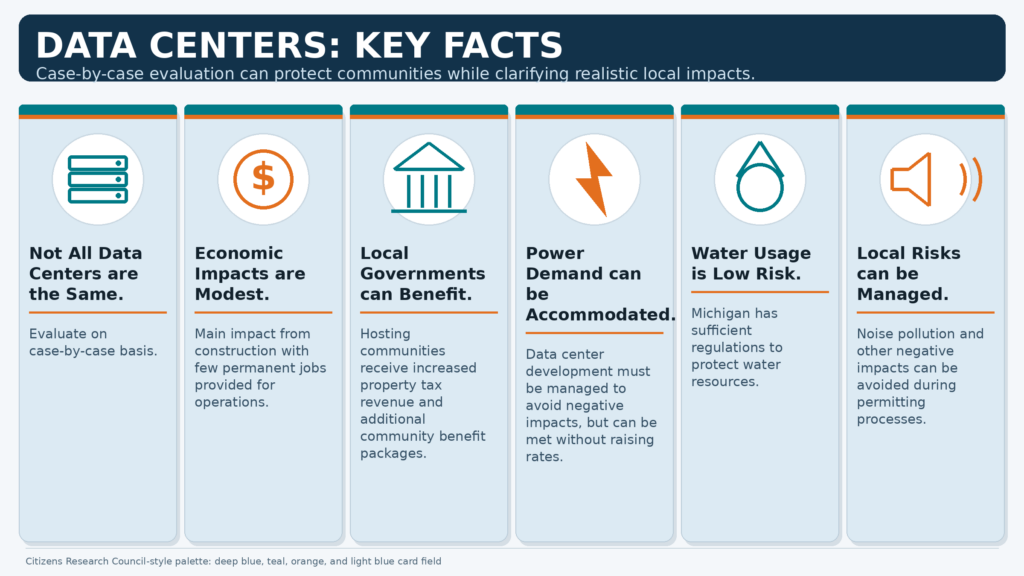
Data center development proposals should be evaluated on a case-by-case basis. While large ‘hyperscale’ facilities should be carefully scrutinized to mitigate potential negative impacts (power demand, water use, noise), many smaller, more typical data centers are nearly indistinguishable from office buildings and provide valuable services to local businesses and other cloud users.
The economic benefits of data center investments are modest. The primary economic activity associated with data centers occurs during the construction phase. Attracting data centers is not an effective approach to long-term economic development. However, local host communities may benefit substantially from property tax revenue and/or community benefit agreements.
The negative impacts of data centers are often overstated. While there is a risk of unsustainable development, Michigan’s water resources and power grid appear capable of accommodating substantial data center development under current policies. The most concerning negative impact of data centers is noise pollution. Protecting nearby residents from the harmful impacts of data center noise is feasible but requires particular attention from local permitting agencies.
###
Founded in 1916, the Citizens Research Council of Michigan works to improve government in Michigan. The organization provides factual, unbiased, independent information concerning significant issues of state and local government organization, policy, and finance. By delivery of this information to policymakers and citizens, the Research Council aims to ensure sound and rational public policy formation in Michigan. For more information, visit www.crcmich.org.
