

Get Involved
Right Arrow
Array
October 1, 2025

Regulation of Large Livestock Farms is Not Working for Farmers or the Environment

In a Nutshell:

  • Concentrated Animal Feed Operations (CAFOs) create immense amounts of animal waste—largely manure. While valuable as fertilizer, CAFO waste is often produced in quantities that exceed local demand. In such areas, CAFO waste is applied in excess and contributes to water pollution.
  • Environmental regulation of CAFOs largely depends on the use of ‘best management practices’ that are costly to farmers and unreliable for pollution control.
  • CAFOs could be permitted in a way that allows more efficient agricultural production while better protecting the environment. Before this approach can be adopted, environmental regulators must have the resources to understand where water pollution is coming from, allowing them to address problem areas without imposing unnecessary restrictions on farming operations.

Introduction

Concentrated Animal Feed Operations (CAFOs) generally describe large livestock farms where animals are confined within a relatively small area, rather than being fed through grazing or foraging in open fields.1 These facilities are designed for cost-efficient large-scale production of meat, milk, or eggs, and have become critical in global food supply chains. While CAFOs help meet demand for affordable protein, they also generate large quantities of animal waste that can pose environmental and public health concerns.

CAFO waste is primarily manure and is usually disposed of by application to crop fields as an organic fertilizer. When applied appropriately, the land-application of manure is a sustainable and beneficial practice. However, CAFOs are industrial-scale agricultural operations, and produce industrial quantities of waste. When more manure is spread on a field than can be taken up by the land, the waste may leach into groundwater or run off into surface waters and pollute rivers, lakes, and streams.

Current approaches to CAFO waste regulation have imposed costly restrictions on farmers without adequately protecting Michigan’s environment and residents. The environmental and public health threats of CAFO waste deserve increased attention from Michigan policymakers.

Environmental Impacts of CAFO Waste

CAFO waste can take a variety of forms depending on the operation that produces the waste,2 resulting in a variety of potential hazards. The bulk of CAFO waste is manure, but may also contain other animal wastes, pharmaceuticals, pesticides, and numerous chemicals used in agricultural production.

The impact of agricultural operations on water quality has been a concern for decades. CAFOs amplify these issues due to the immense amounts of waste that they produce in a single location. While manure is a valuable fertilizer, transporting it is expensive. The cost of transporting CAFO waste only one mile can exceed the value of the waste as fertilizer. Thus, most CAFO waste is applied to fields within 2.5 miles of the CAFO.

When multiple CAFOs are located in an area, the economics of manure management can reverse. Rather than manure providing value as fertilizer, crop fields provide value as a means of waste disposal. When manure is over-applied, it is no longer beneficial as fertilizer; the soil is oversaturated with more nutrients than can be held in the soil or used by the crops. Excess nutrients in such fields often leach into groundwater or run-off as surface water pollution.

CAFOs tend to be geographically clustered in a few areas of Michigan. Figure 1 shows the location of 271 permitted CAFOs and permitted CAFO land application fields in Michigan’s counties.

Figure 1
Permitted CAFOs and Land Application Fields by County
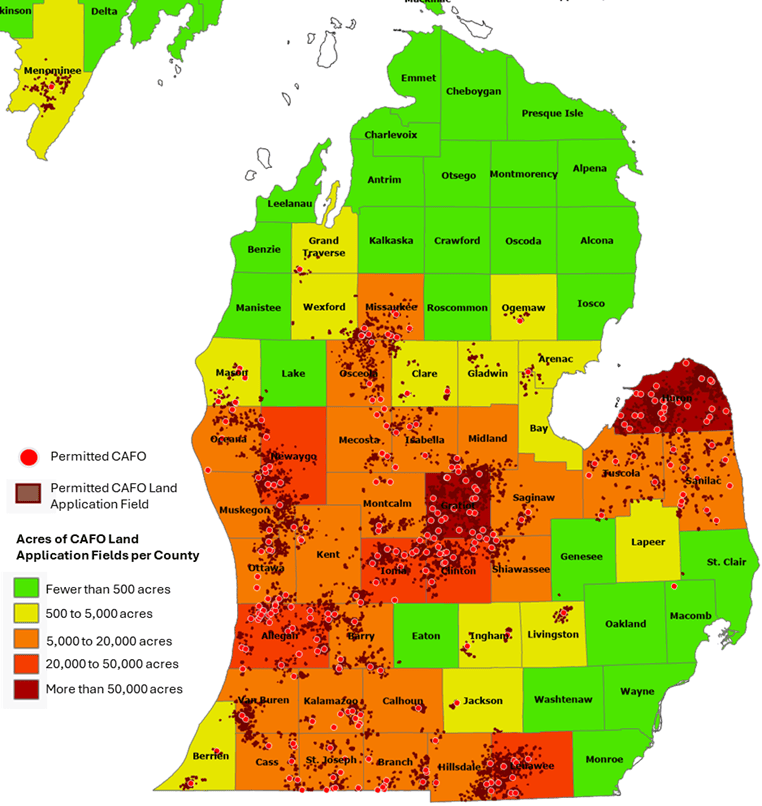
County map of lower Michigan. Counties are color-coded by acres of permitted CAFO land-application fields.

Source: Michigan Department of Environment, Great Lakes, and Energy
Note: Menominee is the only county in the upper penninsula with any permitted CAFOs or land-application fields.

As might be expected, CAFOs are concentrated in rural counties ranging from southwest to mid-Michigan, as well as the ‘thumb’ region. Huron County hosts the greatest area of permitted land disposal fields with over 83,000 acres. Ranked second is Gratiot County in mid-Michigan with about 55,000 acres.

Only about half of CAFO waste is applied to permitted fields. CAFO waste that is not applied to permitted fields is typically “manifested” and applied to non-permitted fields. Considering the costs of transporting CAFO waste, most of it is likely applied in the same general areas as the permitted fields. The localized concentration of land disposal fields around CAFOs may impose more localized risks to water quality.3

In groundwater, CAFO pollution can render drinking water wells unusable due to nitrate contamination. It remains unclear how widespread nitrate contamination of groundwater is in Michigan. The most recent available data was collected over 20 years ago. CAFO waste may also contaminate wells with infectious pathogens such as Cryptosporidium and Salmonella. Nearly half of Michigan’s population draws drinking water from wells, often in the same areas where CAFOs are prevalent.

In surface waters, nutrient pollution can promote uncontrolled growth of algae and aquatic plants, leading to a condition called eutrophication. Eutrophic waters are almost entirely devoid of dissolved oxygen. This can cause fish kills and harm to numerous aquatic species. Eutrophic waters are also generally undesirable for recreation, as oxygen depleted waters are usually choked with decomposing plant and algae material, resulting in the septic smell of methane.

Waters that are not so nutrient-rich as to become eutrophic can still be impacted when excess nutrients fuel a harmful algal bloom (HAB). HABs refer to rapid concentrated growth of a type of algae (cyanobacteria) that produces something called cyanotoxin. Dozens of Michigan’s inland lakes have documented cyanobacteria blooms,4 as well as some areas in the Great Lakes.5 Figure 3 shows satellite monitoring of a September 2025 HAB in the western Lake Erie basin, which has become a regular occurrence.

Figure 2
Satellite monitoring of a harmful algal bloom (HAB) in western Lake Erie, September 1, 2025.6
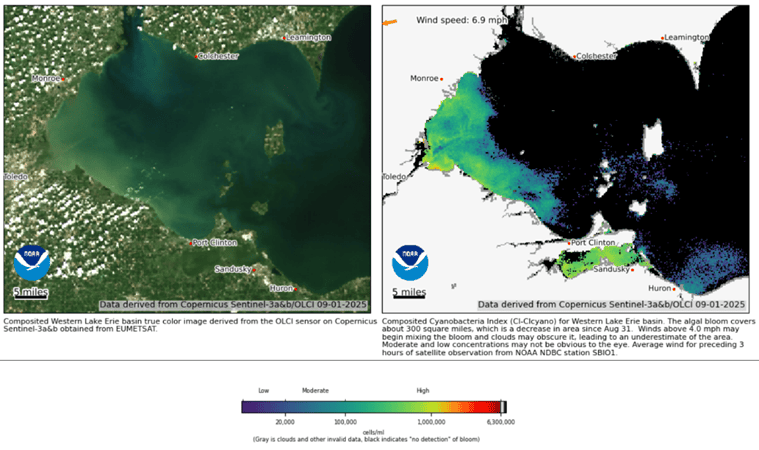
Screen shot of NOAA satelite monitoring of HAB nloom in western Lake Erie basin.

Source: National Oceanic and Atmospheric Administration

Exposure to cyanotoxin can lead to various health problems, including skin rashes, gastrointestinal issues, liver and kidney damage, and in severe cases, even death. Cyanotoxin is difficult to filter out of water, making this a threat to drinking water sources. Cyanotoxin can even become airborne when water is disturbed, such as by wind and waves.

Figure 3
A harmful algal bloom with telltale green water in Lake Erie at Luna Pier, Michigan (south of the River Raisin outlet).
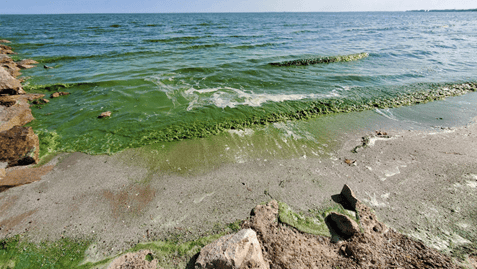
Water the color of pea soup laps up against a sandy beach.

Source: Michigan EGLE

CAFO runoff may also include E. coli, a bacteria with the potential to cause severe gastrointestinal illness. E. coli pollution in state of Michigan waters has increased significantly in recent years. Approximately 50 percent of Michigan’s rivers and streams are not meeting water quality standards for E. coli, and roughly 20 percent of Michigan’s beaches have been closed at some point due to bacterial pollution.7

Uncertainty of CAFO Contribution to Pollution

It is important to recognize that the overall contribution to water pollution from CAFOs is very unclear.

The most problematic constituents of animal waste (including nitrogen, phosphorus, and E. coli) are also present in other sources of pollution. Other sources may include smaller non-CAFO agricultural facilities, urban surface runoff, municipal sewage overflows, and failing septic systems.

These contaminants may also be naturally present in the environment. Algal blooms may be driven by runoff from naturally nutrient rich soils, and e. coli may be related to wild animal feces.

That said, there is a preponderance of evidence that CAFOs have become a significant source of water pollution in Michigan. In January 2025, an Administrative Law Judge found that “as a Matter of Fact” CAFOs contribute both nutrient and E. coli pollution to Michigan’s rivers and lakes.

Michigan CAFO Permitting Controversy

Large CAFOs are regulated through both federal and state law. Generally, they are required to obtain a permit through the National Pollutant Discharge Elimination System (NPDES) under the federal Clean Water Act (CWA), as adopted into state law through the Michigan Natural Resources and Environmental Protection Act (NREPA). The Michigan Department of Environment, Great Lakes, and Energy (EGLE) is responsible for permit administration in Michigan. While some CAFOs receive individual permits, most receive a certificate of coverage under a statewide general permit. This lowers administrative costs for both the CAFO and EGLE.

EGLE’s Water Resources Division (WRD) has become increasingly concerned with CAFO pollution. In 2020, WRD issued a revised CAFO general permit with more stringent conditions. The 2020 permit was challenged by CAFO interests, both through Michigan’s Administrative Procedures Act and through the court system. The challenges have not yet been entirely resolved and the 2020 general permit was never enacted. As of publication (October 1, 2025), most CAFO’s continue to operate under the less stringent 2015 general permit, which is widely believed to be inadequate.

To understand the root of the permit controversy, it is necessary to understand something about how CAFOs are regulated under the Clean Water Act. Other NPDES permittees (e.g., wastewater treatment plants and industrial facilities) are permitted to discharge a specific amount of waste through a “point source” such as a pipe or culvert. In contrast, CAFOs are not permitted to discharge any specific amount of waste. Instead they are required to operate with “best management practices” (BMPs) that are intended to prevent discharge of waste into surface waters.8

Current approaches to CAFO regulation impose cost on farmers without reliably protecting the environment.

There are two important things to note about relying on best management practices for CAFO pollution control:

First, many BMPs impose economic costs on farmers. For example, a permit may require that CAFO waste not be spread on crop fields within a 100-ft wide buffer adjacent to any waterway (including agricultural ditches and county drains). This requires the farmer to use chemical fertilizers within that buffer zone, imposing additional material and labor costs. An alternative BMP may require the use of 35-foot-wide “vegetative strips” along waterways. This would require growing low-value perennial crops in certain strips or possibly taking the land out of production. For some farmers, implementing vegetative strips requires not growing crops (or growing low-value crops) on a significant percentage of their land. Generally, many BMPs that are intended to prevent water pollution also impose costs and decrease revenue for agricultural producers.

The second important feature of BMPs is that they do not reliably prevent discharge of waste and associated pollution. Farm fields can be very different and have very different pollution risk profiles. This can depend on things like soil type, slope of the land, distance to sensitive bodies of water, the use of drain tiles, and much more. For example, farmers that do not spread manure within a 100-foot buffer zone often still use chemical fertilizer, which also contains problematic nutrients and can contribute to pollution. The use of vegetative strips may only temporarily store nutrients such as phosphorus and release it into the environment in the winter when the plants die. Overall, the use of BMPs is ineffective in some fields, and may be unnecessary in others.

A central aspect of the CAFO industry’s challenge to the 2020 general permit is that it included more stringent BMPs and operational requirements that would impose unnecessary costs without providing additional environmental protection.

Environmental groups agree that the 2020 general permit would not reliably prevent water pollution and have petitioned for a general permit with even more stringent BMPs.

The crux of this controversy is that the basic approach to CAFO NPDES permitting imposes costs on farmers without reliably protecting water resources. This is a weakness with the federal Clean Water Act. Michigan policymakers cannot amend the CWA, but it is possible to work within existing frameworks more effectively.

EGLE Needs More Resources to Permit CAFOs for Efficient Agricultural Production and Environmental Protection

Michigan’s future is tied both to the health of its agricultural industry and the sustainable management of water resources. Ideally, regulation of CAFOs would prevent pollution that contaminates groundwater and impairs surface waters—without imposing unnecessary restrictions and cost burdens on agricultural facilities.

This can be done, but there is a prerequisite; policymakers need better data regarding the contribution of CAFO waste to water pollution.

In recent years, EGLE has identified numerous water quality problems around Michigan. EGLE’s latest CWA Water Quality Report lists nearly 1,500 known impairments of surface waters where levels of pollution do not support a designated use such as fish consumption or recreational contact. There is some evidence that water quality in Michigan is getting worse. However, the specific source of the pollution is rarely clear.

There are tests and procedures that can determine where water pollution originates. But EGLE’s Water Resources Division does not have the capacity to routinely conduct such tests, or even consistently monitor water quality in many areas of the state.

Discussions around EGLE’s 2020 CAFO general permit show agreement that the concentration of CAFOs is correlated with water pollution. However, the extent to which CAFOs cause water quality problems is not known. Pollution may also be related to failing septic systems, urban runoff, non-permitted agricultural facilities, or a host of other sources. With better data, EGLE would be able to focus on specific sources of pollution rather than imposing more stringent requirements on all permitted CAFOs.

To obtain this data, EGLE needs more support from the legislature. EGLE’s budget has increased in recent years, but still falls short of what is needed to adequately track and remediate polluted areas in Michigan.

One potential source of revenue is the CAFO permits themselves. Michigan’s NPDES permit fees are set by the legislature and have not changed since 2003. Most CAFOs pay $600  annually. Considering that a CAFO NPDES permit may cover thousands of acres of land-application fields, this fee covers only a fraction of the costs necessary to monitor compliance and identify issues. By comparison, the smallest municipal wastewater treatment plants pay an annual fee of $5,500. For larger facilities, fees range up to $213,000.9

With more funding, EGLE could focus on the sources of water pollution rather than imposing operational restrictions on all CAFOs.

It is critical that EGLE’s Water Resources Division is equipped with the budget and resources to monitor pollution and identify the source. EGLE is statutorily mandated to enforce environmental laws such as the Clean Water Act. If EGLE lacks the resources to prevent pollution, this could make the state of Michigan vulnerable to citizen lawsuits or enforcement by the federal EPA.

Increasing EGLEs budget could provide the WRD the resources needed to obtain better data on water pollution, protect Michigan’s environment, and adopt an approach to CAFO NPDES permitting that targets problem polluters. Many CAFOs are likely not problem polluters and can be permitted in such a way that costly and unnecessary BMPs are not required.

To protect Michigan’s water resources and agricultural industry, policymakers should provide more support to EGLE—specifically the Water Resources Division.

Summary

CAFOs are contributing to water pollution in Michigan, but the extent of the problem is largely unknown. EGLE’s approach to CAFO permitting relies on costly best management practices that are often ineffective. This has resulted in continual controversy between environmental protection groups and agricultural interests. This ongoing dispute is unnecessary.

Nobody is arguing that CAFOs have a right to pollute Michigan’s waters. The arguments center around how best to protect the environment without imposing excessive restrictions. With more data, EGLE could better understand where water pollution is coming from. This would allow EGLE’s Water Resources Division to work with problem polluters to maintain water quality, while allowing typical CAFOs and farmers to operate more efficiently.

EGLE’s Water Resources Division needs more support and funding to make this happen. Policymakers should support EGLE as necessary to support Michigan’s agricultural industry while protecting natural water resources. Sustainable management of agriculture and water is critical for Michigan’s future prospects.

Ongoing Research

As of October 1, 2025, there are pending policy decisions that will impact State oversight of CAFOs. Most Michigan CAFOs continue to operate under administrative extension of the 2015 general permit, which expired in 2020. The 2020 permit has cleared multiple legal challenges, but EGLE’s Water Resources Division and several environmental groups have petitioned for more stringent requirements. The next step is an administrative decision by the Director of EGLE, which is expected in the coming weeks. Additionally, ongoing budget discussions may impact EGLE’s relevant resources and administrative capacity to monitor and enforce compliance with environmental protection laws, including NPDES permits.

Considering the importance of this issue to Michigan’s environment, farmers, and residents, the Citizens Research Council will provide future research and analysis as necessary to best inform citizens and policymakers.10


Footnotes

  1. CAFOs are legally defined as large animal feed operations where animals are kept indoors at least 45 days per year. Most permitted CAFOs keep livestock confined for the full year. ↩︎
  2. E.g., types of animals, manure handling processes, etc. ↩︎
  3. While this post will focus on water pollution, CAFO waste may also create air pollution in the form of noxious fumes laden with hydrogen sulfide, ammonia, or methane compounds. Solid waste may be emitted as dust, risking exposure to airborne fecal matter, infectious bacteria, allergens, and other toxic microparticles. Notably, CAFOs are generally exempt from the federal Clean Air Act. ↩︎
  4. Most HABs likely go undetected. While extreme HABs may create telltale green water, many HABs can produce harmful levels of cyanotoxin without a visible change in water condition. ↩︎
  5. Especially Saginaw Bay and Western Lake Erie. ↩︎
  6. CAFOs and agricultural runoff in Michigan’s River Raisin watershed have been identified as contributing to this issue. ↩︎
  7. Long-term trends in E. coli pollution in Michigan are unclear due to lack of comprehensive data. EGLE adopted a statewide TMDL for e.coli in 2019 and has ramped-up monitoring activities. Listing of impaired waters and beach closures may be increasing due to improved data collection, rather than increasing pollution. Ongoing data collection is needed to assess current trends. ↩︎
  8. The regulation of CAFOs under the CWA is complicated and often unclear. CAFOs obtain an NPDES permit for discharge of pollution, but are not permitted to discharge any amount of pollution. Instead, the permits require BMPs that, ideally, would prevent pollution. But it is recognized that whenever CAFO waste is land-applied to farm fields, there is always a risk that the waste might contribute to water pollution. As such, if a CAFO is found to be in compliance with the BMPs required by the NPDES permit, any pollution discharge from the CAFO or permitted fields is considered a permitted discharge. ↩︎
  9. Notably, NPDES permit fees in Michigan appear to have expired as of October 1, 2025. It is unclear if any bills have been introduced to extend the sunset provision, if current permit fees will remain under administrative extension, or if fees will be rescinded pending legislative action. (MCL 234.3120) ↩︎
  10. CRC welcomes all comments and input on our research and analysis. Feedback can be directed to Eric Paul Dennis, epdennis@crcmich.org. ↩︎

Acknowledgements

This research was supported by Alikhan (Ali) Turmakhanov. Ali is a studying polital science/pre-law at Michigan State University. Ali’s summer 2025 internship with the Citizen’s Research Council focused on regulatory issues with water resource management. Ali identified CAFOs as a critical challenge within broader environmental policy and provided much of the initial research supporting this post.

Research Associate - Infrastructure

About The Author

Eric Paul Dennis

Research Associate - Infrastructure

Eric joined the Citizens Research Council in 2022 as an expert in civil infrastructure policy. Previous to his position with the Research Council, Eric spent nearly ten years as a transportation systems analyst, focusing on the policy implications of emerging technologies such as autonomous vehicles, connected vehicles, and intelligent transportation systems. Eric has been a Michigan-licensed professional engineer (PE) since 2012. As a practicing engineer, Eric has design and project experience across multiple domains, including highways, airfields, telecommunications, and watershed management. Eric received his Bachelor’s degree in civil engineering from Michigan State University in 2006. Eric also holds Masters degrees in environmental engineering and urban/regional planning, both from the University of Michigan.

Regulation of Large Livestock Farms is Not Working for Farmers or the Environment

In a Nutshell:

  • Concentrated Animal Feed Operations (CAFOs) create immense amounts of animal waste—largely manure. While valuable as fertilizer, CAFO waste is often produced in quantities that exceed local demand. In such areas, CAFO waste is applied in excess and contributes to water pollution.
  • Environmental regulation of CAFOs largely depends on the use of ‘best management practices’ that are costly to farmers and unreliable for pollution control.
  • CAFOs could be permitted in a way that allows more efficient agricultural production while better protecting the environment. Before this approach can be adopted, environmental regulators must have the resources to understand where water pollution is coming from, allowing them to address problem areas without imposing unnecessary restrictions on farming operations.

Introduction

Concentrated Animal Feed Operations (CAFOs) generally describe large livestock farms where animals are confined within a relatively small area, rather than being fed through grazing or foraging in open fields.1 These facilities are designed for cost-efficient large-scale production of meat, milk, or eggs, and have become critical in global food supply chains. While CAFOs help meet demand for affordable protein, they also generate large quantities of animal waste that can pose environmental and public health concerns.

CAFO waste is primarily manure and is usually disposed of by application to crop fields as an organic fertilizer. When applied appropriately, the land-application of manure is a sustainable and beneficial practice. However, CAFOs are industrial-scale agricultural operations, and produce industrial quantities of waste. When more manure is spread on a field than can be taken up by the land, the waste may leach into groundwater or run off into surface waters and pollute rivers, lakes, and streams.

Current approaches to CAFO waste regulation have imposed costly restrictions on farmers without adequately protecting Michigan’s environment and residents. The environmental and public health threats of CAFO waste deserve increased attention from Michigan policymakers.

Environmental Impacts of CAFO Waste

CAFO waste can take a variety of forms depending on the operation that produces the waste,2 resulting in a variety of potential hazards. The bulk of CAFO waste is manure, but may also contain other animal wastes, pharmaceuticals, pesticides, and numerous chemicals used in agricultural production.

The impact of agricultural operations on water quality has been a concern for decades. CAFOs amplify these issues due to the immense amounts of waste that they produce in a single location. While manure is a valuable fertilizer, transporting it is expensive. The cost of transporting CAFO waste only one mile can exceed the value of the waste as fertilizer. Thus, most CAFO waste is applied to fields within 2.5 miles of the CAFO.

When multiple CAFOs are located in an area, the economics of manure management can reverse. Rather than manure providing value as fertilizer, crop fields provide value as a means of waste disposal. When manure is over-applied, it is no longer beneficial as fertilizer; the soil is oversaturated with more nutrients than can be held in the soil or used by the crops. Excess nutrients in such fields often leach into groundwater or run-off as surface water pollution.

CAFOs tend to be geographically clustered in a few areas of Michigan. Figure 1 shows the location of 271 permitted CAFOs and permitted CAFO land application fields in Michigan’s counties.

Figure 1
Permitted CAFOs and Land Application Fields by County

County map of lower Michigan. Counties are color-coded by acres of permitted CAFO land-application fields.

Source: Michigan Department of Environment, Great Lakes, and Energy
Note: Menominee is the only county in the upper penninsula with any permitted CAFOs or land-application fields.

As might be expected, CAFOs are concentrated in rural counties ranging from southwest to mid-Michigan, as well as the ‘thumb’ region. Huron County hosts the greatest area of permitted land disposal fields with over 83,000 acres. Ranked second is Gratiot County in mid-Michigan with about 55,000 acres.

Only about half of CAFO waste is applied to permitted fields. CAFO waste that is not applied to permitted fields is typically “manifested” and applied to non-permitted fields. Considering the costs of transporting CAFO waste, most of it is likely applied in the same general areas as the permitted fields. The localized concentration of land disposal fields around CAFOs may impose more localized risks to water quality.3

In groundwater, CAFO pollution can render drinking water wells unusable due to nitrate contamination. It remains unclear how widespread nitrate contamination of groundwater is in Michigan. The most recent available data was collected over 20 years ago. CAFO waste may also contaminate wells with infectious pathogens such as Cryptosporidium and Salmonella. Nearly half of Michigan’s population draws drinking water from wells, often in the same areas where CAFOs are prevalent.

In surface waters, nutrient pollution can promote uncontrolled growth of algae and aquatic plants, leading to a condition called eutrophication. Eutrophic waters are almost entirely devoid of dissolved oxygen. This can cause fish kills and harm to numerous aquatic species. Eutrophic waters are also generally undesirable for recreation, as oxygen depleted waters are usually choked with decomposing plant and algae material, resulting in the septic smell of methane.

Waters that are not so nutrient-rich as to become eutrophic can still be impacted when excess nutrients fuel a harmful algal bloom (HAB). HABs refer to rapid concentrated growth of a type of algae (cyanobacteria) that produces something called cyanotoxin. Dozens of Michigan’s inland lakes have documented cyanobacteria blooms,4 as well as some areas in the Great Lakes.5 Figure 3 shows satellite monitoring of a September 2025 HAB in the western Lake Erie basin, which has become a regular occurrence.

Figure 2
Satellite monitoring of a harmful algal bloom (HAB) in western Lake Erie, September 1, 2025.6

Screen shot of NOAA satelite monitoring of HAB nloom in western Lake Erie basin.

Source: National Oceanic and Atmospheric Administration

Exposure to cyanotoxin can lead to various health problems, including skin rashes, gastrointestinal issues, liver and kidney damage, and in severe cases, even death. Cyanotoxin is difficult to filter out of water, making this a threat to drinking water sources. Cyanotoxin can even become airborne when water is disturbed, such as by wind and waves.

Figure 3
A harmful algal bloom with telltale green water in Lake Erie at Luna Pier, Michigan (south of the River Raisin outlet).

Water the color of pea soup laps up against a sandy beach.

Source: Michigan EGLE

CAFO runoff may also include E. coli, a bacteria with the potential to cause severe gastrointestinal illness. E. coli pollution in state of Michigan waters has increased significantly in recent years. Approximately 50 percent of Michigan’s rivers and streams are not meeting water quality standards for E. coli, and roughly 20 percent of Michigan’s beaches have been closed at some point due to bacterial pollution.7

Uncertainty of CAFO Contribution to Pollution

It is important to recognize that the overall contribution to water pollution from CAFOs is very unclear.

The most problematic constituents of animal waste (including nitrogen, phosphorus, and E. coli) are also present in other sources of pollution. Other sources may include smaller non-CAFO agricultural facilities, urban surface runoff, municipal sewage overflows, and failing septic systems.

These contaminants may also be naturally present in the environment. Algal blooms may be driven by runoff from naturally nutrient rich soils, and e. coli may be related to wild animal feces.

That said, there is a preponderance of evidence that CAFOs have become a significant source of water pollution in Michigan. In January 2025, an Administrative Law Judge found that “as a Matter of Fact” CAFOs contribute both nutrient and E. coli pollution to Michigan’s rivers and lakes.

Michigan CAFO Permitting Controversy

Large CAFOs are regulated through both federal and state law. Generally, they are required to obtain a permit through the National Pollutant Discharge Elimination System (NPDES) under the federal Clean Water Act (CWA), as adopted into state law through the Michigan Natural Resources and Environmental Protection Act (NREPA). The Michigan Department of Environment, Great Lakes, and Energy (EGLE) is responsible for permit administration in Michigan. While some CAFOs receive individual permits, most receive a certificate of coverage under a statewide general permit. This lowers administrative costs for both the CAFO and EGLE.

EGLE’s Water Resources Division (WRD) has become increasingly concerned with CAFO pollution. In 2020, WRD issued a revised CAFO general permit with more stringent conditions. The 2020 permit was challenged by CAFO interests, both through Michigan’s Administrative Procedures Act and through the court system. The challenges have not yet been entirely resolved and the 2020 general permit was never enacted. As of publication (October 1, 2025), most CAFO’s continue to operate under the less stringent 2015 general permit, which is widely believed to be inadequate.

To understand the root of the permit controversy, it is necessary to understand something about how CAFOs are regulated under the Clean Water Act. Other NPDES permittees (e.g., wastewater treatment plants and industrial facilities) are permitted to discharge a specific amount of waste through a “point source” such as a pipe or culvert. In contrast, CAFOs are not permitted to discharge any specific amount of waste. Instead they are required to operate with “best management practices” (BMPs) that are intended to prevent discharge of waste into surface waters.8

Current approaches to CAFO regulation impose cost on farmers without reliably protecting the environment.

There are two important things to note about relying on best management practices for CAFO pollution control:

First, many BMPs impose economic costs on farmers. For example, a permit may require that CAFO waste not be spread on crop fields within a 100-ft wide buffer adjacent to any waterway (including agricultural ditches and county drains). This requires the farmer to use chemical fertilizers within that buffer zone, imposing additional material and labor costs. An alternative BMP may require the use of 35-foot-wide “vegetative strips” along waterways. This would require growing low-value perennial crops in certain strips or possibly taking the land out of production. For some farmers, implementing vegetative strips requires not growing crops (or growing low-value crops) on a significant percentage of their land. Generally, many BMPs that are intended to prevent water pollution also impose costs and decrease revenue for agricultural producers.

The second important feature of BMPs is that they do not reliably prevent discharge of waste and associated pollution. Farm fields can be very different and have very different pollution risk profiles. This can depend on things like soil type, slope of the land, distance to sensitive bodies of water, the use of drain tiles, and much more. For example, farmers that do not spread manure within a 100-foot buffer zone often still use chemical fertilizer, which also contains problematic nutrients and can contribute to pollution. The use of vegetative strips may only temporarily store nutrients such as phosphorus and release it into the environment in the winter when the plants die. Overall, the use of BMPs is ineffective in some fields, and may be unnecessary in others.

A central aspect of the CAFO industry’s challenge to the 2020 general permit is that it included more stringent BMPs and operational requirements that would impose unnecessary costs without providing additional environmental protection.

Environmental groups agree that the 2020 general permit would not reliably prevent water pollution and have petitioned for a general permit with even more stringent BMPs.

The crux of this controversy is that the basic approach to CAFO NPDES permitting imposes costs on farmers without reliably protecting water resources. This is a weakness with the federal Clean Water Act. Michigan policymakers cannot amend the CWA, but it is possible to work within existing frameworks more effectively.

EGLE Needs More Resources to Permit CAFOs for Efficient Agricultural Production and Environmental Protection

Michigan’s future is tied both to the health of its agricultural industry and the sustainable management of water resources. Ideally, regulation of CAFOs would prevent pollution that contaminates groundwater and impairs surface waters—without imposing unnecessary restrictions and cost burdens on agricultural facilities.

This can be done, but there is a prerequisite; policymakers need better data regarding the contribution of CAFO waste to water pollution.

In recent years, EGLE has identified numerous water quality problems around Michigan. EGLE’s latest CWA Water Quality Report lists nearly 1,500 known impairments of surface waters where levels of pollution do not support a designated use such as fish consumption or recreational contact. There is some evidence that water quality in Michigan is getting worse. However, the specific source of the pollution is rarely clear.

There are tests and procedures that can determine where water pollution originates. But EGLE’s Water Resources Division does not have the capacity to routinely conduct such tests, or even consistently monitor water quality in many areas of the state.

Discussions around EGLE’s 2020 CAFO general permit show agreement that the concentration of CAFOs is correlated with water pollution. However, the extent to which CAFOs cause water quality problems is not known. Pollution may also be related to failing septic systems, urban runoff, non-permitted agricultural facilities, or a host of other sources. With better data, EGLE would be able to focus on specific sources of pollution rather than imposing more stringent requirements on all permitted CAFOs.

To obtain this data, EGLE needs more support from the legislature. EGLE’s budget has increased in recent years, but still falls short of what is needed to adequately track and remediate polluted areas in Michigan.

One potential source of revenue is the CAFO permits themselves. Michigan’s NPDES permit fees are set by the legislature and have not changed since 2003. Most CAFOs pay $600  annually. Considering that a CAFO NPDES permit may cover thousands of acres of land-application fields, this fee covers only a fraction of the costs necessary to monitor compliance and identify issues. By comparison, the smallest municipal wastewater treatment plants pay an annual fee of $5,500. For larger facilities, fees range up to $213,000.9

With more funding, EGLE could focus on the sources of water pollution rather than imposing operational restrictions on all CAFOs.

It is critical that EGLE’s Water Resources Division is equipped with the budget and resources to monitor pollution and identify the source. EGLE is statutorily mandated to enforce environmental laws such as the Clean Water Act. If EGLE lacks the resources to prevent pollution, this could make the state of Michigan vulnerable to citizen lawsuits or enforcement by the federal EPA.

Increasing EGLEs budget could provide the WRD the resources needed to obtain better data on water pollution, protect Michigan’s environment, and adopt an approach to CAFO NPDES permitting that targets problem polluters. Many CAFOs are likely not problem polluters and can be permitted in such a way that costly and unnecessary BMPs are not required.

To protect Michigan’s water resources and agricultural industry, policymakers should provide more support to EGLE—specifically the Water Resources Division.

Summary

CAFOs are contributing to water pollution in Michigan, but the extent of the problem is largely unknown. EGLE’s approach to CAFO permitting relies on costly best management practices that are often ineffective. This has resulted in continual controversy between environmental protection groups and agricultural interests. This ongoing dispute is unnecessary.

Nobody is arguing that CAFOs have a right to pollute Michigan’s waters. The arguments center around how best to protect the environment without imposing excessive restrictions. With more data, EGLE could better understand where water pollution is coming from. This would allow EGLE’s Water Resources Division to work with problem polluters to maintain water quality, while allowing typical CAFOs and farmers to operate more efficiently.

EGLE’s Water Resources Division needs more support and funding to make this happen. Policymakers should support EGLE as necessary to support Michigan’s agricultural industry while protecting natural water resources. Sustainable management of agriculture and water is critical for Michigan’s future prospects.

Ongoing Research

As of October 1, 2025, there are pending policy decisions that will impact State oversight of CAFOs. Most Michigan CAFOs continue to operate under administrative extension of the 2015 general permit, which expired in 2020. The 2020 permit has cleared multiple legal challenges, but EGLE’s Water Resources Division and several environmental groups have petitioned for more stringent requirements. The next step is an administrative decision by the Director of EGLE, which is expected in the coming weeks. Additionally, ongoing budget discussions may impact EGLE’s relevant resources and administrative capacity to monitor and enforce compliance with environmental protection laws, including NPDES permits.

Considering the importance of this issue to Michigan’s environment, farmers, and residents, the Citizens Research Council will provide future research and analysis as necessary to best inform citizens and policymakers.10


Footnotes

  1. CAFOs are legally defined as large animal feed operations where animals are kept indoors at least 45 days per year. Most permitted CAFOs keep livestock confined for the full year. ↩︎
  2. E.g., types of animals, manure handling processes, etc. ↩︎
  3. While this post will focus on water pollution, CAFO waste may also create air pollution in the form of noxious fumes laden with hydrogen sulfide, ammonia, or methane compounds. Solid waste may be emitted as dust, risking exposure to airborne fecal matter, infectious bacteria, allergens, and other toxic microparticles. Notably, CAFOs are generally exempt from the federal Clean Air Act. ↩︎
  4. Most HABs likely go undetected. While extreme HABs may create telltale green water, many HABs can produce harmful levels of cyanotoxin without a visible change in water condition. ↩︎
  5. Especially Saginaw Bay and Western Lake Erie. ↩︎
  6. CAFOs and agricultural runoff in Michigan’s River Raisin watershed have been identified as contributing to this issue. ↩︎
  7. Long-term trends in E. coli pollution in Michigan are unclear due to lack of comprehensive data. EGLE adopted a statewide TMDL for e.coli in 2019 and has ramped-up monitoring activities. Listing of impaired waters and beach closures may be increasing due to improved data collection, rather than increasing pollution. Ongoing data collection is needed to assess current trends. ↩︎
  8. The regulation of CAFOs under the CWA is complicated and often unclear. CAFOs obtain an NPDES permit for discharge of pollution, but are not permitted to discharge any amount of pollution. Instead, the permits require BMPs that, ideally, would prevent pollution. But it is recognized that whenever CAFO waste is land-applied to farm fields, there is always a risk that the waste might contribute to water pollution. As such, if a CAFO is found to be in compliance with the BMPs required by the NPDES permit, any pollution discharge from the CAFO or permitted fields is considered a permitted discharge. ↩︎
  9. Notably, NPDES permit fees in Michigan appear to have expired as of October 1, 2025. It is unclear if any bills have been introduced to extend the sunset provision, if current permit fees will remain under administrative extension, or if fees will be rescinded pending legislative action. (MCL 234.3120) ↩︎
  10. CRC welcomes all comments and input on our research and analysis. Feedback can be directed to Eric Paul Dennis, epdennis@crcmich.org. ↩︎

Acknowledgements

This research was supported by Alikhan (Ali) Turmakhanov. Ali is a studying polital science/pre-law at Michigan State University. Ali’s summer 2025 internship with the Citizen’s Research Council focused on regulatory issues with water resource management. Ali identified CAFOs as a critical challenge within broader environmental policy and provided much of the initial research supporting this post.

  • Permission to reprint this blog post in whole or in part is hereby granted, provided that the Citizens Research Council of Michigan is properly cited.

  • Recent Posts

  • Stay informed of new research published and other Citizens Research Council news.
    [ctct form="10424" show_title="false"]
    Research Associate - Infrastructure

    About The Author

    Eric Paul Dennis

    Research Associate - Infrastructure

    Eric joined the Citizens Research Council in 2022 as an expert in civil infrastructure policy. Previous to his position with the Research Council, Eric spent nearly ten years as a transportation systems analyst, focusing on the policy implications of emerging technologies such as autonomous vehicles, connected vehicles, and intelligent transportation systems. Eric has been a Michigan-licensed professional engineer (PE) since 2012. As a practicing engineer, Eric has design and project experience across multiple domains, including highways, airfields, telecommunications, and watershed management. Eric received his Bachelor’s degree in civil engineering from Michigan State University in 2006. Eric also holds Masters degrees in environmental engineering and urban/regional planning, both from the University of Michigan.

    Latest Research Posts

    Array
    Back To Top