
Get Involved
Right Arrow
Array
January 16, 2026

Three Takeaways from the January 2026 CREC

In a Nutshell

  • The January CREC resulted in significant decreases in estimated GF/GP revenue, while SAF revenues were upgraded relative to the last forecasts from May.
  • Much of the drop in estimated GF/GP is tied to road funding reforms and tax relief measures enacted last October, so they come as no surprise.
  • Still, the GF/GP revisions will complicate FY2027 budget deliberations that were already looking difficult; we estimate that between $600-700 million in GF/GP reductions will need to immediately be identified to keep appropriations aligned with revenue.

State economists met on January 16 to hold a Consensus Revenue Estimating Conference (CREC) as required under state law to revise the revenue forecasts that will guide Governor Whitmer’s Fiscal Year (FY)2027 budget proposal that will be unveiled in February, and the news was mixed with upgrades to School Aid Fund (SAF) estimates but significant downgrades to General Fund/General Purpose (GF/GP) revenue projections.

Here are our three takeaways from the revisions outlining both the revenue numbers and what they mean for the upcoming budget cycle.

1. GF/GP down; School Aid Fund up

GF/GP and the SAF are the two major revenue sources that drive much of budget decision-making. The SAF supports K-12 education, community colleges, and a portion of public university appropriations, and GF/GP revenue represents discretionary dollars for general state programming (Medicaid, corrections, and public universities are the three largest recipients).

The news was largely good for the SAF, with revenue revised upward by roughly one percent across FY2025, FY2026, and FY2027.  That provides a modest increase in education funding for the upcoming budget.

Table 1 – Summary of CREC Revenue Revisions

Source: January 2026 CREC Executive Summary

The opposite was true with GF/GP revenue with estimates revised significantly downward across the entire forecast horizon. For FY2027, GF/GP revenue is expected to down by more than $1.2 billion from the May forecast, an 8.3 percent decrease.

If there’s good news on the GF/GP front, though, it’s that we already knew a good portion of these revenue adjustments were coming, and the FY2026 budget enacted in October already baked that portion of the adjustment into its revenue assumptions.

2. Most of the adjustments to GF/GP revenue estimates were expected

Most of the reduction in GF/GP revenue coming out of the CREC is tied to policy changes enacted late last year by state policymakers. That includes the elimination of the sales tax on fuel; an increase in earmarks for road maintenance from the state’s corporate income tax; and the “coupling” of the state’s income tax to new federal relief for retirees and tipped income and overtime earners under the One Big Beautiful Bill Act (OBBBA).

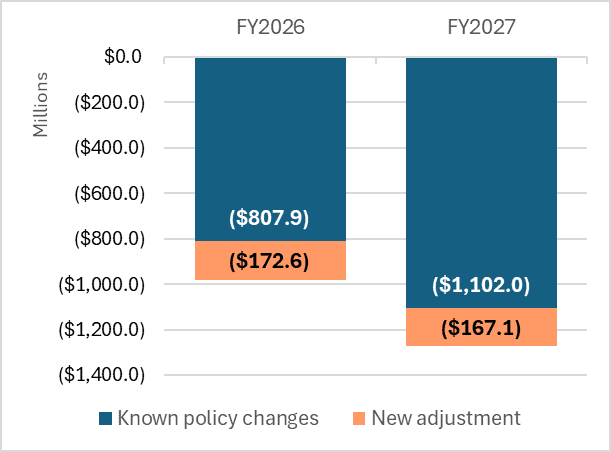
As noted in Chart 1, of the $980 million downgrade in estimated GF/GP revenue for FY2026, $808 million was tied to policy changes.  Only $173 million was a new adjustment based on economic factors and collection trends.  For FY2027, $1.1 billion was tied to the policy changes, driven largely by the annualization of the revenue decline tied to the elimination of the sales tax on fuel (for FY2026, the change went into effect on January 1, three months after the start of the state fiscal year).

Chart 1 – Composition of GF/GP Revisions: “Known” versus “New”
Source: House, Senate and Administration Economic Outlooks and Revenue Estimates

So, most of the GF/GP revenue adjustment reflects factors that were already known last October when the FY2026 budget was enacted

3. An already difficult GF/GP budget situation gets a little worse

Still, the downgraded estimates will make what would have been an already challenging FY2027 budget cycle just a little more difficult.

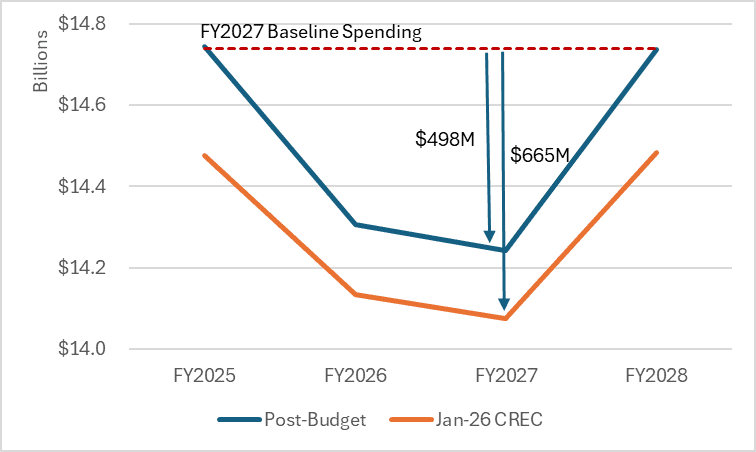
Chart 2 explains this impact.  The blue line outlines where policymakers were expecting GF/GP revenue to trend in October after factoring in all of the policy changes discussed above.  The orange line reflects today’s CREC consensus with the new adjustments reducing revenue somewhat more.

Chart 2 – CREC’s Impact on the GF/GP Budget Outlook
Source: Research Council calculations based on CREC estimates and Senate Fiscal Agency, Economic Outlook and Budget Review. Note: baseline spending projection includes revenue sharing appropriations which are not directly appropriated as GF/GP but are financed out of the estimated GF/GP revenue.

The red dotted line reflects FY2027 baseline spending levels based on Senate Fiscal Agency estimates released on January 15. This baseline represents FY2026 ongoing GF/GP appropriations approved in October, plus a set of known new costs that the state will face in FY2027.  Those new costs include expected caseload and inflationary increases for public assistance programs (primarily Medicaid); new state cost-sharing requirements under the federal OBBBA for the administration of the Supplemental Nutrition Assistance Program, which provides food assistance for low-income households; and inflationary adjustments for state employee payroll costs.

Even before the CREC, the FY2027 budget cycle looked like a challenging one. Post-budget GF/GP revenue projections were $498 million below this FY2027 baseline spending projection.  With the CREC revisions, that gap grows to about $665 million. That means that $665 million in GF/GP reductions will need to be identified immediately to keep revenues and appropriations aligned once these new cost pressures are recognized.  Beyond that, any new investment proposals that grow the budget will necessitate additional dollar-for-dollar reductions to offset their impact.

In short, the conference suggests that the key challenge for budget writers during FY2027 budget deliberations will be addressing deficits, rather than allocating surpluses, as has been the case for several consecutive years. Given last year’s politically contentious deliberations, that could make for another difficult path toward reaching a budget compromise. We shall see starting in February.

About The Author

Bob Schneider

Three Takeaways from the January 2026 CREC

In a Nutshell

  • The January CREC resulted in significant decreases in estimated GF/GP revenue, while SAF revenues were upgraded relative to the last forecasts from May.
  • Much of the drop in estimated GF/GP is tied to road funding reforms and tax relief measures enacted last October, so they come as no surprise.
  • Still, the GF/GP revisions will complicate FY2027 budget deliberations that were already looking difficult; we estimate that between $600-700 million in GF/GP reductions will need to immediately be identified to keep appropriations aligned with revenue.

State economists met on January 16 to hold a Consensus Revenue Estimating Conference (CREC) as required under state law to revise the revenue forecasts that will guide Governor Whitmer’s Fiscal Year (FY)2027 budget proposal that will be unveiled in February, and the news was mixed with upgrades to School Aid Fund (SAF) estimates but significant downgrades to General Fund/General Purpose (GF/GP) revenue projections.

Here are our three takeaways from the revisions outlining both the revenue numbers and what they mean for the upcoming budget cycle.

1. GF/GP down; School Aid Fund up

GF/GP and the SAF are the two major revenue sources that drive much of budget decision-making. The SAF supports K-12 education, community colleges, and a portion of public university appropriations, and GF/GP revenue represents discretionary dollars for general state programming (Medicaid, corrections, and public universities are the three largest recipients).

The news was largely good for the SAF, with revenue revised upward by roughly one percent across FY2025, FY2026, and FY2027.  That provides a modest increase in education funding for the upcoming budget.

Table 1 – Summary of CREC Revenue Revisions

Source: January 2026 CREC Executive Summary

The opposite was true with GF/GP revenue with estimates revised significantly downward across the entire forecast horizon. For FY2027, GF/GP revenue is expected to down by more than $1.2 billion from the May forecast, an 8.3 percent decrease.

If there’s good news on the GF/GP front, though, it’s that we already knew a good portion of these revenue adjustments were coming, and the FY2026 budget enacted in October already baked that portion of the adjustment into its revenue assumptions.

2. Most of the adjustments to GF/GP revenue estimates were expected

Most of the reduction in GF/GP revenue coming out of the CREC is tied to policy changes enacted late last year by state policymakers. That includes the elimination of the sales tax on fuel; an increase in earmarks for road maintenance from the state’s corporate income tax; and the “coupling” of the state’s income tax to new federal relief for retirees and tipped income and overtime earners under the One Big Beautiful Bill Act (OBBBA).

As noted in Chart 1, of the $980 million downgrade in estimated GF/GP revenue for FY2026, $808 million was tied to policy changes.  Only $173 million was a new adjustment based on economic factors and collection trends.  For FY2027, $1.1 billion was tied to the policy changes, driven largely by the annualization of the revenue decline tied to the elimination of the sales tax on fuel (for FY2026, the change went into effect on January 1, three months after the start of the state fiscal year).

Chart 1 – Composition of GF/GP Revisions: “Known” versus “New”

Source: House, Senate and Administration Economic Outlooks and Revenue Estimates

So, most of the GF/GP revenue adjustment reflects factors that were already known last October when the FY2026 budget was enacted

3. An already difficult GF/GP budget situation gets a little worse

Still, the downgraded estimates will make what would have been an already challenging FY2027 budget cycle just a little more difficult.

Chart 2 explains this impact.  The blue line outlines where policymakers were expecting GF/GP revenue to trend in October after factoring in all of the policy changes discussed above.  The orange line reflects today’s CREC consensus with the new adjustments reducing revenue somewhat more.

Chart 2 – CREC’s Impact on the GF/GP Budget Outlook

Source: Research Council calculations based on CREC estimates and Senate Fiscal Agency, Economic Outlook and Budget Review. Note: baseline spending projection includes revenue sharing appropriations which are not directly appropriated as GF/GP but are financed out of the estimated GF/GP revenue.

The red dotted line reflects FY2027 baseline spending levels based on Senate Fiscal Agency estimates released on January 15. This baseline represents FY2026 ongoing GF/GP appropriations approved in October, plus a set of known new costs that the state will face in FY2027.  Those new costs include expected caseload and inflationary increases for public assistance programs (primarily Medicaid); new state cost-sharing requirements under the federal OBBBA for the administration of the Supplemental Nutrition Assistance Program, which provides food assistance for low-income households; and inflationary adjustments for state employee payroll costs.

Even before the CREC, the FY2027 budget cycle looked like a challenging one. Post-budget GF/GP revenue projections were $498 million below this FY2027 baseline spending projection.  With the CREC revisions, that gap grows to about $665 million. That means that $665 million in GF/GP reductions will need to be identified immediately to keep revenues and appropriations aligned once these new cost pressures are recognized.  Beyond that, any new investment proposals that grow the budget will necessitate additional dollar-for-dollar reductions to offset their impact.

In short, the conference suggests that the key challenge for budget writers during FY2027 budget deliberations will be addressing deficits, rather than allocating surpluses, as has been the case for several consecutive years. Given last year’s politically contentious deliberations, that could make for another difficult path toward reaching a budget compromise. We shall see starting in February.

  • Permission to reprint this blog post in whole or in part is hereby granted, provided that the Citizens Research Council of Michigan is properly cited.

  • Recent Posts

  • Stay informed of new research published and other Citizens Research Council news.
    [ctct form="10424" show_title="false"]

    About The Author

    Bob Schneider

    Latest Research Posts

    Array
    Back To Top