"The right to criticize government is also an obligation to know what you are talking about."
-Lent Upson, first director of Citizens Research Council
|
Highlights: - Ballot Proposal Run-down:
- Proposal 1: A Constitutional Convention (Con-Con)
- Proposal 2: Mop Up Michigan (Money Out of Politics)
- Southeast Michigan Public Historical Museum Authority Millage Proposal
- Detroit Issues Guide; Detroit's EVC: Detroit In-Person Early Voting Ends Monday, Nov. 2
- Town Hall GR at the Ford: Data Centers: Kick-Off of a New Townhall Series Partnership
|
A Guide to Michigan's Two Ballot Proposals and
Southeast Michigan's Public Museum Millage Proposal
|
Proposal 2026-01
Constitutional Revision
|
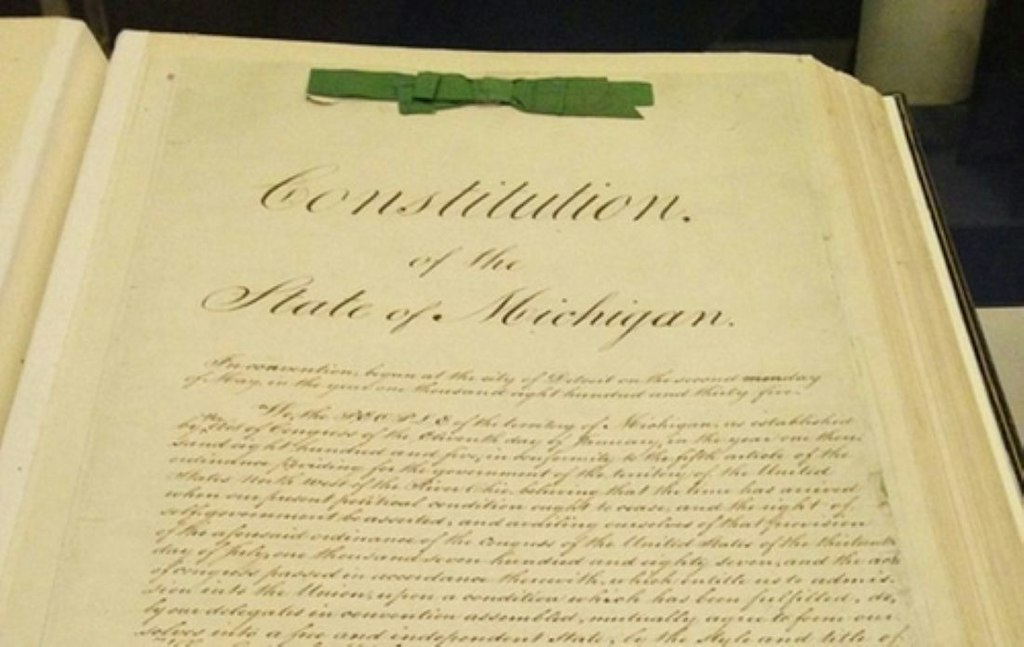
In November's election, Michigan voters are being asked whether to call for a constitutional convention to revise the 1963 Michigan Constitution. That convention would be charged with drafting a general revision of the state constitution to be submitted to the voters at a later date. The question is automatically placed on the ballot by a provision of the current constitution that requires the question to be asked every 16 years.
Michigan’s current constitution was narrowly adopted by the voters in 1963. Since then, 98 proposed amendments have been initiated by the legislature and voter-circulated petitions. The voters have adopted 44 amendments, most frequently amending Article IX (Finance and Taxation) and Article IV (Legislative Branch). Article I (Declaration of Rights), Article V (Executive Branch), Article II (Elections), and Article VIII (Education) have been amended less frequently. Some articles, such as Article VII (Local Government), have never had an amendment proposed, let alone adopted.
From February to September of this year, the Citizens Research Council of Michigan reviewed the provisions in each article in the current constitution. This 15-part analysis found sections and articles that have withstood the test of time and seem to be working as intended. Across several current articles, the Research Council identified highly charged provisions that have come under scrutiny over the years and likely would be the subject of debate and reform efforts at a convention. Provisions that are obsolete and violate provisions of the U.S. Constitution and should be amended or struck from the state’s constitution were also identified. A summary analysis is also available to all.
|
Proposal 2026-02
Mop Up Michigan Initiative
|
Proposal 2, also known as Mop Up Michigan, is a proposed statutory initiative to amend the Michigan Campaign Finance Act (MCFA). If adopted, the law would be amended to require “paid for by” disclosures on certain political ads distributed on the internet; expanded donor and spending disclosure for certain political ads; and restrictions certain campaign contributions by regulated utilities and their principals and state and local government contractors and their principals. It contains a severability clause, meaning that if any provisions are found to be unconstitutional, the unaffected provisions would remain in effect.
Major issues include tightening Michigan’s campaign finance laws, which currently allow groups to run political ads without disclosing their donors or spending if the ads avoid using “express advocacy” language. Proposal 2 would provide the public with more information about these ads and the organizations running them.
Proposal 2 additionally places restrictions on significant campaign contributions by Michigan's regulated utilities and certain government contractors. It is not clear how much impact placing restrictions on campaign contributions would have on these issues, given other methods of political influence and the regulatory complexity of the targeted industries.
The analysis points out that laws restricting political spending must clear a high constitutional bar under existing U.S. Supreme Court precedent. It is likely the provisions restricting utility and contractor campaign contributions would be challenged as failing to meet a sufficiently important governmental interest and/or as restricting more speech than is necessary.
|
Oakland and Wayne County Ballot Issue: Public Historical Museum Authority Millage Proposal
|
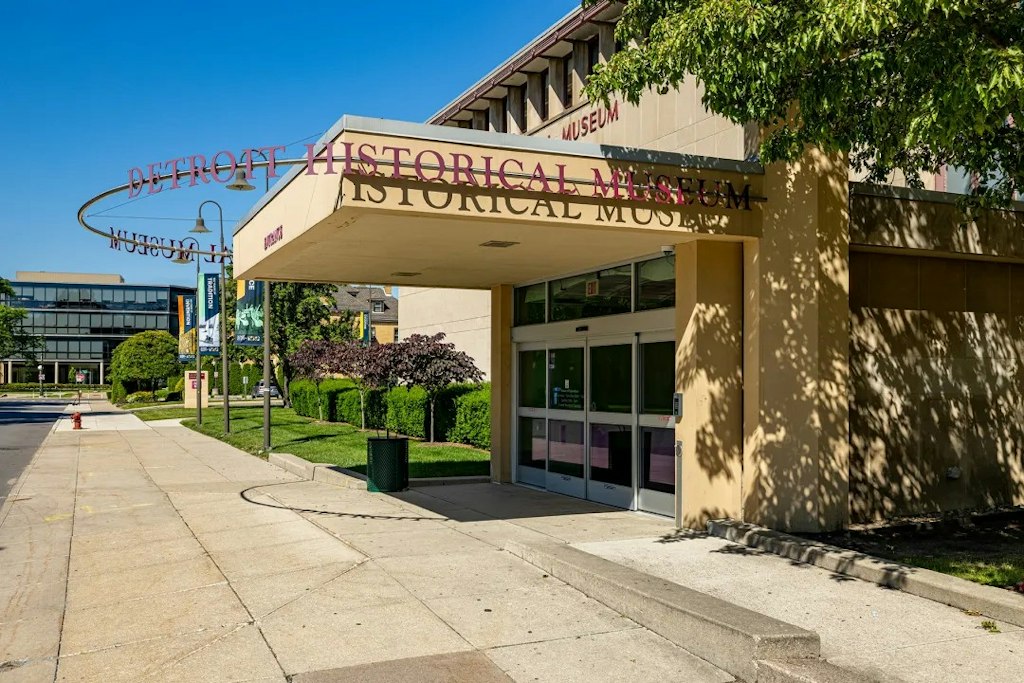
At the November 3 election, Wayne and Oakland County voters will be asked to approve or reject a new 0.2 mill tax (a mill is equal to $1 of tax for every $1,000 of taxable value) on all non-exempt taxable property within the two counties to support Southeast Michigan public historical museums for a period of 10 years. For the millage vote to succeed, the majority of the electors voting on this question across the authority (both counties in total) must vote for approval.
|
If the Proposal passes: The Charles H. Wright Museum of African American History and the Detroit Historical Society would have a sustainable revenue source for the next 10 years, bringing them financial stability. Residents in Oakland and Wayne would see a slight increase in their property taxes as a result of the new millage. A parcel of property with a taxable value of $100,000 would pay an additional $20.0 per year in property taxes.
Residents of these counties would gain free admission at the Wright Museum, Detroit Historical Museum, and the Dossin Great Lakes Museum. Other benefits include free transportation for students and seniors, expanded exhibitions, new curriculum guides, training teachers in regional history, and preserving publicly owned collections for both museums. Fifteen percent of revenue raised in each county via the millage will support other public history museums in Wayne and Oakland.
If the Proposal is rejected: Without a sustainable funding source to close the financial gaps, these Detroit museums will continue to operate on admission fees, grants, and donations and may have to scale back operations to avoid deficits which could involve laying off staff, reducing hours of operations, or scaling back exhibits.
|
Detroit Issues Guide 2026 – Updated Edition
Early Voting Challenge for Detroit's Seven Districts
|
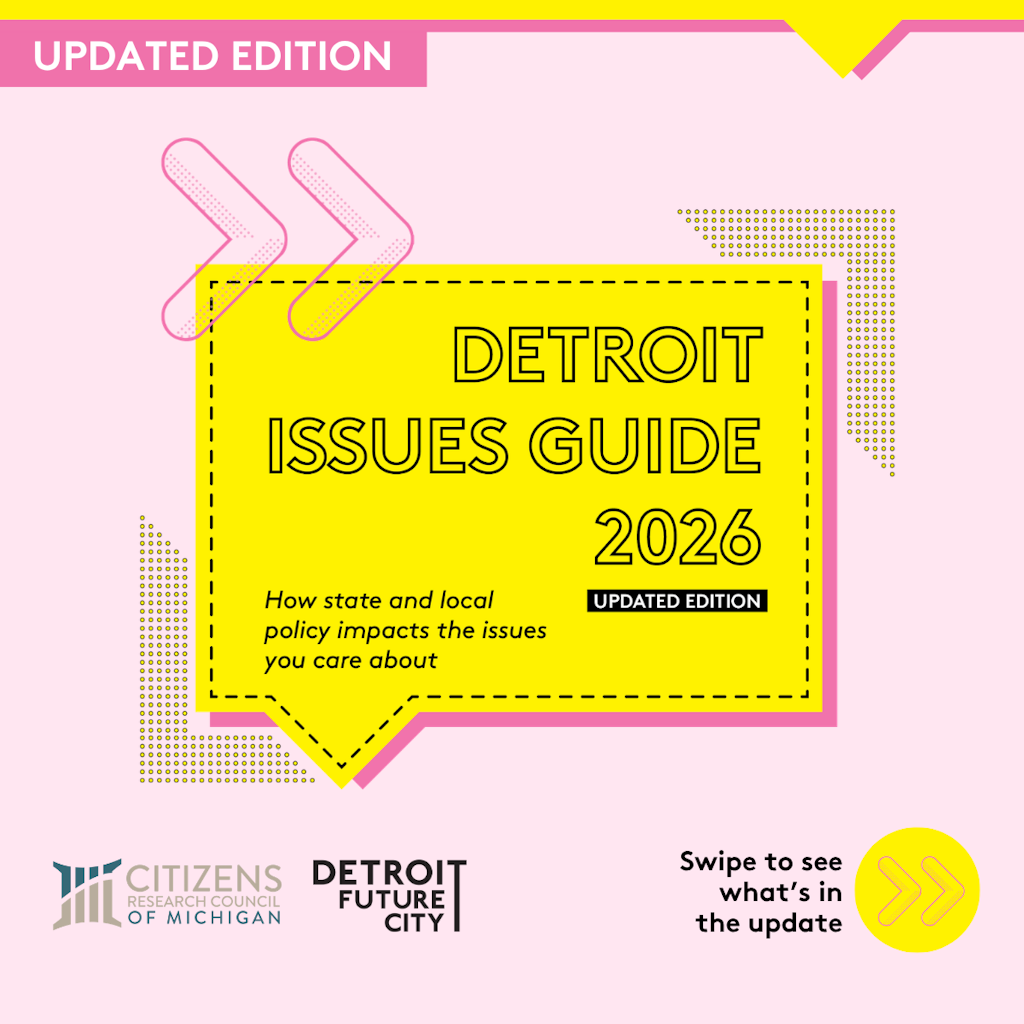
Detroit Future City and the Citizens Research Council of Michigan have developed a nonpartisan Detroit Issues Guide 2026 to help Detroit residents better understand how state and local government decisions affect the issues they care about most—including housing, public transit, public education, taxes and business attraction, and crime and public safety. Designed to encourage informed civic engagement and support voter participation, the guide provides factual context around each issue.
|
The Early Voting Challenge
The Detroit Issues Guide is part of a broader voter education effort led by the Detroit Early Voting Coalition, a collective of organizations that includes the Research Council, dedicated to increasing civic engagement and voter literacy in Detroit.
|
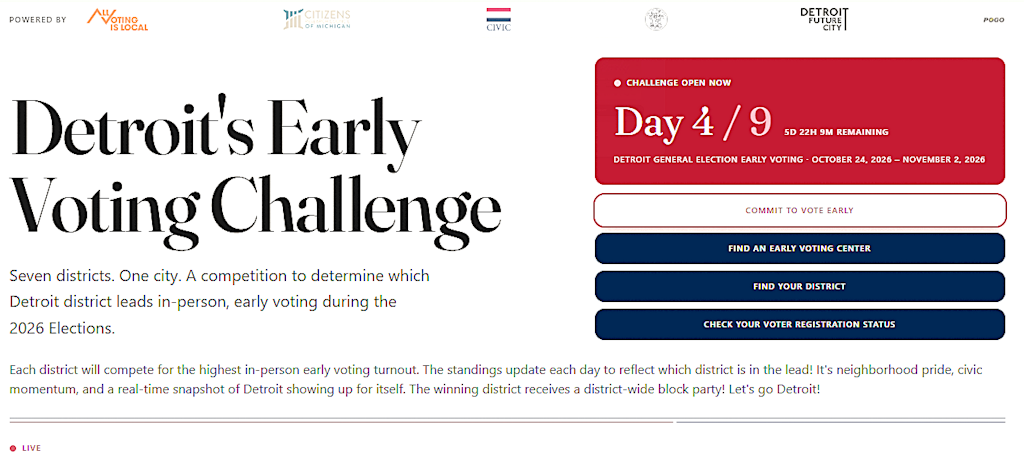
The coalition helped launch Detroit’s Early Voting Challenge (EVC), headed by CIVIC, a competition that encourages Detroiters to beat their neighborhoods to the polls during the in-person early voting period.
After the first weekend of in-person early voting, which started Saturday and ends on November 2, EVC excitement helped drive 3,581 voters to early voting centers, setting a new opening-weekend record and surpassing the 2,511 ballots cast during the first weekend of early voting for the November 2024 presidential election.
To build awareness and foster district pride, CIVIC compiled video storytelling for each district. District 1 and District 2 have dropped and the rest will be released over the next week.
Each district will compete for the highest voter turnout during early voting. The standings update each day to reflect which district is in the lead. It's neighborhood pride, civic momentum, and a real-time snapshot of Detroit showing up for itself. The winning district receives a distrtict-wide celebration!
Residents can visit early.onecivic.org to see how many people in each district have voted.
|
Inaugural Town Hall GR at the Ford: Data Centers
Livestream Option Available!
|
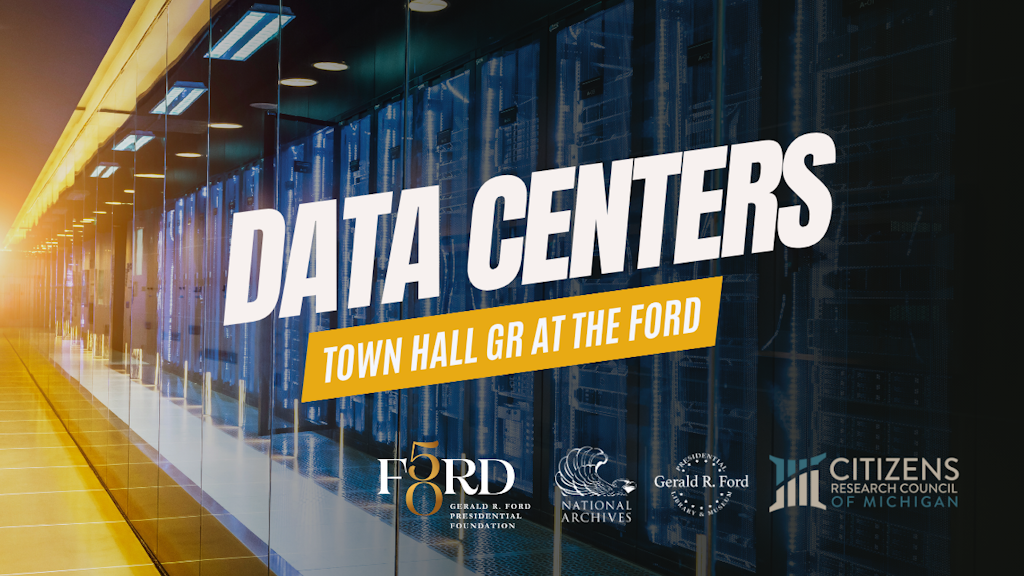
Join the Citizens Research Council of Michigan and the Gerald R. Ford Presidential Foundation for the inaugural Town Hall GR at the Ford, a community conversation examining the many dimensions of data-center development. Rather than a traditional debate, this program will bring together experts with different perspectives and areas of expertise for a thoughtful, fact-based conversation.
Moderated by Professor Sarah Mills of the University of Michigan, the discussion will feature Professor Michael Webber of the University of Texas at Austin, an expert in energy policy and energy systems; Eric Paul Dennis, PE, of the Citizens Research Council, whose work examines data-center development and its implications for Michigan communities; and Professor Jason Peters of Hillsdale College, whose scholarship includes agrarian thought and the work of Wendell Berry.
Together, the panelists will explore questions surrounding data centers, including energy and water use, economic development, land use, infrastructure, community impacts, and the broader technological changes driving their growth. Audience members will have an opportunity to ask questions and engage with the panel.
Details on Attending Ford Presidential Museum
303 Pearl St NW, Grand Rapids, MI 49504 Monday, November 16, 2026 - Free Brown Bag Lunch: 11:30 a.m. (Registration required)
- Program: noon - 1:30 p.m. (Registration required)
|
How Michigan's Proposal 2 would change campaign finances, WILX News10 (October 27)
High power bills, blackouts land Michigan utilities on the ballot, Interlochen Public Radio and Grist (October 27)
Detroit museums seek stability with tax hike plan in Wayne, Oakland counties, The Detroit News (October 27)
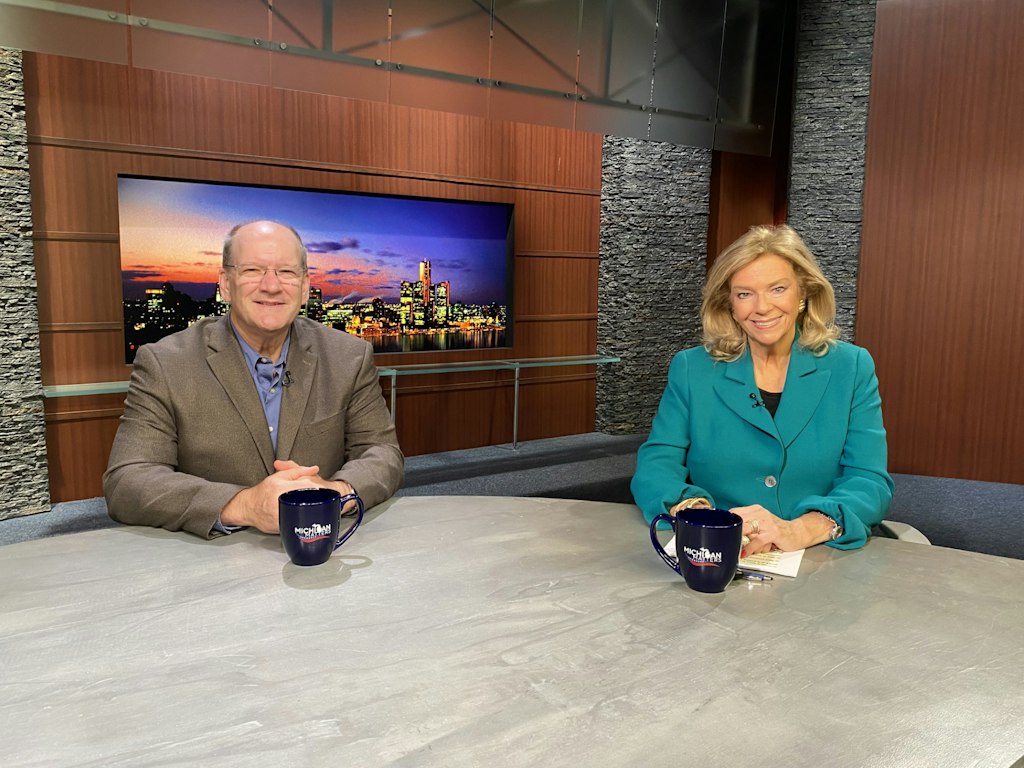
Previewing Michigan’s 10th congressional race and Prop 1, Michigan Matters CBS Detroit (Oct. 26)
Michigan Proposal 1 and 2: What to know about statewide ballot measures, Bridge Michigan (October 26)
Clinton Township Freezes Data Centers for 180 Days With No Project in Sight, Hoodline Detroit (October 26)
El-Sayed or Rogers? That’s the wrong question — focus on down-ballot races instead | Brady, The Detroit News (October 26)
What is Prop 1? Michigan voters will decide whether to hold a state constitutional convention in the midterms, The Michigan Daily (October 26)
Will Proposal 2 get money out of politics? One researcher says ‘not really’, WLNS TV6 (October 24)
Should Michigan vote to have a constitutional convention? WJR (October 23)
Both Indiana and Michigan voters will see public questions on their ballots this year, ABC57 (October 21)
Michigan mulls local government revenue sharing trust fund, Bond Buyer (October 21)
Banning utility donations in Michigan politics hinges on voters, legal action, Detroit News (Oct. 20)
SNAP changes cut off food assistance benefits for some Michigan residents, Capital News Service, Midland Daily News, Escanaba Daily Press (October 16)
Want to Understand What You are Voting For? Jack Lessenberry Substack (October 15)
|
CBS News Michigan Matters: Previewing Prop 1 with Eric Lupher.
|
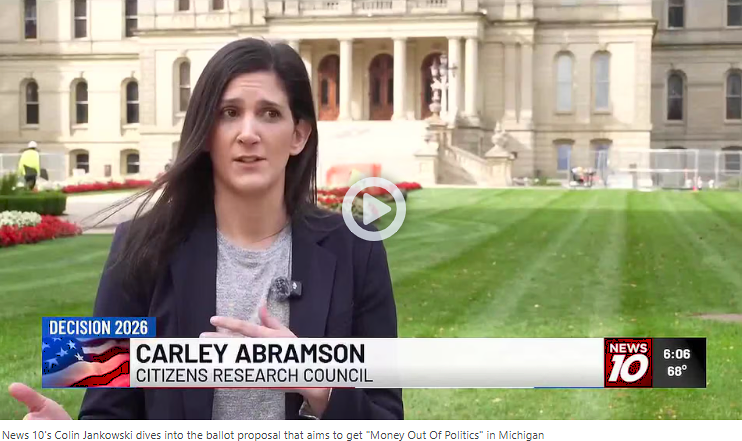
Karley Abramson explains what Proposal 2 would and would not do if voters approve it, WILX TV10 in Lansing.
|
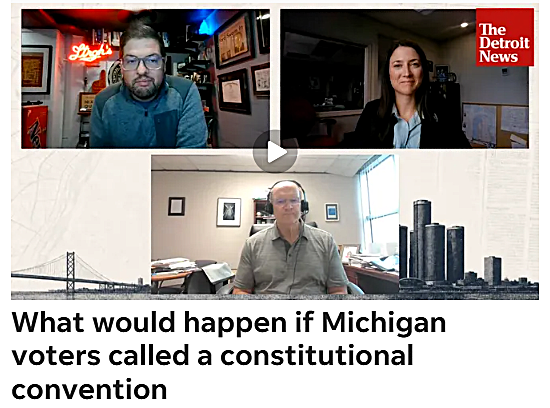
The Detroit News "Political Insider" podcast: Eric Lupher explains how a constitutional convention would work.
|
Help Power Policy That Works for Michigan
|
Our “Fact Tank” fuels better government through trusted, independent research. But it doesn’t run on fumes—it runs on your support.
Make your tax-deductible donation today to keep Michigan informed, accountable, and moving forward.
Ready to make a lasting impact? Learn more about planned giving today.
|
Citizens Research Council of Michigan
Livonia 734.542.8001 | Lansing 517.485.9444 | Holland 616.294.8359
|
|