"The right to criticize government is also an obligation to know what you are talking about."
-Lent Upson, first director of Citizens Research Council
|
Highlights: - New Council Brief: Southeast Michigan Public Historical Museum Authority Millage Proposal
- ICYMI: Council Brief - State Awaits Gov. Whitmer’s Decision on Federal Scholarship Tax Credit
- ICYMI: Podcast - A Budget Shortfall, A Revenue Spike, and A Whole Lot of Uncertainty Ahead
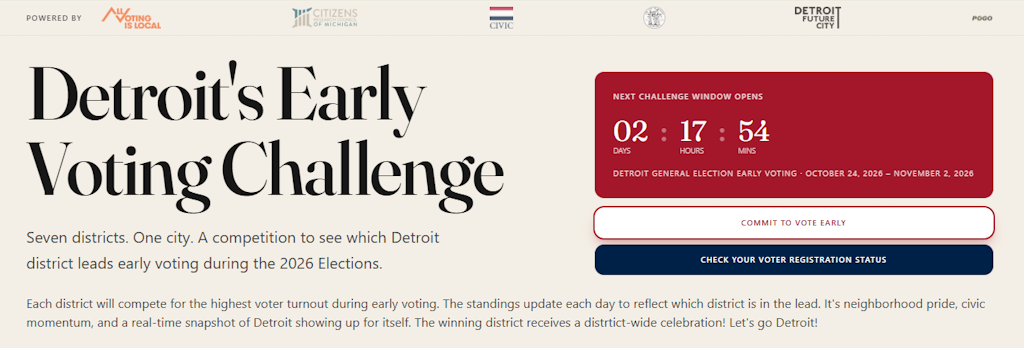
- Detroit Issues Guide; Detroit's Early Voting Challenge In-Person Early Voting Starts 10.24
- Town Hall GR at the Ford: Data Centers: Kick-Off of a New Townhall Series Partnership
|
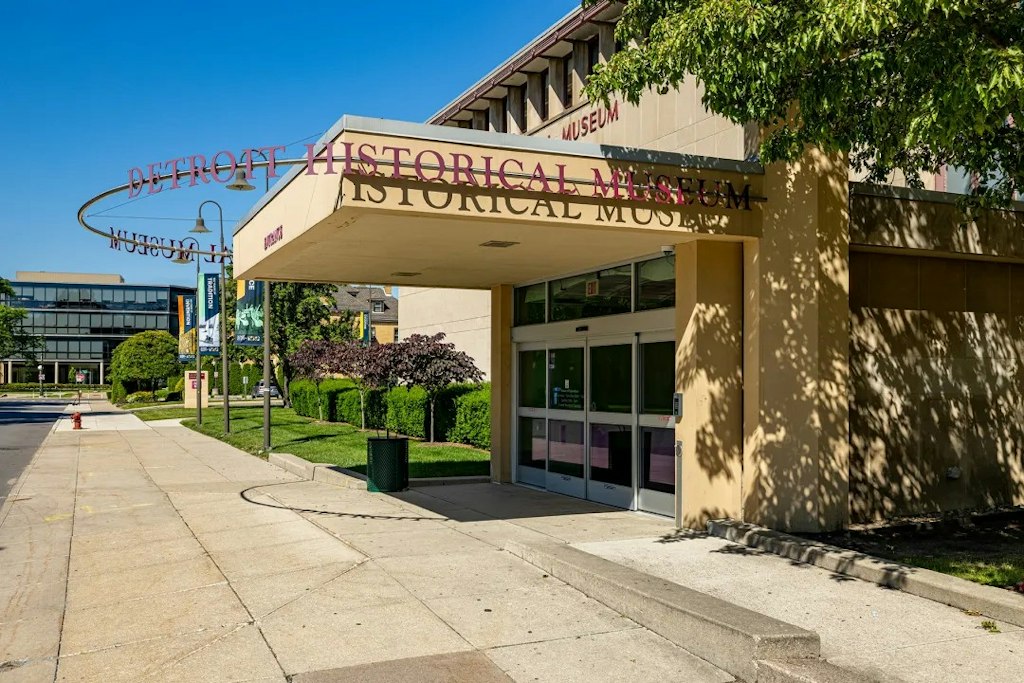
Oakland and Wayne County Ballot Issue: Southeast Michigan Public Historical Museum Authority Millage Proposal
|
At the November 3 election, Wayne and Oakland County voters will be asked to approve or reject a new 0.2 mill tax (a mill is equal to $1 of tax for every $1,000 of taxable value) on all non-exempt taxable property within the two counties to support Southeast Michigan public historical museums for a period of 10 years. For the millage vote to succeed, the majority of the electors voting on this question across the authority (both counties in total) must vote for approval.
|
If the Proposal passes: The Charles H. Wright Museum of African American History and the Detroit Historical Society would have a sustainable revenue source for the next 10 years, bringing them financial stability. Residents in Oakland and Wayne would see a slight increase in their property taxes as a result of the new millage. A parcel of property with a taxable value of $100,000 would pay an additional $20.0 per year in property taxes.
Residents of these counties would gain free admission at the Wright Museum, Detroit Historical Museum, and the Dossin Great Lakes Museum. Other benefits include free transportation for students and seniors, expanded exhibitions, new curriculum guides, training teachers in regional history, and preserving publicly owned collections for both museums. Fifteen percent of revenue raised in each county via the millage will support other public history museums in Wayne and Oakland.
If the Proposal is rejected: Without a sustainable funding source to close the financial gaps, these Detroit museums will continue to operate on admission fees, grants, and donations and may have to scale back operations to avoid deficits which could involve laying off staff, reducing hours of operations, or scaling back exhibits.
|
Michigan Awaits Governor Whitmer’s Decision on Federal Scholarship Tax Credit
|
Despite a decades-long state constitutional ban on public funding for private K-12 schools, Michigan could join 35 other states that provide families with a school choice option starting in 2027. That is if Governor Gretchen Whitmer opts in to the new Federal Scholarship Tax Credit program before year’s end. Unlike similar state-run school choice tax credit programs, a Michigan program would be governed by federal law and funded by private donations that donors recoup through a federal tax credit.
|
That is why participation is generally viewed as consistent with the constitutional ban, and also why Michigan policymakers would have little say in how the program works.
In a Nutshell -- Michigan’s constitution bars state aid to private schools, but the federal credit relies on private donations and federal tax dollars, so participation is generally viewed as permissible. No court or attorney general has ruled on the question.
-- About 93 percent of Michigan school-age children would be income-eligible, but early scholarship dollars will likely flow mostly to private school families and to wealthier metro areas.
-- If Governor Whitmer opts in by January 1, 2027, Michigan’s role would be largely administrative. Congress and the IRS set the rules, and the state cannot add its own requirements.
|
A Budget Shortfall, A Revenue Spike, and A Whole Lot of Uncertainty Ahead
|
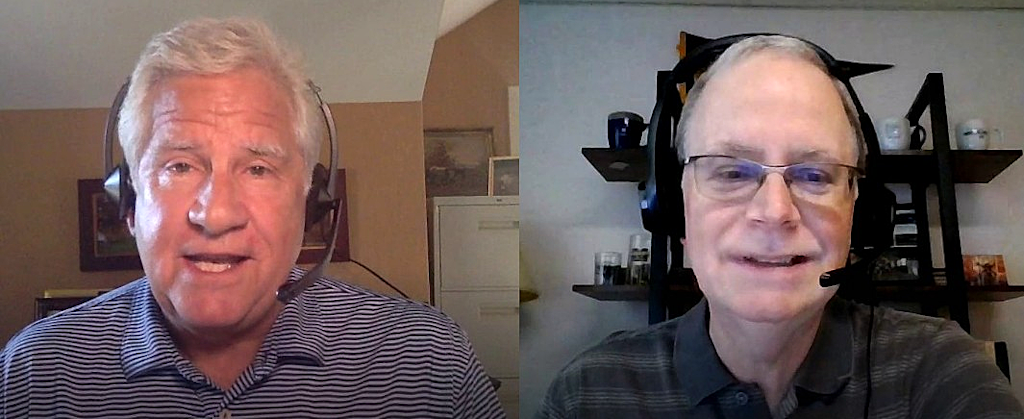
#FactsMatter host Guy Gordon reconnects with Bob Schneider, Senior Research Associate for State Affairs at the Citizens Research Council, for a timely update on Michigan’s budget outlook. Their July conversation (“The Budget That was Balanced – But Not Transparent”) warned of a potential “fiscal cliff” awaiting the next governor and legislature. With new revenue data now in hand, Schneider revisits the numbers—and the picture is more complicated than anyone expected.
|
Schneider explains that Michigan was already facing a $523 million general fund shortfall heading into FY 2028, driven by rising Medicaid costs, state employee payroll increases, and a major shift in federal SNAP funding that requires the state to cover an additional $320 million in benefit costs.
But the current budget funded two long-running programs, direct care worker wage supports and certified community behavioral health clinics, as one-time appropriations, despite their years of operation.
If lawmakers want to continue them, they’ll need to restore $165 million in ongoing general fund support, pushing the projected shortfall toward a $700 million structural deficit.
|
Find all #FactsMatter podcasts on Substack, Apple, Spotify, Amazon or wherever you get your podcasts. LIKE and SUBSCRIBE!
|
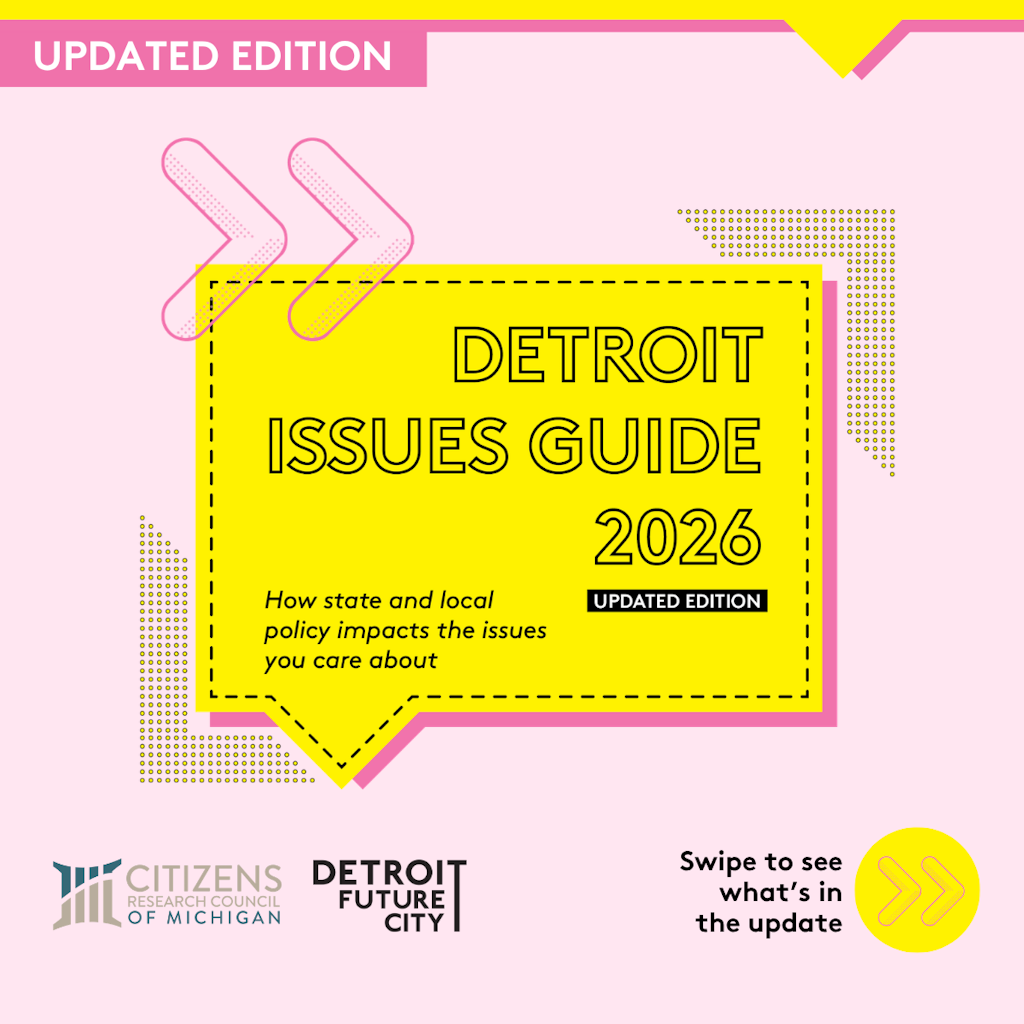
Detroit Issues Guide 2026 – Updated Edition
|
Detroit Future City and the Citizens Research Council of Michigan have developed a nonpartisan Detroit Issues Guide 2026 to help Detroit residents better understand how state and local government decisions affect the issues they care about most—including housing, public transit, public education, taxes and business attraction, and crime and public safety. Designed to encourage informed civic engagement and support voter participation, the guide provides factual context around each issue.
|
The Early Voting Challenge
The Detroit Issues Guide is part of a broader voter education effort led by the Detroit Early Voting Coalition, a collective of organizations that includes the Research Council, dedicated to increasing civic engagement and voter literacy in Detroit.
The coalition launched Detroit’s Early Voting Challenge, headed by CIVIC, a competition that encourages Detroiters to beat their neighborhoods to the polls during the in-person early voting period. For the 2026 General Election, early voting starts on October 24 and lasts until November 2.
Each district will compete for the highest voter turnout during early voting. The standings update each day to reflect which district is in the lead. It's neighborhood pride, civic momentum, and a real-time snapshot of Detroit showing up for itself. The winning district receives a distrtict-wide celebration!
Residents can visit early.onecivic.org to see how many people in each district have voted.
|
Inaugural Town Hall GR at the Ford: Data Centers
|
Join the Citizens Research Council of Michigan and the Gerald R. Ford Presidential Foundation for the inaugural Town Hall GR at the Ford, a community conversation examining the many dimensions of data-center development. Rather than a traditional debate, this program will bring together experts with different perspectives and areas of expertise for a thoughtful, fact-based conversation.
Moderated by Professor Sarah Mills of the University of Michigan, the discussion will feature Professor Michael Webber of the University of Texas at Austin, an expert in energy policy and energy systems; Eric Paul Dennis, PE, of the Citizens Research Council, whose work examines data-center development and its implications for Michigan communities; and Professor Jason Peters of Hillsdale College, whose scholarship includes agrarian thought and the work of Wendell Berry.
Together, the panelists will explore questions surrounding data centers, including energy and water use, economic development, land use, infrastructure, community impacts, and the broader technological changes driving their growth. Audience members will have an opportunity to ask questions and engage with the panel.
Details on Attending Ford Presidential Museum
303 Pearl St NW, Grand Rapids, MI 49504 Monday, November 16, 2026 - Free Brown Bag Lunch: 11:30 a.m. (Registration required)
- Program: noon - 1:30 p.m. (Registration required)
|
Banning utility donations in Michigan politics hinges on voters, legal action, Detroit News (Oct. 20)
SNAP changes cut off food assistance benefits for some Michigan residents, Capital News Service, Midland Daily News, Escanaba Daily Press (October 16)
Want to Understand What You are Voting For? Jack Lessenberry Substack (October 15)
Fact check: What’s true and what’s not in Michigan’s data center debate, Bridge Michigan (Oct. 14)
Township vote paves way for Michigan’s second hyperscale data center, Bridge Michigan (Oct. 14)
Potential for a Con-Con looms large with some groups prepping even as they urge a no vote, Gongwer|State Affairs (October 14)
Progressive groups working to rally Black Michigan voters against Mike Rogers, Michigan Public (October 13)
167K Michiganders fell off SNAP since last summer, Detroit Free Press (October 12)
A Constitutional Convention? An MSU Dialogue, MSU IPPSR (October 12)
The Michigan Ballot Proposal They’re Ignoring, Jack Lessenbery Substack (October 11)
Citizens Research Council honors Fred Upton, WSJM (October 11)
Online Sports Betting In Alberta In 2026, Read From A Michigan Newsroom, The Argus-Press (October 9)
Why LGBTQ+ Voters Are Watching Michigan’s Proposals 1 and 2, PrideSource (October 9)
|
Help Power Policy That Works for Michigan
|
Our “Fact Tank” fuels better government through trusted, independent research. But it doesn’t run on fumes—it runs on your support.
Make your tax-deductible donation today to keep Michigan informed, accountable, and moving forward.
Ready to make a lasting impact? Learn more about planned giving today.
|
Citizens Research Council of Michigan
Livonia 734.542.8001 | Lansing 517.485.9444 | Holland 616.294.8359
|
|