|

|
"The right to criticize government is also an obligation to know what you are talking about." -Lent Upson, first director of Citizens Research Council |
|
Please add maureen.saxton@crcmich-newsletter.com to your safe sender/contact list
February 10, 2026 Biweekly Newsletter |
|
|
|
This Week's Highlights
|
|
|
|
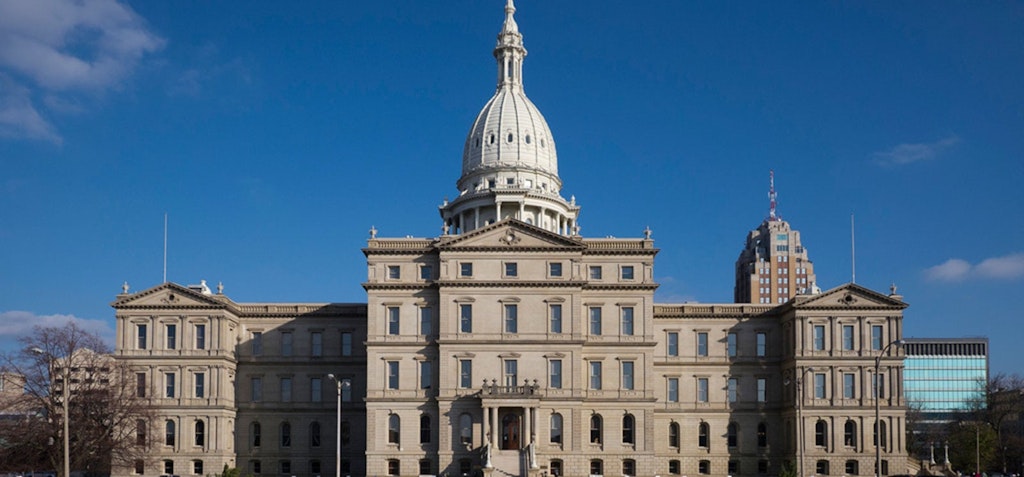
Should Michigan Hold a Constitutional Convention? Voters will be asked on the November Ballot. |
|
Citizens Research Council of Michigan just released the first in a 15-paper series designed to inform voters ahead of the November vote on whether Michigan should hold a Constitutional Convention (“Con-Con”). In November, voters will decide Proposal 2026-01: whether to convene a convention to review and revise the 1963 Michigan Constitution. This question appears automatically every 16 years, as required by the state constitution. A “yes” vote would trigger a convention in Lansing on October 5, 2027; a "no" vote means the question returns to the ballot in 2042. The first paper, General Revision of the Michigan Constitution, explains how a convention would be convened, reviews past votes on the question, outlines the potential for a full constitutional rewrite, describes the purpose of a constitution, and summarizes the elements of the current 1963 document. Although voters rejected conventions in 1978, 1994, and 2010, the current constitution has been amended many times. The Research Council will release new “Con-Con” papers every other week through October 2026. The first three papers cover mechanics, costs, and historical context; the remaining 12 will address each of the 12 articles of the Michigan Constitution. All papers will be available before absentee ballots are distributed. Citizens Research Council does not take a position on whether a constitution should be called. |
|
|
|

Key to FY2027 budget debate is understanding the two-way funding flow between the School Aid Fund and General Fund |
|
Because responsibility for community college and university funding had historically been placed on the General Fund, public school interest groups and politicians publicly characterize the current $1.3 billion in School Aid Fund higher education appropriations as a “raid” or “skim” of dollars away from K-12 schools. The Research Council sees the issue as being a bit more complex. In fact, Michigan’s constitutional history and evolving state fiscal architecture suggest the same. Much like the perpetual public confusion and misunderstanding about the role that Michigan Lottery proceeds play in funding K-12 schools, there is a growing tendency in state budget circles, as well as the public narrative, to view the General Fund/School Aid Fund swap only through the lens of the SAF appropriation for higher education. Here, the Research Council expands the aperture on this funding swap to provide insights into the true relationship between these funds and share important context that often gets little attention during annual state budget deliberations. IN A NUTSHELL -- A perennial, and often contentious, issue has been the use of School Aid Fund (SAF) dollars to finance appropriations for Michigan’s community colleges and four-year universities. This is likely to be a hot topic again as the governor and lawmakers sit down to write the upcoming Fiscal Year (FY)2027 state budget. -- A more complete and comprehensive review of the School Aid Fund/General Fund funding swap resembles more of a two-way street with resources moving in both directions; from the SAF to the General Fund budget, and vice versa. -- The flow of dollars out of the General Fund to “hold harmless” the SAF and public schools from the potential revenue losses arising from various state tax policy changes has grown over time. Collectively, “hold harmless” provisions are estimated to reach $900 million for the FY2027 budget year, or about 70 percent of the total $1.3 billion SAF appropriation for higher education purposes. Understanding the two-sided relationship between the two funds will enhance the discourse during the upcoming state budget deliberations. |
|
|
|

|
Webinar Analysis of Gov. Whitmer’s FY2027 Executive Budget February 24 at Noon |
|
Several federal and state policy changes over the past year set the stage for an interesting budget cycle this year. For FY2027, GF/GP revenue is expected to be down by more than $1.2 billion from the May forecast, an 8.3 percent decrease. On top of that, state budget writers will begin to address federal cost shifts that place greater burdens on states for Medicaid and food assistance programs. The key challenge for budget writers during FY2027 budget deliberations will be addressing deficits, rather than allocating surpluses, as has been the case for several consecutive years. Any new investment proposals that grow the budget will necessitate additional dollar-for-dollar reductions to offset their impact. Senior Research Council staff Bob Schneider and Craig Thiel will provide their assessments of the General Fund and School Aid Fund Governor Whitmer’s FY2027 Executive Budget in a noon-time session, February 24. |
|
|
Media Coverage |
|
Preview of Whitmer's final budget focuses on savings for seniors, families, working class, WWMT News3 (February 9)
Time for reform, I Have Questions (Stephen Henderson-Substack) (February 9)
Should Michigan rewrite its constitution? Voters can decide in upcoming ballot, WDIV-ClickOnDetroit (February 9)
Michigan voters will decide in November whether to convene a constitutional convention, WKAR Public Media (February 9)
Constitution Convention: A Michigan Mystery! WJR-Detroit (February 9)
Opinion: Michigan deserves Medicare for All, Metro Times (February 5)
How much lottery ticket cash ends up in Michigan classrooms? We did the math, Bridge Michigan (February 4)
Why Detroit needs more money — and how it could be raised, WDET-The Metro (February 4)
CMS Gives The All Clear On $3B In Medicaid Funds, MIRS News (January 30)
Michigan Matters: A new entertainment and sales tax for Detroit? Michigan Matters CBS Detroit (January 30) |
|
|
|
Help Power Policy That Works for Michigan |
|
Our “Fact Tank” fuels better government through trusted, independent research. But it doesn’t run on fumes—it runs on your support.
Make your tax-deductible donation today to keep Michigan informed, accountable, and moving forward.
Ready to make a lasting impact? Learn more about planned giving today. |

|
Citizens Research Council of Michigan
Livonia 734.542.8001 | Lansing 517.485.9444 | Holland 616.294.8359
|
|


|
Unsubscribe Footer
|