"The right to criticize government is also an obligation to know what you are talking about."
-Lent Upson, first director of Citizens Research Council
|
Highlights: - The Good News of Detroit’s Reduced Homicide Rates, but Peer City Analysis Shows More Work to be Done (the social determinants of homicide)
- Con-Con Podcast Series: Article I - The Declaration of Rights. Foundational and Contentious
- Con-Con Research Series, paper #5: Article II - Elections
- Research Council turns 110! Please Support our April Anniversary Campaign.
|
Detroit Homicides Down but Still Highest Among Six Peer Cities
|
In the second report in a series about crime in Detroit and across peer cities, the Research Council’s analysis reports that Detroit homicides in 2025 were the lowest recorded since 1964, mirroring a national trend where U.S. violent crime has declined since peaking in the early 1990s. However, while Detroit has experienced a rapid decline in its homicide rate since 2022, the city still has more work to do if it wants to match the homicide rates of its peer cities (Cleveland, Milwaukee, Rochester, Buffalo, Newark, Toledo). Since 2016, Detroit’s homicide rate has been consistently higher than those cities and much higher than the national homicide rate. Only Cleveland’s homicide rate came close to Detroit’s.
Future reports will examine property crime, the public safety budget, and differences in crime rates across the state, metro area, and at the neighborhood level.
|
IN A NUTSHELL -- FBI data show that Detroit’s homicide rate in 2024 was 31.4 homicides per 100,000 residents. It has declined significantly from a recent high of 49.5 homicides per 100,000 residents in 2022. Even with this decline, it has consistently been higher than the homicide rates of its peer cities since 2015. Three (out of six) peer cities and Detroit have had sizable declines in their homicide rate from 2019 to 2024.
-- Despite historic declines in Detroit homicides, continued progress in reducing Detroit’s homicide rate must be a focus if the city wishes to achieve rates of homicide similar to or better than those observed in peer cities.
-- While the city launched several public safety programs aimed at reducing crime, for long-lasting improvements, the Research Council recommends that the Sheffield Administration focus on addressing the structural determinants of homicide, which include poverty, income inequality, and family disruption/divorce, based on this analysis and existing homicide research.
|
|
Foundational and Contentious: Michigan's Article I - The Declaration of Rights
|
Episode 3 of the Research Council's podcast series dropped this week, examining Article 1 – The Declaration of Rights of the Michigan Constitution. This is part of a series of podcasts looking at each element of the current state constitution before Michigan voters are asked this November whether to approve a Constitutional Convention (Con-Con). Michiganders should consider before casting their vote this November on whether to hold a Con-Con.
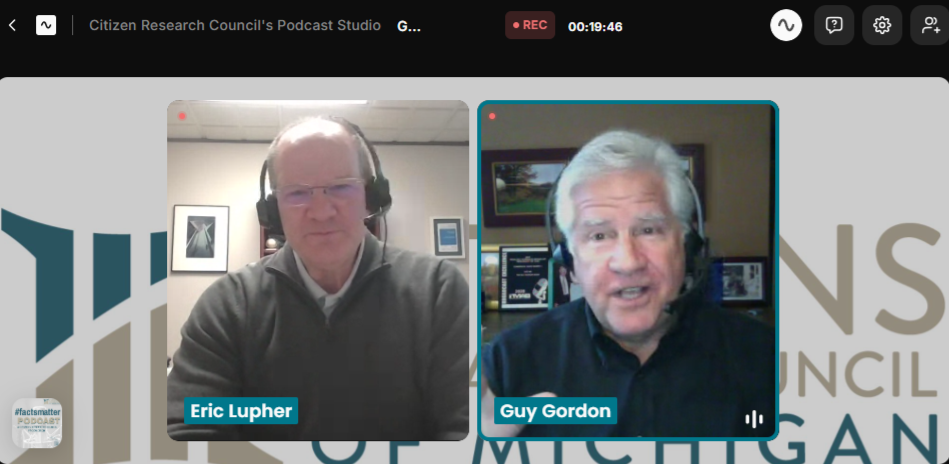
Guy and Eric discuss why Article I is both foundational and highly contentious.
|
Michiganders view their constitutional rights as sacred, but the debate has intensified because Article I now includes rights—such as same-sex marriage, reproductive freedom, and affirmative action—that were not universally accepted when originally adopted and remain controversial today.
They touch on several hot-button issues in Article I, issues that would likely take center stage if there were a Con-Con, such as gun rights, same-sex marriage, affirmative action, and reproductive freedoms.
|
Find all #FactsMatter podcasts on SoundCloud, Apple, Spotify, Amazon or wherever you get your podcasts. LIKE and SUBSCRIBE!
|
The Research Council this week released the fifth in a series of 15 papers providing information to Michigan voters ahead of the November ballot question asking whether Michigan should hold a Constitutional Convention (Con-Con). It addresses Article II: Elections.
|
Article II of Michigan’s Constitution: Elections
|
The paper points out several inoperative provisions of Article II that currently violate the U.S. Constitution and federal law.
It also addresses major points of discussion for a potential convention, including voter qualifications and whether to require documentary proof of citizenship for voter registration, replacing the current system of self-attestation.
A convention also may discuss recall, initiative, and referendum tools that allow citizens to bypass the legislature. The report notes that they are increasingly used by special interests to "referenda-proof" laws or to bypass the governor's veto.
|
For 110 years, the Citizens Research Council has helped Michiganders make informed decisions through independent, nonpartisan research.
Today, we are launching our 110th Anniversary Campaign with a goal of raising $25,000 by April 30 to support the research and analysis communities across Michigan rely on.
Your support keeps trusted facts at the center of public policy.
Celebrate with us today by donating to help us continue this work for the next generation.
crcmich.org/april-appeal
|
This group has researched your tax dollars, public policy for 110 years, WWJ Detroit (April 6)
The Citizens Research Council turns 110, Shelley Irwin-WGVU Public Media (April 6)
Lupher reflects on the organization’s 110-year history (1:24:38), Steve Gruber Show (April 6)
Blue Cross wants to pay less, my son may pay the price, Michigan Advance (April 6)
Another lawsuit challenges Michigan’s new marijuana wholesale tax, Michigan Public (April 3)
Mayor Sheffield proposes cutting property taxes to ease burden on local homeowners, promote growth, WXYZ-TV7 (April 2)
Citizens Research Council Turns 110, Michigan Business Network (April 2)
Sheffield 'swings for fences' with tax cut plan, Gilbert coalition, The Detroit News (April 1)
Utilities Face Cost-Benefit Debate Over Buried Electric Lines, WOWO NewsTalk (April 1)
Pay Detroiters a living wage, Sheffield urges employers in her first State of the City address, Crain's Detroit Business (March 31)
Michigan Approves $276.6 Million Consumers Energy Rate Hike, Bigger Bills Due in May, TechStock² (March 31)
Michigan voters to decide on constitutional convention in 2026 election, WZMQ TV19 (March 31)
Fact check: Perry Johnson’s $4,747 plan overstates Michigan tax cut savings, Bridge Michigan (March 31)
The northern Michigan ice storm battered the electric grid. Is burying power lines the solution? Interlochen Public Radio (March 30)
Michigan’s Constitution: Article 1 – Declaration of Rights, Michigan Business Network (March 30)
Perry Johnson bets on massive tax cut, others say it's not realistic, The Detroit News (March 27)
Pay Detroiters a living wage, Sheffield urges employers in her first State of the City address, Crain’s Detroit Business (March 31)
Michigan Approves $276.6 Million Consumers Energy Rate Hike, Bigger Bills Due in May, TechStock² (March 31)
Michigan voters to decide on constitutional convention in 2026 election, WZMQ TV19 (March 31)
Fact check: Perry Johnson’s $4,747 plan overstates Michigan tax cut savings, Bridge Michigan (March 31)
The northern Michigan ice storm battered the electric grid. Is burying power lines the solution? Interlochen Public Radio (March 30)
Michigan’s Constitution: Article 1 – Declaration of Rights, Michigan Business Network (March 30)
Perry Johnson bets on massive tax cut, others say it’s not realistic, The Detroit News (March 27)
|
Help Power Policy That Works for Michigan
|
Our “Fact Tank” fuels better government through trusted, independent research. But it doesn’t run on fumes—it runs on your support.
Make your tax-deductible donation today to keep Michigan informed, accountable, and moving forward.
Ready to make a lasting impact? Learn more about planned giving today.
|
Citizens Research Council of Michigan
Livonia 734.542.8001 | Lansing 517.485.9444 | Holland 616.294.8359
|
|