|

|
"The right to criticize government is also an obligation to know what you are talking about." -Lent Upson, first director of Citizens Research Council |
|

A Data-Driven Assessment of Michigan's Road Program |
|
This post provides a summary of Citizens Research Council of Michigan’s recent report, A Data-Driven Assessment of Michigan’s Road Program. The report offers a fact-based analysis to inform ongoing public policy discussions. One key conclusion: overall funding levels are just one factor affecting road quality—smarter spending and systemic reforms may be just as critical as additional revenue to maintain and improve infrastructure conditions statewide.
Despite conventional wisdom, data does not support the idea that Michigan has ‘historically underfunded’ its roads. Michigan has long struggled with deteriorating road conditions—but underfunding is only part of the problem.
Michigan’s road funding ranks in the middle of the pack and has reached a 20-year high. However, the state ranks near the bottom in road conditions. Without addressing inefficiencies in how money is distributed and spent, simply increasing funding may not solve the problem.
Before asking taxpayers for more revenue or reallocating state dollars, Michigan policymakers should evaluate how to make the most of the funding already available. |
|
IN A NUTSHELL -- Michigan ranks 30th among all 50 states in road funding levels by an assessment of data from 2012 to 2021 and 40th in road system conditions using the latest available data.
-- The performance of Michigan’s road program—the effectiveness in using available funding to maintain public roads—has declined between 2004 and 2024.
-- Improving road conditions in Michigan will require more than just increasing funding. Policy solutions should focus on how money is spent. This includes revisiting the state’s pavement management strategies and replacing Michigan’s outdated road funding law, Public Act 51 of 1951. |
Register Today! Join Us at Noon April 9:
|
|

|
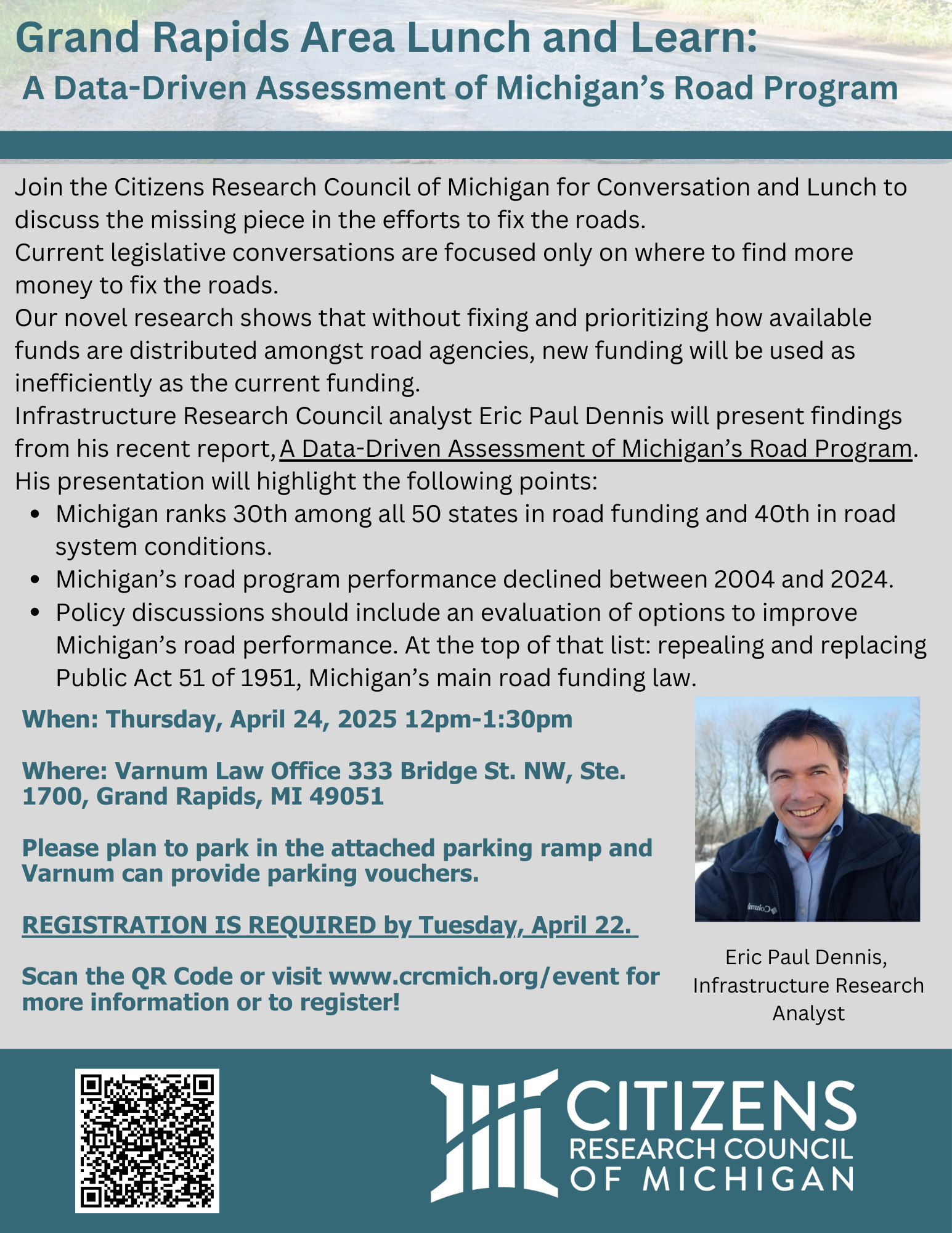
On April 9, from 12-1 pm, Infrastructure Research Council analyst Eric Paul Dennis will present findings from his recent report, A Data-Driven Assessment of Michigan’s Road Program. His presentation will highlight the following points:
|
|
|
|

Medicaid Eligibility Rule Changes Will Create "At-Risk" Funding Cliff for Schools Next Year |
|
IN A NUTSHELL -- Collectively, Michigan school districts experienced a massive 7.5 percent decline in the number of economically disadvantaged students counted across all public K-12 schools this year; a decline that is attributed to changes to pandemic-era federal Medicaid eligibility rules in 2024. -- Because schools receive state at-risk funding based on the number of economically disadvantaged students counted in enrollment, those experiencing above-average enrollment losses will see substantial year-over-year state funding reductions in their at-risk budgets. -- This analysis provides Michigan schools with a “first look” at the fiscal impact of Governor Whitmer’s K-12 state budget proposal on changes in state at-risk funding allocation for public schools’ 2025-26 budgets. |

|
|
|

Michigan May Want to Reconsider Requiring Foreign-Trained Doctors to Repeat Residency Training |
|
IN A NUTSHELL -- Some parts of Michigan – particularly the state’s rural areas – have a shortage of primary care providers.
-- Foreign-trained doctors are required to repeat post-graduate training in the United States to obtain a medical license in Michigan, but many states have removed or are considering removing this requirement.
-- Research is not available to assess how well foreign-trained doctors perform without this requirement, but the state has the ability to enact safeguards to limit the risk if it chooses to pursue this approach to reducing the physician shortage. |
|
Catch Up On Other Recent Papers:
|
|
|
|

|
Tomorrow, April 1, please join us for a webinar being held exclusively for ELC members with Research Council Infrastructure Analyst Eric Paul Dennis will discuss a comprehensive, data-heavy study and a novel approach to the road funding discussion in Michigan. His research will demonstrate methodologies used for state road funding, road funding levels nationwide, funding among peer states and how Michigan stacks up. It also looks at, through data driven metrics, whether more money means better roads.
Once you become an ELC member, a registration code will be sent to you.
Become a member today: https://crcmich.org/elc.
ELC members receive access to public policy leaders and can participate in critical conversations facing our local and state governments, as well as other networking opportunities. Members can also join us at our annual fall policy dinner at a 50 percent discount ticket rate. |
|
|
|

Join Us April 24 for Lunch & Conversation in Grand Rapids |
|
|
|
|

|
Research Director Craig Thiel last week testified before the House K-12 Appropriations Subcommittee on two recent papers where he addressed issues of K-12 funding and equity for disadvantaged students and the schools they attend. The first paper, Congress has failed to address the inequities of Title I. Michigan Lawmakers Should Step In, revealed substantial variation in the amount of per-student dollars that similarly-situated districts receive.
He also testified on his most recent report (see above) on how changes in the federal government's pandemic-era Medicaid eligibility rules will create an "at-risk" funding cliff for schools next year. Read the summary above and find the paper here: Major Drop in Economically Disadvantaged Student Counts Will Create "At-Risk" Funding Cliff for Schools Next Year. |
|
|
|

|
Catch Up on Recent Podcasts:
|
|
|
The Research Council in the News |
|
(See above for the week's coverage of the 2025 Michigan Road Program Report)
Detroit mayoral hopefuls embrace tax breaks for revival despite some objection, Detroit News (March 26)
Port Austin Michigan Zoning Crackdown Sparks Public Outcry Over Tent, Camper Ban, Newsbreak (March 26)
Michigan districts brace for cuts, as number of needy students falls, Bridge Michigan (March 20)
Tax relief, road projects competing for dollars in Lansing, Detroit News (March 12)
Michigan road funding efforts have stalled before. Can new plans break the traffic jam?, Detroit Free Press (March 12)
MI House Republicans shock Democrats with introduction - and quick passage - of budget bills in Lansing, WCMU Public Media (March 7)
Tax, cut or both? Gretchen Whitmer needs House GOP help to fix Michigan roads, Bridge Michigan (March 6)
A year later, Whitmer silent on MSU board’s request to remove 2 trustees for misconduct, Lansing State Journal (March 6)
Hall Not Sold on Final Book Closing, MIRS News (March 5) |
|
|
Learn More About Citizens Research Council |
|
|
|
|
Do you want to ensure better policy decisions and better government in Michigan? A donation to support our organization will help us to continue providing the trusted, unbiased, high-quality public policy research Michigan needs. We also accept charitable bequests. Click the fuel tank to donate or learn more about planned giving. |
|

|
Citizens Research Council of Michigan
Livonia 734.542.8001 | Lansing 517.485.9444 | Holland 616.294.8359
|
|


|
Unsubscribe Footer
|